

〜たら vs 〜なら vs 〜と: Choosing the Right Japanese Conditional
The same “if” can point to three different ideas
Japanese has several conditional patterns, but 〜たら, 〜なら, and 〜と do not simply substitute for one another. Compare these three sentences:
- 雨が降ったら、試合を中止します。
If it rains, we will cancel the game. - 雨なら、試合を中止します。
If it is rain / If the situation is rain, we will cancel the game. - 春になると、桜が咲きます。
When spring comes, the cherry blossoms bloom.
The first sentence treats rain as a future condition for one decision. The second takes “rain” as information or a premise and responds to it. The third describes a predictable result that happens whenever the condition occurs. The English word “if” hides these differences, so Japanese learners need to ask what kind of relationship they mean.
This lesson gives you a practical way to choose the pattern, form it accurately, and avoid the most common mistakes.
1. 〜たら: a condition, a completed step, or a one-time event
Form 〜たら by attaching ら to the plain past form:
| Before たら | Form | Example |
|---|---|---|
| Verb | Vた + ら | 駅に着いたら、連絡してください。 — When you arrive at the station, contact me. |
| い-adjective | Aかった + ら | 暑かったら、窓を開けてください。 — If it is hot, please open the window. |
| な-adjective | Aだった + ら | 暇だったら、映画を見ませんか。 — If you are free, shall we watch a movie? |
| Noun | Nだった + ら | 休日だったら、家で休みます。 — If it is a holiday, I will rest at home. |
Use 〜たら when the condition is a particular event or a step that must happen first. It works especially well for plans, instructions, promises, and one-time decisions.
- 仕事が終わったら、駅の近くで会いましょう。
When work is finished, let’s meet near the station. - もし分からなかったら、もう一度説明します。
If you do not understand, I will explain it again. - 日本に行ったら、温泉に入りたいです。
When I go to Japan, I want to visit a hot spring.
The past-looking form does not necessarily mean the entire sentence is in the past. In 駅に着いたら, the arrival is presented as a completed step before the next action. This is why 〜たら can naturally appear with future plans and requests.
A useful test is: “Is this a particular situation, and does the second action follow it?” If yes, 〜たら is often the safest choice.
2. 〜なら: taking information as a premise
Use 〜なら when the condition is a topic, piece of information, or premise that has entered the conversation. It often sounds like “if that is the case,” “if you are talking about…,” or “if you plan to….” The speaker is not necessarily predicting that the condition will happen; they are responding to it.
- 京都に行くなら、秋がおすすめです。
If you are going to Kyoto, autumn is recommended. - その店なら、駅の北口にあります。
If you mean that shop, it is by the station’s north exit. - 明日が休みなら、少し遠くまで行けます。
If tomorrow is a day off, we can go a little farther.
With a verb or い-adjective, attach なら to the plain form: 行くなら, 高いなら. With a noun or な-adjective, use the noun or adjective directly: 学生なら, 静かなら. In polite conversation, でしたら is also common when responding respectfully to a premise.
- 初めてなら、簡単なコースにしましょう。
If it is your first time, let’s choose the easy course. - 安全なら、子どもも参加できます。
If it is safe, children can participate too.
〜なら is especially useful for advice. It sets up the listener’s plan or preference, then gives a recommendation.
- 電車で行くなら、早めに切符を買ったほうがいいです。
If you are going by train, you should buy the ticket early. - 甘いものが好きなら、この店を試してみてください。
If you like sweets, please try this shop.
3. 〜と: an automatic, repeated, or dependable result
Use 〜と when one event naturally, mechanically, or habitually leads to another. The relationship may be a fact of nature, a machine’s operation, a routine discovery, or a result that happens every time.
- このボタンを押すと、ドアが開きます。
When you press this button, the door opens. - 春になると、暖かくなります。
When spring comes, it becomes warm. - この道をまっすぐ行くと、右に銀行があります。
If you go straight along this road, there is a bank on the right.
The condition before と normally uses the plain non-past form: 押すと, なると, 行くと. Negative forms are also possible: ボタンを押さないと、画面が消えます means “If you do not press the button, the screen goes off” or “Unless you press the button, the screen goes off,” depending on context.
Because と presents the result as automatic or dependable, it usually does not pair with a freely chosen request, invitation, or command in the main clause.
- Natural: 駅に着いたら、電話してください。
When you arrive at the station, please call me. - Unnatural for this meaning: 駅に着くと、電話してください。
The second sentence sounds as if “arriving” automatically causes the listener to call, rather than expressing a request. Choose 〜たら when a person decides what to do after the condition.
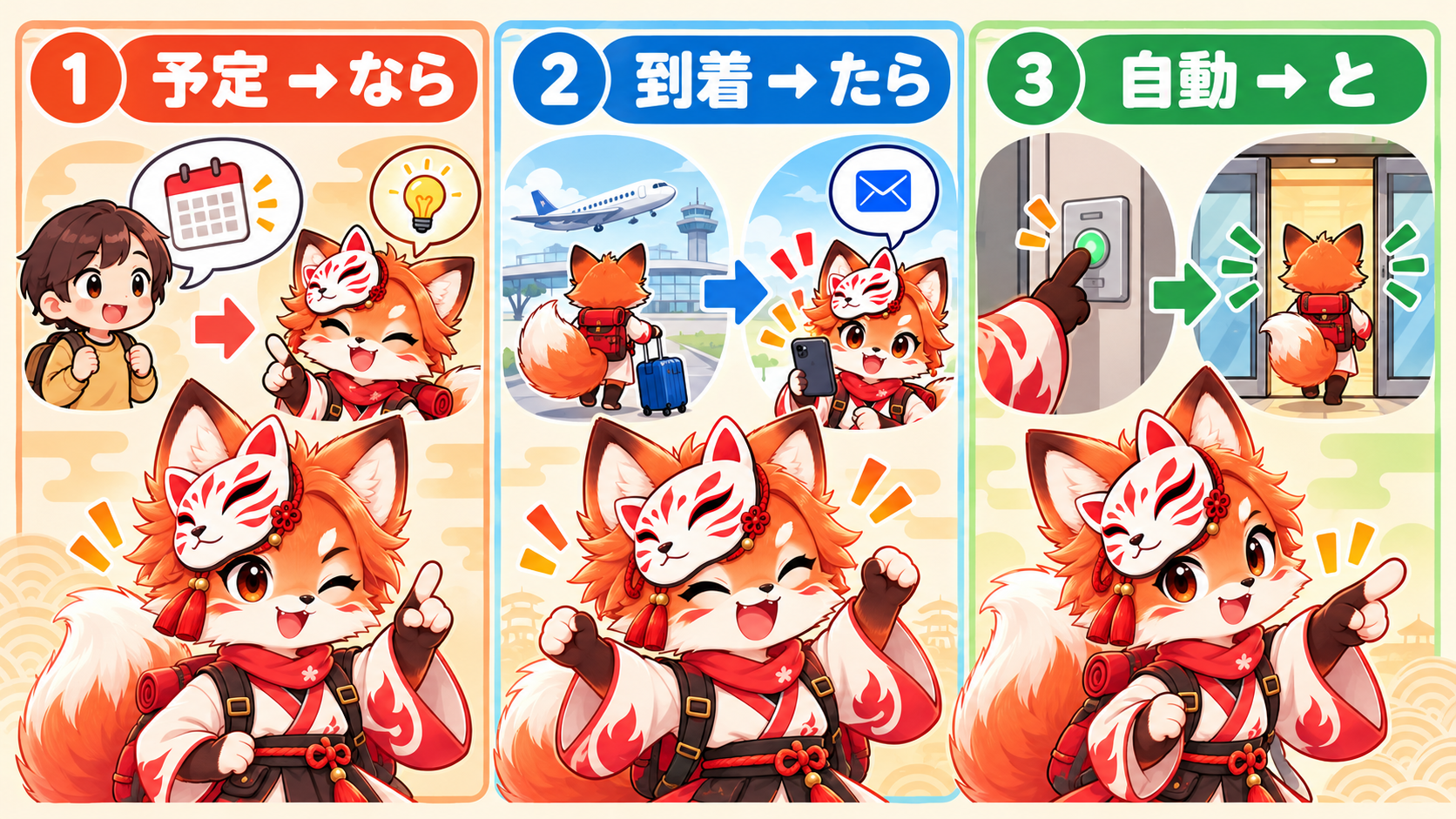
A comparison you can use while speaking
| Pattern | Core viewpoint | Typical result | Example | Translation |
|---|---|---|---|---|
| 〜たら | A particular condition or completed step | A plan, request, promise, or one-time result | 雨が降ったら、タクシーを呼びます。 | If it rains, I will call a taxi. |
| 〜なら | Information or a topic taken as a premise | Advice, correction, recommendation, or response | 雨なら、傘を持っていきましょう。 | If it is raining, let’s take an umbrella. |
| 〜と | A natural, automatic, or repeated link | A dependable result, discovery, or machine action | 雨が降ると、道が滑りやすくなります。 | When it rains, the roads become slippery. |
The three patterns can describe a similar situation, but the speaker’s viewpoint changes:
- 雨が降ったら、試合を中止します。
The speaker announces a decision for a particular possible event. - 雨なら、試合を中止します。
The speaker responds to “What if the weather is rain?” or to information about the forecast. - 雨が降ると、試合が中止になります。
The sentence presents cancellation as an established or automatic consequence.
A three-question decision guide
Use this sequence before choosing the form:
-
Is this a particular event, a future plan, or a step that happens before another action?
→ Choose 〜たら.
駅に着いたら、メッセージをください。 -
Am I taking something the listener said, planned, or identified and giving advice or a response?
→ Choose 〜なら.
東京に行くなら、浅草もおすすめです。 -
Does the result happen naturally, mechanically, or repeatedly whenever the condition occurs?
→ Choose 〜と.
左のボタンを押すと、音が小さくなります。
This is a guide, not a rule that ignores context. For example, 東京に行ったら、連絡してください describes a particular trip and a request, while 東京に行くなら、連絡してください frames the trip as the listener’s plan. Both can be grammatical, but they organize the conversation differently.
Common mistakes
Mistake 1: using 〜と for a personal decision.
✗ 雨が降ると、家に帰ります。
This can sound like an automatic reflex or a general habit. If you mean a plan for the coming day, say 雨が降ったら、家に帰ります.
Mistake 2: attaching なら like たら.
✗ 暑いかったら
✓ 暑かったら
✓ 暑いなら
Use past-form attachment with 〜たら: 暑かったら. Use the plain non-past adjective with 〜なら: 暑いなら.
Mistake 3: forgetting the difference between an event and a topic.
駅に着いたら、電話してください means “When you arrive, call me.”
駅に着くなら、電話してください means “If you are going to arrive / if you plan to arrive, call me.”
駅に着くと、電話が鳴ります means “When you arrive, the phone rings” as a repeated or automatic result. The tense and viewpoint matter.
Mistake 4: assuming “if” always equals 〜たら.
English translation is only a starting point. Ask whether the speaker is describing a one-time condition, responding to a premise, or stating a reliable result.
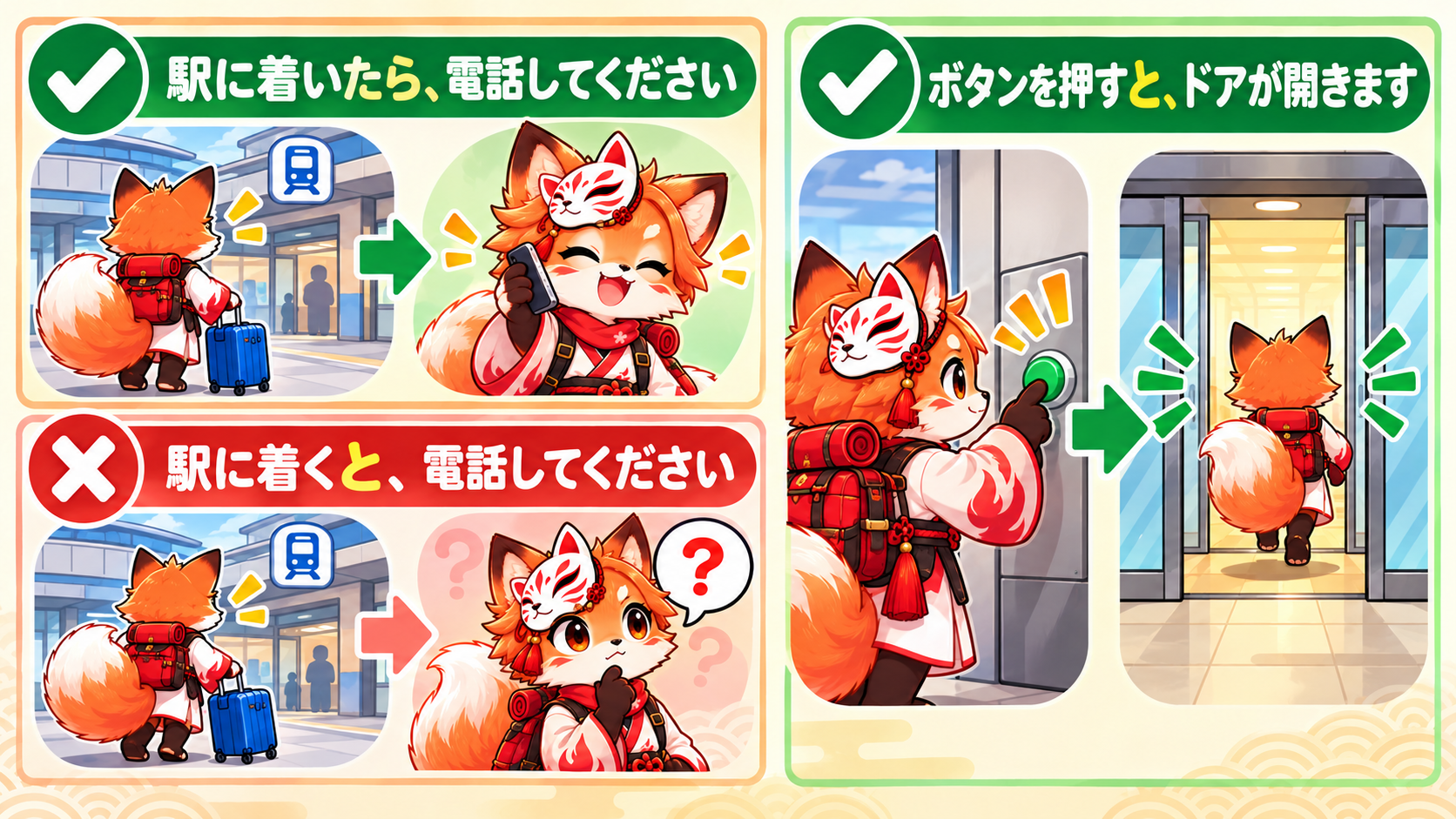
Japanese recap
〜たらは、特定の条件や、先に終わる動作を表します。
例:駅に着いたら、連絡してください。
〜ならは、相手の話や予定を前提にして、助言や返事をするときに使います。
例:京都に行くなら、秋がおすすめです。
〜とは、自動的・習慣的な結果を表します。
例:春になると、桜が咲きます。
「一回の予定なら〜たら、話題や前提なら〜なら、自然な結果なら〜と」と覚えると、選びやすくなります。
A practical closing
When you build your own sentence, first imagine the result. Is it something you choose after a particular event? Use 〜たら. Is it advice based on the listener’s plan or information? Use 〜なら. Does it happen on its own each time? Use 〜と.
Try describing the same situation three ways:
- 電車が遅れたら、会議に遅れるかもしれません。
If the train is delayed, I may be late for the meeting. - 電車で来るなら、少し早く出てください。
If you are coming by train, please leave a little early. - 電車が遅れると、駅が混みます。
When trains are delayed, the station gets crowded.
The grammar becomes easier when you stop translating all three as the same “if” and instead identify the relationship between the condition and the result.