
〜ていく vs 〜てくる: Seeing Change From a Reference Point
〜ていく vs 〜てくる: Seeing Change From a Reference Point
A small change in viewpoint can change the meaning of an entire Japanese sentence. Compare these two sentences:
- これから日本語を勉強していきます。
From now on, I will continue studying Japanese. - 最近、日本語が分かってきました。
Recently, I have started to understand Japanese better.
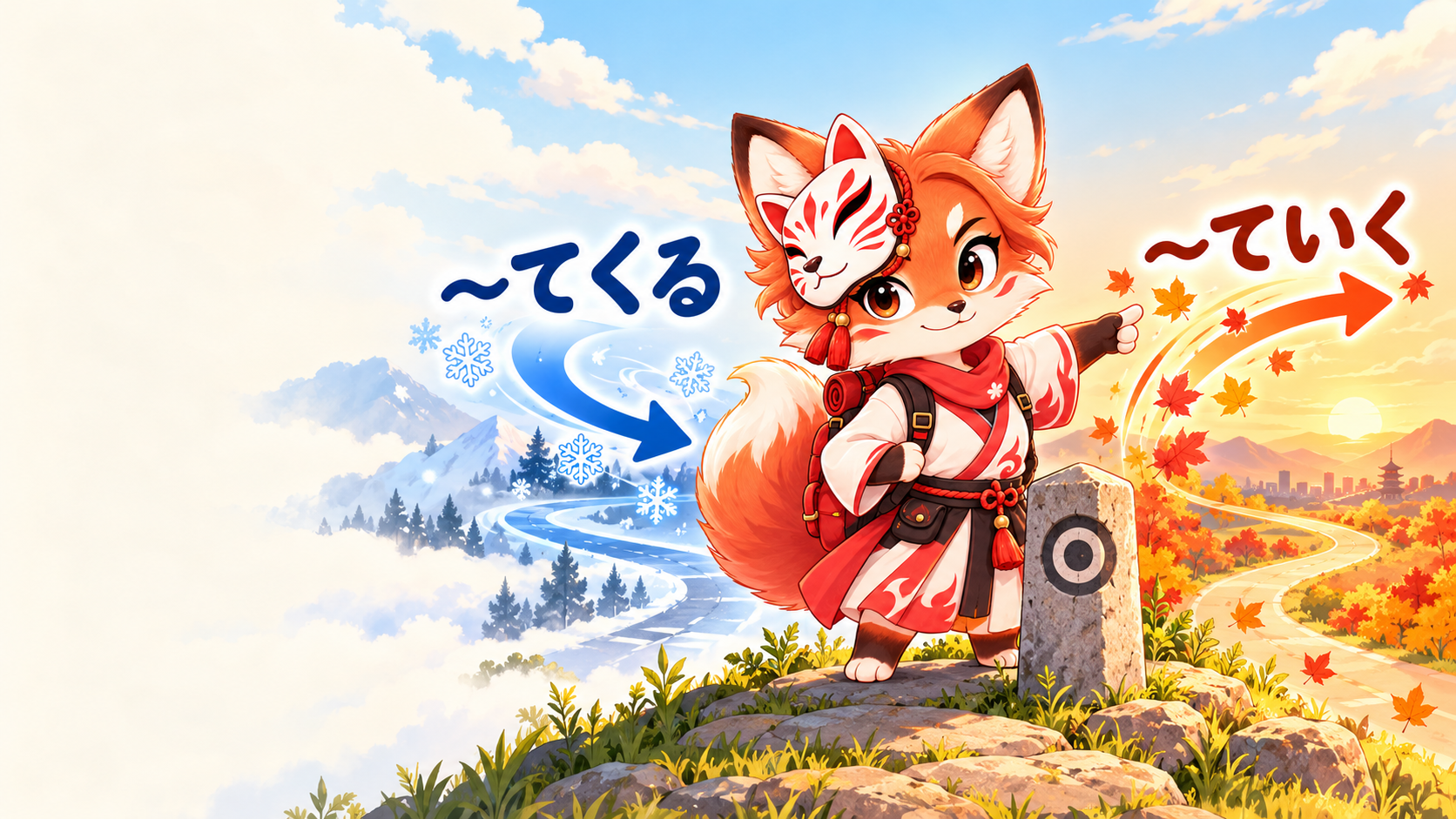
Both sentences describe progress, but they point in different directions. 〜ていく presents an action or change moving forward from the speaker’s current reference point. 〜てくる presents an action or change that has come toward the current reference point, often from the past until now. The contrast is not simply “go” versus “come,” and it is not always about physical movement. It is about where the speaker places the center of attention.
This lesson will help you use the two patterns for movement, continuing change, and actions that bring something toward the speaker. The most useful habit is to imagine a small dot labeled “here” or “now.” Then ask whether the action moves away from that dot or arrives at it.
The basic formation
Attach いく or くる to the て-form of a verb:
| Pattern | Formation | Example | Basic idea |
|---|---|---|---|
| 〜ていく | Verb て-form + いく | 持っていく | take something away; continue from now |
| 〜てくる | Verb て-form + くる | 持ってくる | bring something here; come toward the reference point |
| Polite 〜ていきます | Verb て-form + いきます | 勉強していきます | will continue or take |
| Polite 〜てきました | Verb て-form + きました | 分かってきました | has come to be; has started to become clear |
The て-form does not change. The tense and politeness belong to いく or くる:
- 読んでいく — read and go / continue reading
- 読んでいった — read and went / continued reading
- 読んでいきます — will read and go / will continue reading
- 読んできた — read and came / have read up to now
- 読んできました — have read up to now, polite
With 〜てくる, the past form 〜てきた is especially common when describing a gradual change that has reached the present:
- だんだん暑くなってきた。
It has gradually become hot. - 仕事に慣れてきました。
I have gradually gotten used to the job. - 日本語のニュースが少し聞き取れるようになってきた。
I have started to be able to understand a little of the Japanese news.
〜ていく: moving away or continuing forward
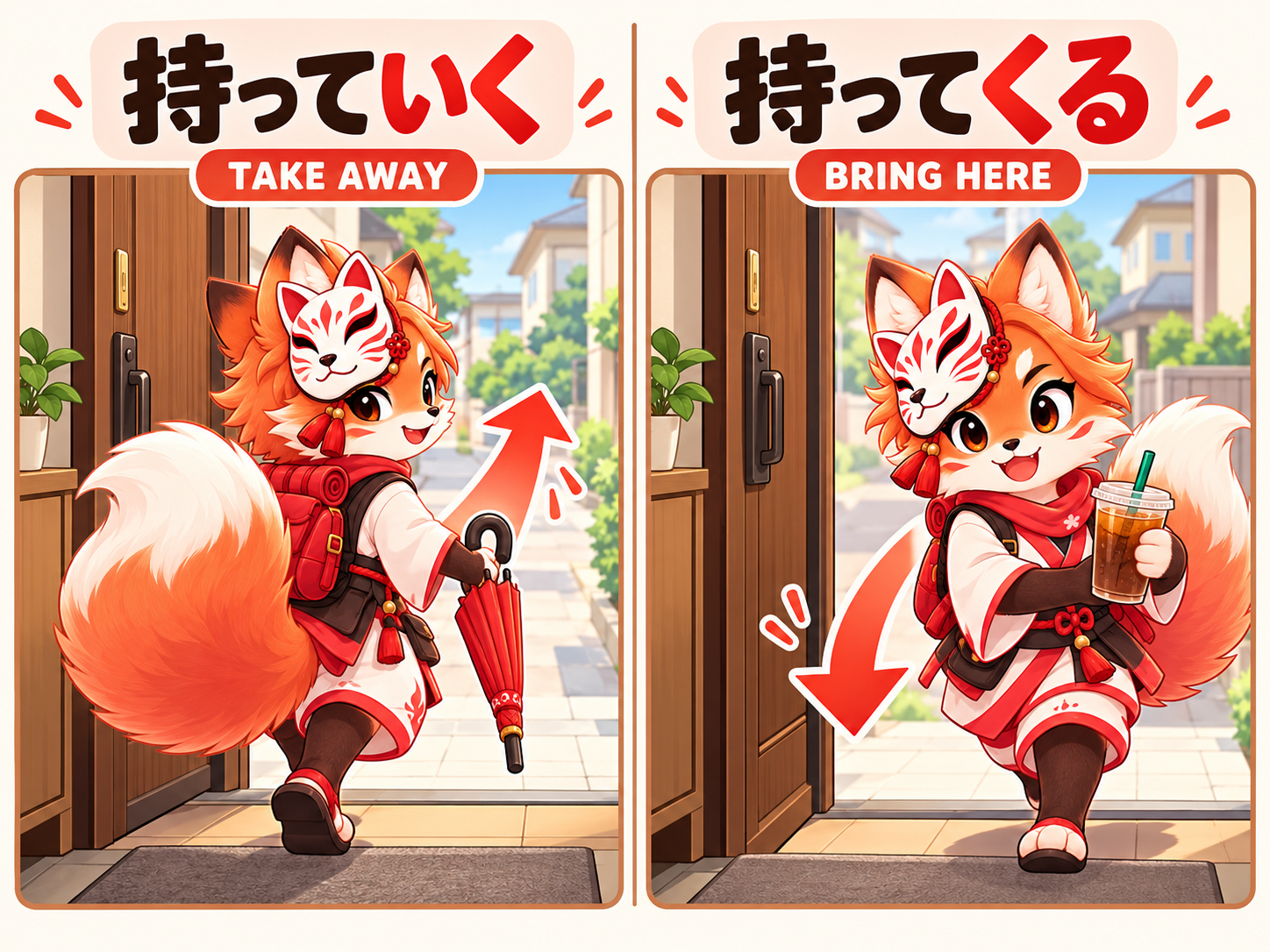
The clearest physical meaning of 〜ていく is “take or do something and go away from the current place.” If you are at home and take an umbrella with you when you leave, you can say:
- 傘を持っていきます。
I will take an umbrella with me.
If you are speaking to someone who is staying at the office, the office is the reference point. You are leaving it, so the umbrella moves away from that point. By contrast, if you are at the office and ask someone to bring an umbrella from home, you can say:
- 家から傘を持ってきてください。
Please bring an umbrella from home.
The same direction appears in these examples:
- この資料を会議室に持っていってください。
Please take these materials to the meeting room. - 駅でお弁当を買っていきます。
I will buy a boxed meal at the station and take it with me. - 旅行に薬を持っていったほうがいいです。
You should take medicine with you on the trip.
The second important meaning is a change or activity that continues from now into the future. The speaker looks at the present and sends the process forward:
- これからも毎日、少しずつ練習していきます。
I will continue practicing little by little every day. - これから人口は減っていくでしょう。
The population will probably continue to decrease. - この経験を生かしていきたいです。
I want to make use of this experience going forward. - 春から気温が上がっていく。
The temperature will keep rising from spring onward.
Here, 〜ていく does not mean that the subject physically walks away. It frames the change as a process that unfolds after the current point. The speaker is looking ahead.
〜てくる: coming toward the present or the speaker
The physical meaning of 〜てくる is “do something and come here” or “bring something toward the current place”:
- ちょっと飲み物を買ってきます。
I will go buy a drink and come back. - 田中さんが資料を持ってきました。
Tanaka brought the materials. - 外から風が入ってきた。
Wind came in from outside. - 友達が駅まで迎えに来てくれました。
My friend came to pick me up at the station.
In everyday conversation, ちょっと見てくる and ちょっと行ってくる often mean “I’ll go check and come back.” The return to the speaker’s current place is part of the expression:
- ちょっと店の様子を見てきます。
I’ll go check the shop and come back. - 忘れ物がないか、部屋を見てきて。
Go check the room and come back.
The more subtle meaning is a change that began in the past and has approached the present. The speaker feels the result now:
- 日本語を三年間勉強してきました。
I have studied Japanese for three years up to now. - 少しずつ生活が変わってきた。
Little by little, life has changed. - 雨が降ってきました。
It has started to rain. - 子どもが大きくなってきましたね。
The child has grown, hasn’t he?
In 雨が降ってきました, the rain is not necessarily traveling toward the speaker. The phrase presents the rain as a new event that has emerged and reached the present moment. This is why 〜てくる is common with sudden or noticeable beginnings:
- 暗くなってきた。
It has started to get dark. - 人が増えてきました。
More and more people have started to appear. - 眠くなってきた。
I am starting to feel sleepy.
A timeline for choosing the viewpoint
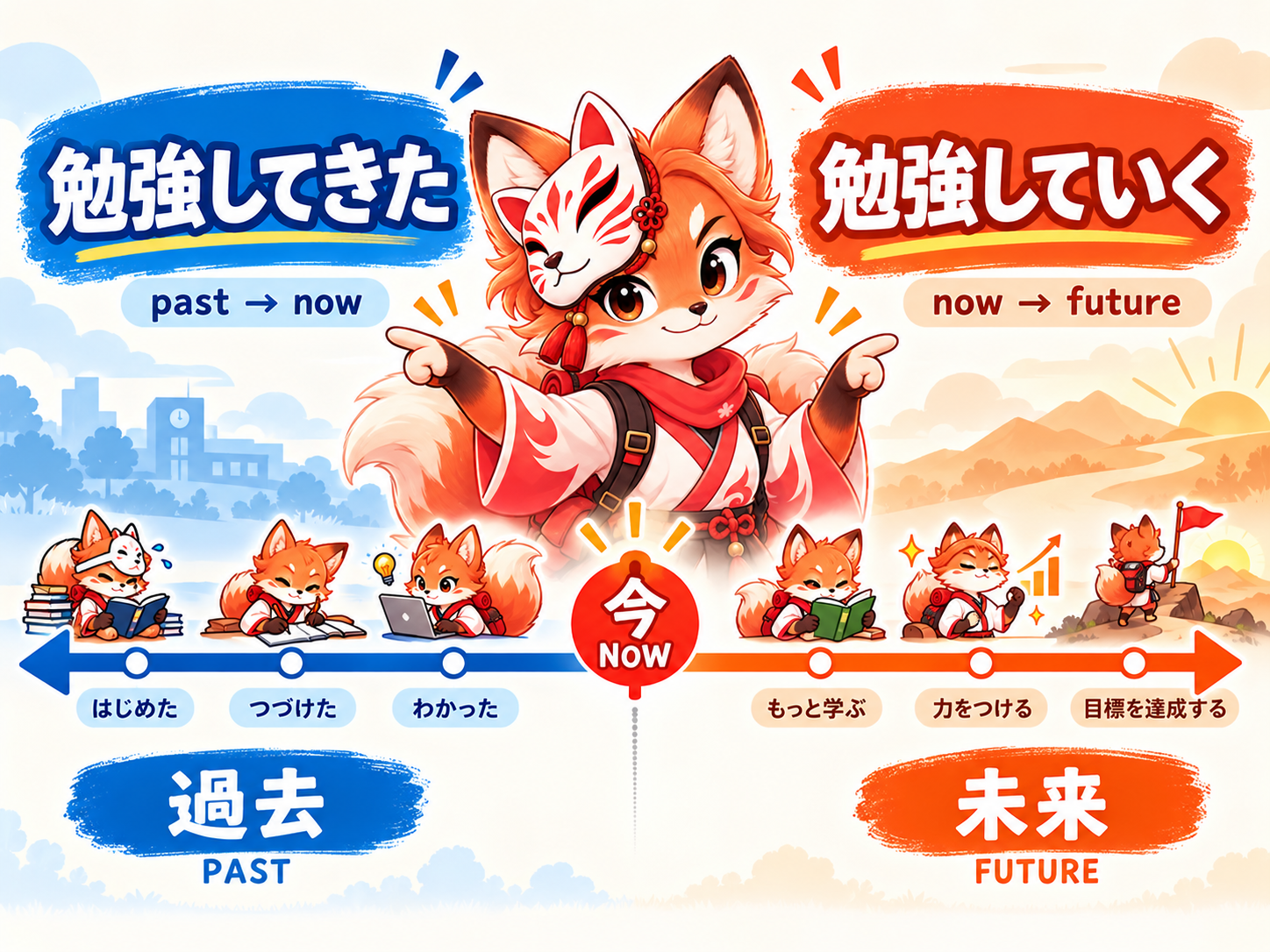
Imagine the present as a reference point:
Past ─────────── ● NOW ─────────── Future
For a change that has developed up to now, use 〜てくる:
Past ─── 勉強してきた ─── ● NOW
For a change that will continue after now, use 〜ていく:
NOW ● ─── 勉強していく ─── Future
This is not a mechanical rule for every sentence. The speaker can choose a different reference point, especially in stories, travel descriptions, and formal explanations. Still, the timeline is a reliable starting point.
A three-question decision guide
-
Is something moving between places?
Decide which place is the reference point. Moving away from it suggests 〜ていく; moving toward it suggests 〜てくる.
駅に荷物を持っていく。— Take the luggage to the station.
駅から荷物を持ってくる。— Bring the luggage from the station. -
Did a gradual change reach the present?
Use 〜てくる when the sentence looks backward at a process that has arrived at now.
分かってきた。— I have come to understand it. -
Will a process continue after the present?
Use 〜ていく when the sentence looks forward from now.
学んでいく。— Continue learning from here onward.
A useful combined sentence is:
- これまで勉強してきたことを、これから仕事で生かしていきます。
I will apply in my work what I have studied up to now.
The first half looks backward toward the present with 〜てきた. The second half looks forward from the present with 〜ていきます.
Compare the forms directly
| Japanese | Viewpoint | Natural translation |
|---|---|---|
| 持っていく | away from the current reference point | take it with you |
| 持ってくる | toward the current reference point | bring it here |
| 慣れてきた | a past-to-present change | have gradually gotten used to it |
| 慣れていく | a present-to-future change | will gradually get used to it |
| 暗くなってきた | darkness has begun and is noticeable now | it is getting dark |
| 暗くなっていく | darkness will continue after now | it will keep getting darker |
| 買っていく | buy before leaving or on the way onward | buy it and take it |
| 買ってくる | go buy it and return | go buy it and come back |
Notice that translation alone can hide the difference. Both 慣れてきた and 慣れていく may be translated with “get used to,” but their timelines are different.
Common mistakes and usage notes
Mistake 1: Treating いく and くる as only literal “go” and “come.”
In 少し分かってきました, nobody is physically coming. The expression describes understanding that has reached the speaker’s current awareness. In これから変わっていく, nobody has to walk away. The process is simply moving forward from now.
Mistake 2: Using 〜てくる for every new future activity.
If you plan to keep studying from today onward, say これから勉強していきます. Saying これから勉強してきます usually sounds like “I’ll go study and come back,” or it changes the intended viewpoint.
Mistake 3: Forgetting the return meaning in short errands.
ちょっと買ってきます means “I’ll go buy it and come back,” not merely “I’ll buy it.” If you will buy something and continue to another destination, 買っていきます may be more natural.
Mistake 4: Assuming the speaker must be the physical center.
The reference point can be a place, a time, a group, or a narrative viewpoint. A guide at a station might say 電車が入ってきます, “The train is coming in,” because the train is approaching the station. A report looking at future trends might say 高齢化が進んでいく, “Population aging will continue,” because the process is projected forward.
The plain て-form can describe two actions in sequence, but it does not automatically express this viewpoint:
- 昼ご飯を食べて、会社に戻ります。
I will eat lunch and return to the office. - 昼ご飯を食べていきます。
I will eat lunch before going onward / I will take the fact of eating lunch with me before leaving. - 昼ご飯を食べてきます。
I will go eat lunch and come back.
The choice adds information about direction, continuation, or arrival at the reference point.
A natural dialogue
A: 最近、朝早く起きられるようになってきたね。
You have started to be able to get up early lately.
B: うん。これまで寝る前にスマホを見ないようにしてきたんだ。
Yes. Up to now, I have made an effort not to look at my phone before bed.
A: これからもその習慣を続けていこう。
Let’s keep that habit going from now on.
B: そうだね。明日の朝、駅で会う?
Right. Shall we meet at the station tomorrow morning?
A: いいよ。先に着いたら、コーヒーを買ってきて。
Sure. If you arrive first, go buy coffee and bring it back.
The dialogue uses 〜てきた for a habit established up to the present, 〜ていこう for a shared future direction, and 買ってきて for an errand that returns with an item.
Practice the viewpoint, not just the translation
When you meet a new sentence, draw the reference point before translating it. If the sentence describes a process arriving at now, use 〜てくる. If it describes a process continuing after now, use 〜ていく. For physical movement, identify where the object or person is going relative to the place being discussed.
Try completing these sentences:
- これからも日本語を勉強して__。
- 最近、漢字が少し読めるようになって__。
- 会議に必要な資料を持って__ください。
- ちょっとコンビニへ行って、飲み物を買って__。
Suggested answers: いきます, きました, いって, きます. Say the full sentences aloud and notice where your imagined reference point sits.
Japanese recap
- 〜ていく describes movement away from a reference point or a change that continues from now into the future.
- 〜てくる describes movement toward a reference point or a change that has developed from the past up to now.
- 持っていく means “take it onward,” while 持ってくる means “bring it here.”
- 勉強してきた looks back at progress made up to now, while 勉強していく looks forward at continued study.
- When the meaning is unclear, locate the speaker’s “here” and “now” first.
The practical goal is not to memorize one English translation for each form. Instead, learn to see the direction of the speaker’s viewpoint. Once that reference point is clear, 〜ていく and 〜てくる become much easier to choose naturally.