

Declining an Invitation With ちょっと: Say Which Part Does Not Work
「金曜日はちょっと…」 can be a complete social answer even though it looks like an unfinished sentence. After an invitation, it often means that Friday does not work for the speaker. Translating each word as “Friday is a little…” misses what the reply does in the conversation.
The useful skill is to recognize this reply, decline an invitation yourself, and let the conversation move on without pressing for a hidden explanation. You also need the surrounding sentence: ちょっと in 「ちょっと待ってください」 asks someone to wait a moment. It is not a refusal by itself.
Hear the invitation before interpreting the reply
Imagine a colleague asks:
金曜日、一緒にランチに行きませんか。
Would you like to go for lunch together on Friday?すみません、金曜日はちょっと…。
Sorry, Friday doesn't work for me.
The second speaker leaves an unfavorable conclusion unstated. In this context, the listener can understand the reply as declining Friday's invitation. The ellipsis represents the trailing-off ending; you do not pronounce the dots or wait for a missing vocabulary word.
This is one established conversational option, not a rule that everyone must refuse indirectly. A clear 「すみません、金曜日は行けません」, “Sorry, I can't go on Friday,” is also useful. TUFS's invitation guide presents both 〜はちょっと and a refusal with a reason.
Put the real difficulty before は
For this invitation pattern, use a time or activity + は + ちょっと…. You are naming the part of the proposal that is difficult. This is a conversational frame, not a verb ending that attaches to every verb in the same way.
土曜日はちょっと…。
Saturday doesn't work for me.カラオケはちょっと…。
Karaoke isn't really for me / I'd rather pass on karaoke.
The first reply focuses on the day. The second focuses on the activity. If you like karaoke but cannot go on Saturday, naming カラオケ could give the wrong impression. Name 土曜日 instead, and add your actual reason if it helps.
すみません、土曜日は仕事があります。
Sorry, I have work on Saturday.
You do not need to invent an excuse. The point is to make your answer understandable. The Japan Foundation's Akiko grammar notes, lesson 7 explicitly distinguish a difficult date from a difficult proposed activity.
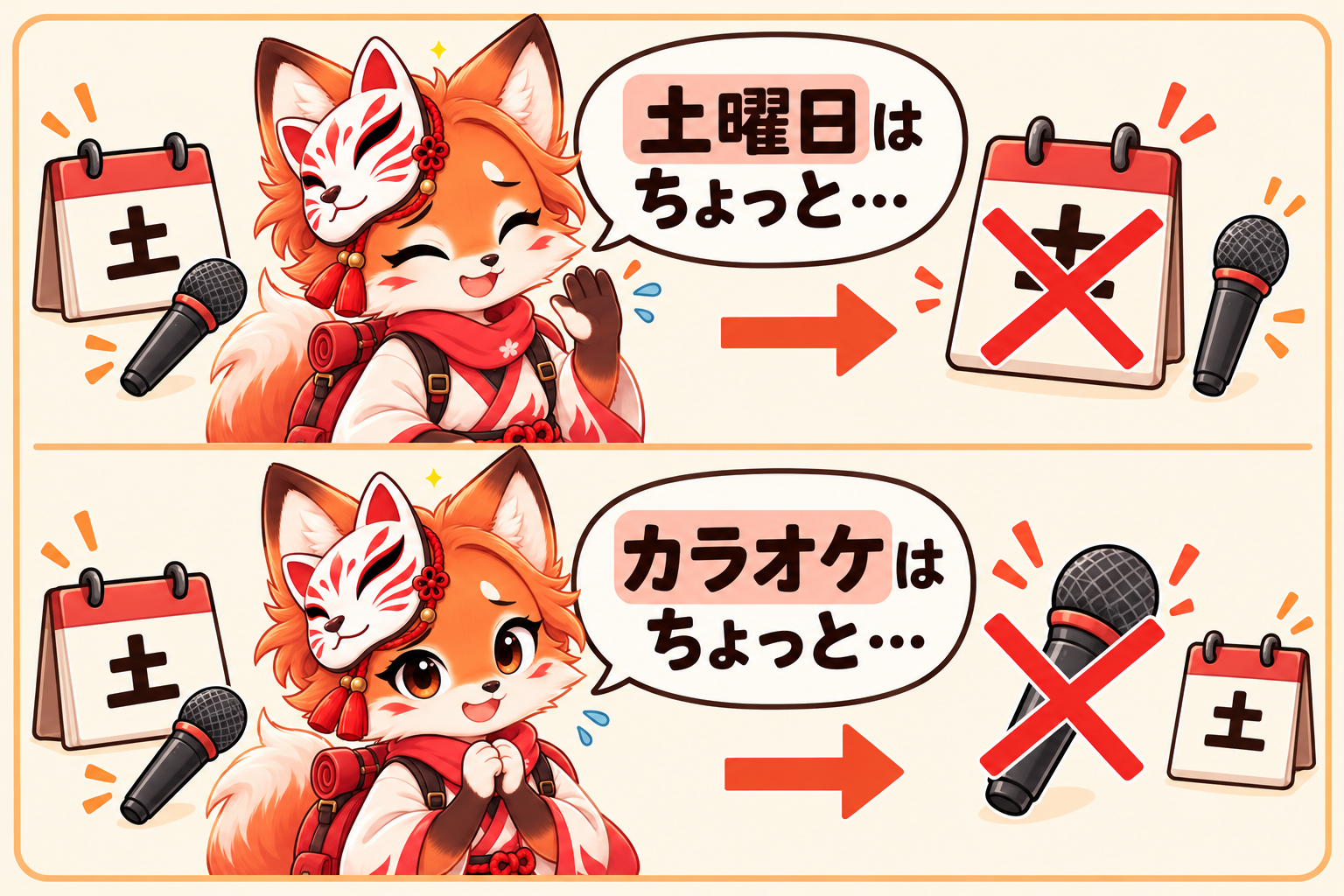
The two contrast panels start with the same proposal: Saturday plus karaoke. In the upper panel, follow the arrow from the mascot's 土曜日はちょっと… reply to the crossed-out Saturday calendar; the microphone remains uncrossed. In the lower panel, follow the arrow from カラオケはちょっと… to the crossed-out microphone; the calendar remains uncrossed. The before-and-after states show how the reply identifies a different obstacle to the same proposal.
Compare the replies in context
| Situation | Japanese | What the listener should understand |
|---|---|---|
| Friday is inconvenient | 金曜日はちょっと…。 | Declining this proposed day |
| You would rather skip karaoke | カラオケはちょっと…。 | Declining the proposed activity |
| You want an unambiguous refusal | 金曜日は行けません。 | You cannot go on Friday |
| You need a brief wait | ちょっと待ってください。 | A request to wait, not a declined invitation |
| You describe a small degree | ちょっと寒いです。 | It is a little cold; no invitation is being answered |
Treat these as contextual readings. A single English equivalent cannot cover all the rows. TUFS's vocabulary entry places the “a little while / a little bit” meanings alongside invitation and waiting examples.
A decision guide for your next reply
Read this from the invitation to the answer. The branches are choices for the speaker, not stages that everyone must perform.
Someone invites you to do something
  ↓
Do you want to accept?
  ├─ Yes → いいですね。行きましょう。
  │         Sounds good. Let's go.
  └─ No → What needs to be clear?
           ├─ The day is difficult → 金曜日はちょっと…。
           ├─ The activity is difficult → カラオケはちょっと…。
           └─ A definite answer is needed → 金曜日は行けません。
If you are the listener and hear the refusal branch, acknowledge it before considering another plan. 「そうですか。わかりました」 means “I see. Understood.” Do not treat the unfinished wording as permission to keep asking until the person agrees.
An annotated conversation
Two colleagues discuss an optional outing. The translations show the function of each turn rather than a word-for-word substitution.
A: 土曜日、一緒にカラオケに行きませんか。
Would you like to go to karaoke together on Saturday?B: 誘ってくれてありがとうございます。でも、土曜日はちょっと…。仕事があります。
Thank you for inviting me. But Saturday doesn't work for me. I have work.A: そうですか。わかりました。
I see. Understood.B: 日曜日は空いています。
I'm free on Sunday.A: じゃあ、日曜日に行きましょうか。
Shall we go on Sunday, then?
B first declines the Saturday plan, then voluntarily offers a specific alternative. A does not infer Sunday from ちょっと. The final question proposes a new plan that still needs agreement. If B had ended after the reason, A could simply accept the refusal.
For a less specific future invitation, 「また今度誘ってください」 means “Please invite me another time.” Use it when that matches your intention. It does not book a date. The Japan Foundation's Care Navi example combines this phrase with declining today's invitation.
Keep the wording natural and clear
ちょっと does not automatically make an utterance polite. 「ちょっと!」 said sharply can attract attention or express displeasure. For an ordinary invitation from a colleague, 「すみません」 or thanks for the invitation gives the reply a considerate opening. Your tone and the relationship still matter.
Avoid learning the shortcut “ちょっと means no.” In 「ちょっと寒いです」 it describes degree. In a request it can present an action as small or brief. Researchers describe several discourse functions, so listeners need the whole turn, not a dictionary gloss alone. See Kashima's study of everyday conversation.
Also avoid using an indirect answer where the other person needs certainty. If someone is counting lunch reservations, say 「すみません、今回は参加できません」, “Sorry, I can't take part this time.” You can be considerate and explicit in the same sentence.
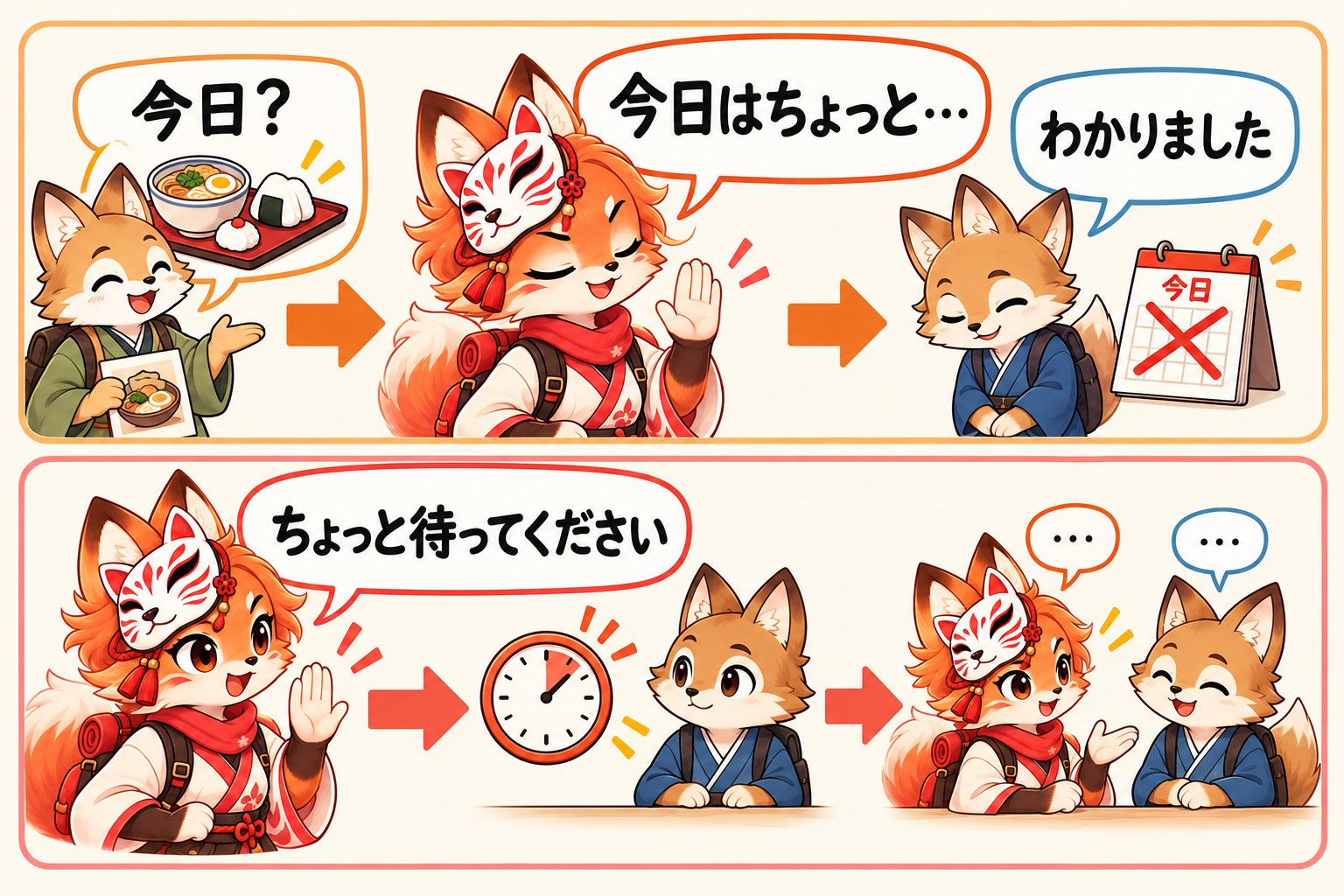
These two panels contrast a declined invitation with a short interruption. The upper panel shows three successive states connected by arrows: today's lunch invitation → 今日はちょっと… → the listener's わかりました and a crossed-out calendar. The lower panel has a different before-and-after flow: ちょっと待ってください → a clock and a waiting listener → resumed conversation. Read the whole utterance to decide whether to acknowledge a refusal or wait briefly.
Practice a reply you can actually use
Try three short rounds aloud. First, a friend suggests lunch on Tuesday, but you have class. Name the day: 「すみません、火曜日はちょっと…。授業があります」. Check that 火曜日 refers to the proposed day, not today by accident.
Second, someone invites you to karaoke. You prefer another activity. Practice 「すみません、カラオケはちょっと…」. If you want to offer something else, add 「カフェに行きませんか」, “Would you like to go to a café?” The alternative is a new invitation, not a required part of refusing.
Third, switch roles. Hear 「今日はちょっと…」 and answer 「そうですか。わかりました」. Leave room for the speaker to continue, but do not demand a reason. Then hear 「ちょっと待ってください」 and notice that the requested action is waiting. These two responses train different listening decisions.
Before your next invitation, choose one honest answer and one respectful acknowledgment. Knowing how to give and receive a refusal makes the exchange easier for both people.
日本語で確認
誘いに「金曜日はちょっと…」と答えると、金曜日は都合が悪いと伝えられます。「カラオケはちょっと…」は、活動についての断りです。はっきり伝えたいときは「今回は参加できません」と言えます。「ちょっと待ってください」は、断りではなく依頼です。