
Describe a Lost Item in Japanese
Describe a Lost Item in Japanese
すみません。財布をなくしました。
Excuse me. I lost my wallet.
This is a useful opening at an information desk, but it leaves the listener with a shelf full of possible wallets. Add a colour, a size, and one recognisable detail, and your next sentences become much more useful. This lesson helps you explain what is missing, describe the object, and separate a remembered location from a guess.
You can do this with short sentences. There is no need to produce one long description while you are worried about your belongings. Start with the item, wait for the staff member's question, and add the detail they need.
Start with the missing object
Put the object before をなくしました. The dictionary form is なくす, and its polite past form is なくしました. Here, を marks the thing you lost. These are ordinary polite sentences suitable for speaking to staff.
- 財布(さいふ)をなくしました。 I lost my wallet.
- 鍵(かぎ)をなくしました。 I lost my key or keys.
- かばんをなくしました。 I lost my bag.
Japanese nouns do not normally show singular or plural in the way English nouns do. If the number matters, add a separate description rather than assuming 鍵 means exactly one key. 鍵は二つです。 means “There are two keys.” You can then explain a feature: 赤いキーホルダーがついています。 “A red key ring is attached.”
You may also hear なくしてしまいました. It can convey regret about the loss. For a first conversation, なくしました already communicates the problem; you do not need the longer ending to make a polite report. The Japan Foundation's Irodori lesson 11 includes a lost-item conversation and this use of 〜てしまいました.
Compare the information each sentence gives
These expressions help with different parts of the conversation. Choose the statement that fits what you actually know.
| Expression | What it communicates | Example and meaning |
|---|---|---|
| Nをなくしました | You lost the object; this alone does not identify the location | 財布をなくしました。 I lost my wallet. |
| Nを探しています | You are looking for the object | 黒い財布を探しています。 I am looking for a black wallet. |
| PlaceにNを忘れました | You left the object behind at that place | 電車にかばんを忘れました。 I left my bag on the train. |
| Nは届いていますか | You ask whether the object has reached this desk or office | 財布は届いていますか。 Has a wallet been handed in? |
At a lost-property counter, 届いていますか asks whether an item has been handed in. 届く is not limited to lost property; the surrounding situation gives this question its meaning. Identify your item first so that staff know what you are asking about.
落とし物(おとしもの) is useful vocabulary for lost property, and 忘れ物(わすれもの) refers to something left behind. Do not try to determine the entire handling procedure from those labels alone. Explain the object and the circumstances in your own sentences.
Build a description that narrows the search
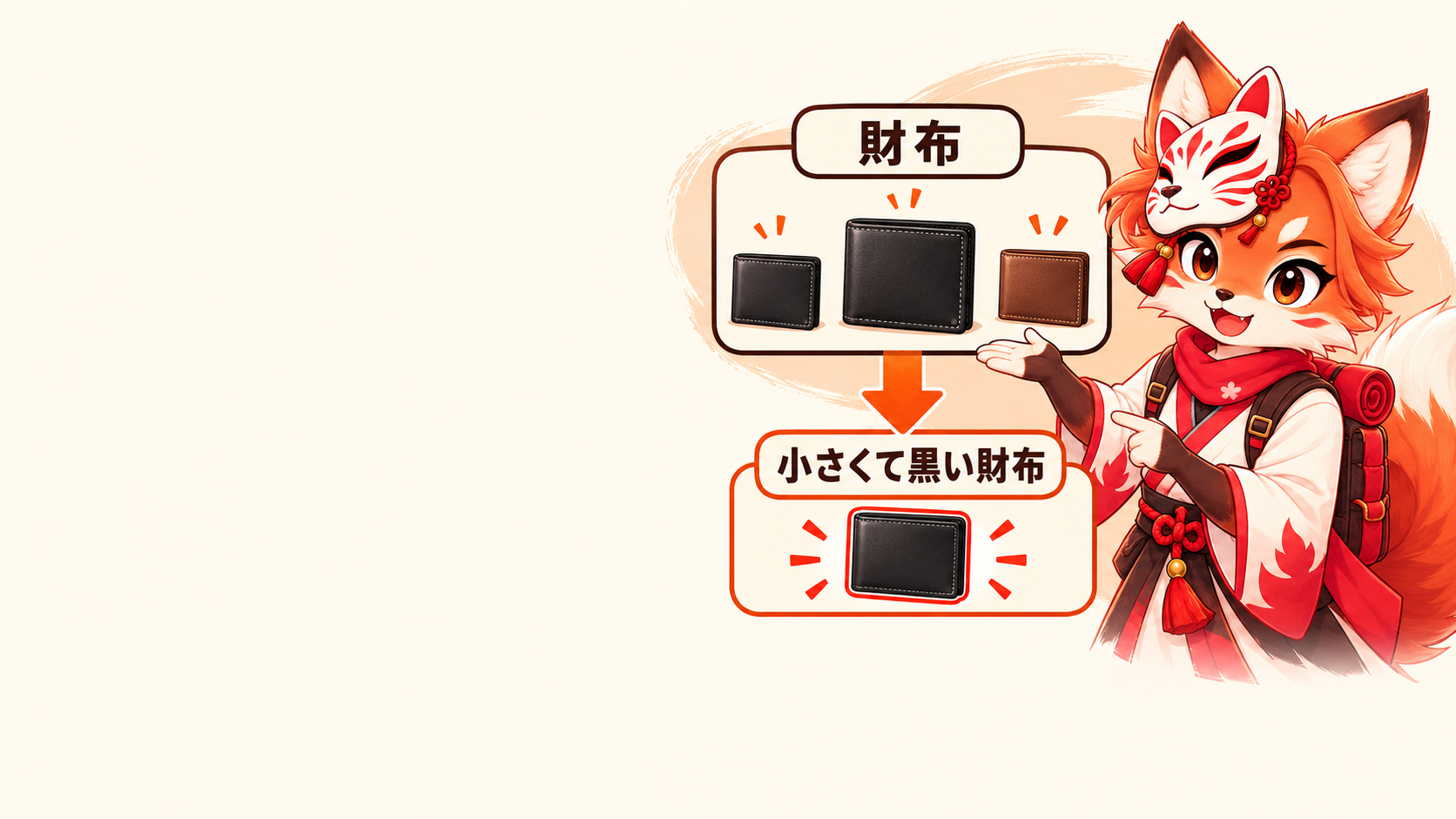
Imagine three wallets: a small black wallet, a large black wallet, and a small brown wallet. “Wallet” leaves three candidates. “Black” leaves two. “Small” leaves one. A useful description adds information that distinguishes your belonging from similar objects.
黒い財布です。小さいです。中に学生証が入っています。
It is a black wallet. It is small. My student ID is inside.
Notice the attachment in 黒い財布. 黒い is an い-adjective, so it directly modifies 財布. Keep its final い before the noun. For the colour noun 茶色(ちゃいろ), one useful pattern is 茶色の財布, “a brown wallet.” Learn these as complete phrases instead of adding の to every colour word.
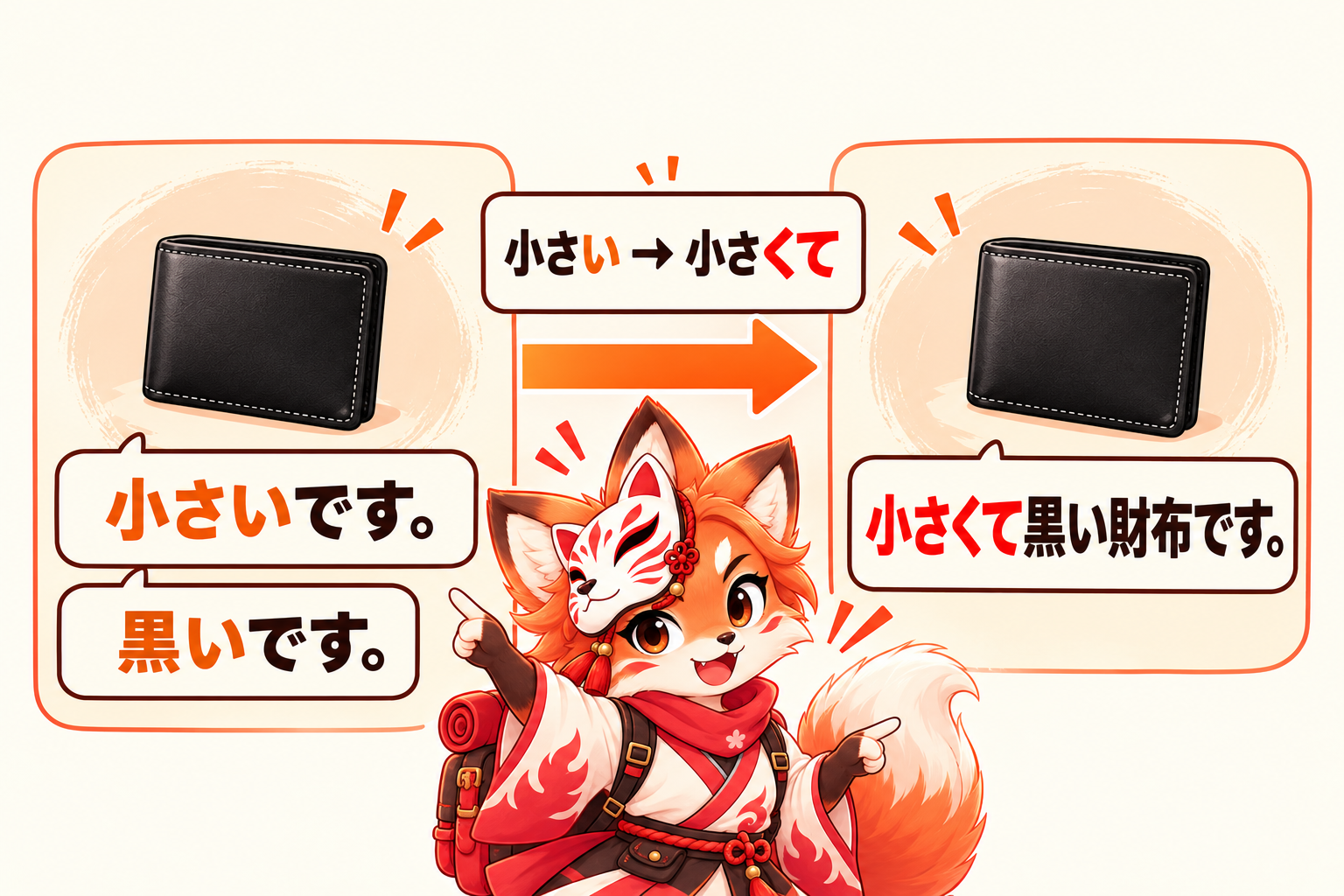
You can combine two い-adjectives by changing the first adjective's final い to くて:
小さい → 小さくて → 小さくて黒い財布です。
It is a small black wallet.
The connecting form belongs to 小さい; the adjective immediately before 財布 remains 黒い. Avoid 小さいで黒い財布. If forming the connection slows you down, 小さいです。黒いです。 is a perfectly usable pair of sentences. Tokyo University of Foreign Studies provides practice with this adjective connection.
For a bag, you could say 青いかばんです。白い猫の絵があります。 “It is a blue bag. It has a picture of a white cat.” Keep the feature specific. A picture, an attached key ring, or something inside can distinguish items that have the same colour.
The diagram moves from two separate statements on the left to one description on the right. Its arrow highlights the change from 小さい to 小さくて while 黒い still directly describes 財布.
A guide for stating the location
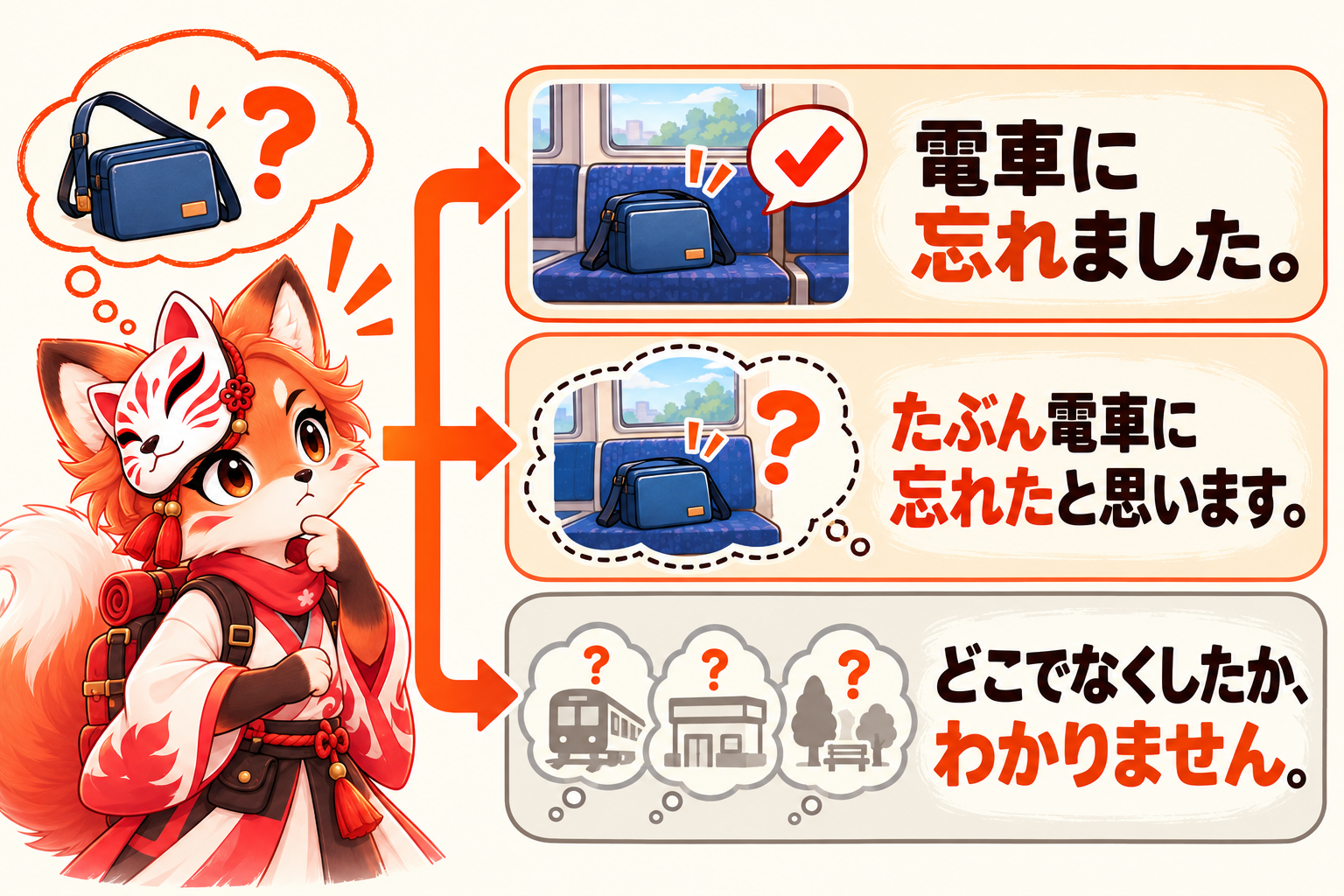
Use this decision guide before choosing your location sentence:
- You remember leaving it in a particular place. Say 電車にかばんを忘れました。 “I left my bag on the train.” Here に marks where the bag was left behind.
- You only think that is where you left it. Say たぶん電車に忘れたと思います。 “I think I probably left it on the train.” 忘れた is the plain past form before と思います; avoid putting 忘れました directly before と思います.
- You do not know where you lost it. Say どこでなくしたか、わかりません。 “I do not know where I lost it.” Here で marks the location of the losing event inside the embedded question.
Do not turn a guess into certainty just to give a short answer. You can instead report your last definite memory: 朝は持っていました。 “I still had it in the morning.” That gives the listener a useful starting point without inventing a location.
The three branches below represent different things you know, not successive events. The clear train scene supports a definite statement; the dotted memory supports a guess; the unselected locations support saying that you do not know.
Follow the questions at the desk
The following dialogue is an original practice example. Read each reply as a response to one information request.
Customer: すみません。財布をなくしました。
Excuse me. I lost my wallet.
The opening names the problem and the object.
Staff: どんな財布ですか。
What kind of wallet is it?
どんな asks for a description, so answer with features rather than a location.
Customer: 小さくて黒い財布です。中に学生証が入っています。
It is a small black wallet. My student ID is inside.
The answer gives its appearance and a distinguishing detail.
Staff: どこでなくしましたか。
Where did you lose it?
Customer: よくわかりません。朝は持っていました。
I am not sure. I still had it in the morning.
This reply states the limit of the customer's knowledge.
Staff: こちらですか。
Is it this one?
Customer: はい、私のです。ありがとうございます。
Yes, it is mine. Thank you.
Check the actual item before confirming it. If it is different, say いいえ、私のではありません。 “No, it is not mine.”
Practise with something you own
Choose a wallet, bag, or set of keys. Without looking at it, say its name and two identifying details in Japanese. Then look again and check whether your description would separate it from another item of the same type. Replace a vague detail with something visible and specific.
Next, practise the location guide with three different situations: a place you remember, a place you suspect, and a place you do not know. The wording should change with your knowledge. Finish by answering どんな財布ですか or どんなかばんですか without reading your notes.
Japan's National Police Agency explains that time, place, and distinctive features help match lost-property information. Use that as a reason to prepare accurate details. For this speaking exercise, your goal is simple: name the item, make it recognisable, and say clearly what you remember.
日本語で確認: なくした物を言います。色や大きさ、特徴を説明します。場所がわからないときは、「わかりません」と言います。