
Describing an Unchanged State with 〜まま
Describing an Unchanged State with 〜まま
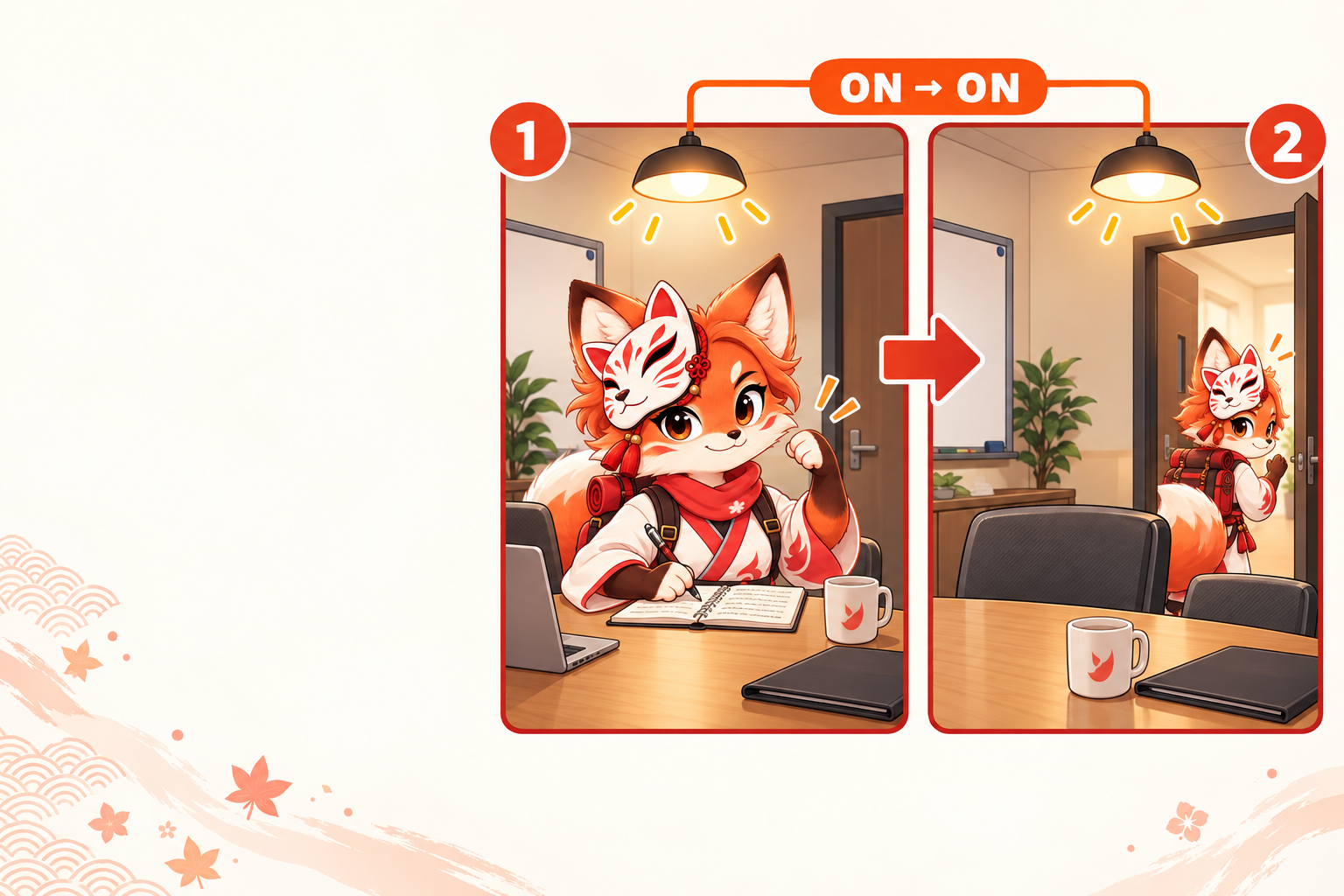
You leave a meeting room, return for your notebook, and find the lights still on. 電気がついたままです means “The lights are still on,” with attention to the state that has continued. The meeting finished, but that state did not change. With 〜まま, you can point out what remains, describe doing something without changing it, or ask someone to leave something as it is.
The useful question is: what is still the same at the next moment? A window can stay open, a person can keep a coat on, and a document can stay in its original form. This lesson focuses on identifying that continuing state and attaching まま correctly. The examples below are practice situations, so choose details that fit the room, person, or task you are actually describing.
Follow the state across two moments
Consider this short sequence:
The light comes on → the meeting ends → the light is still on
つく → ついた → ついたままです
The た-form before まま describes the change that produced the continuing result. It does not make the entire sentence a past-tense report. In 電気がついたままです, the light is on now. To report an earlier observation, change the sentence ending:
昨日の夜、会議室の電気がついたままでした。
Last night, the meeting-room lights were still on.
Compare a person leaving a room:
窓を開けたまま、部屋を出ました。
I left the room with the window open.
The window was opened and remained open when the person left. The sentence does not say that opening and leaving happened simultaneously. Nor does it say who eventually closed the window. Keep the description within the time the sentence actually gives you.
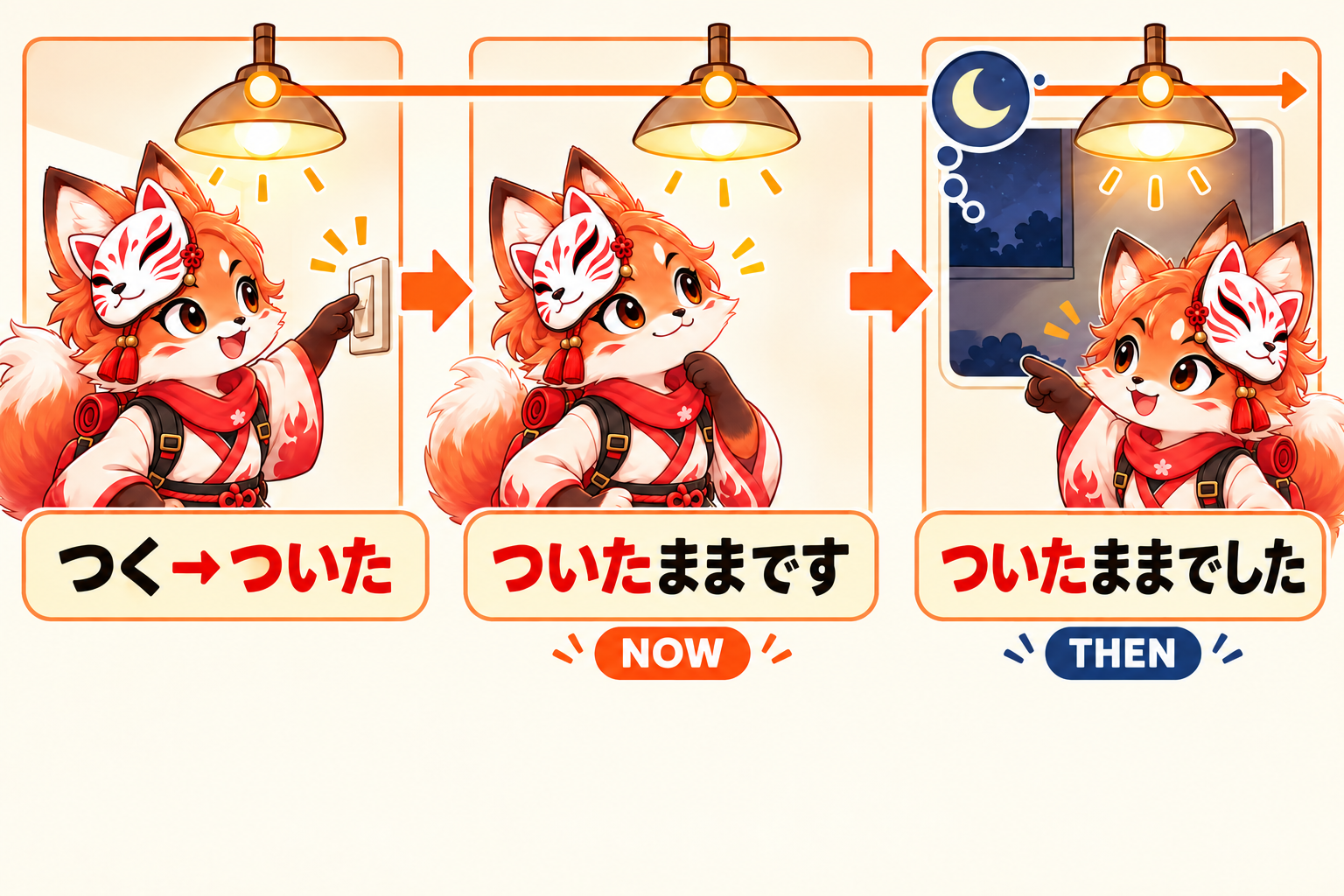
The first panel forms ついた. The middle panel reports the continuing light state now; the framed night scene recalls an earlier observation with でした. The connecting line tracks the unchanged ON state, rather than putting the past after the present.
Build the expression from the right base
For a verb, use its た-form before まま. The usual changes still apply: つく becomes ついた, 開ける becomes 開けた, and 着る becomes 着た. Keep です or ます out of this attachment point. Politeness belongs in the ending of the larger sentence, as in ついたままです or 開けたまま出ました.
You can also describe an unchanged state with an adjective or a noun. This comparison table shows the connector to keep.
| Base type | Form before まま | Example | Meaning |
|---|---|---|---|
| Verb | た-form | コートを着たまま | with a coat still on |
| い-adjective | Keep い | 温かいまま | while still warm |
| な-adjective | Add な | 静かなまま | while remaining quiet |
| Noun | Add の | パジャマのまま | still in pajamas |
コートを着たまま、椅子に座りました。
I sat on the chair with my coat still on.
スープはまだ温かいままです。
The soup is still warm.
部屋は静かなままです。
The room remains quiet.
日曜日は昼までパジャマのままでした。
On Sunday, I stayed in my pajamas until noon.
These expressions describe a state that continues. They do not all contain a hidden action that you must invent. With パジャマのまま, focus on the person's clothing; with 静かなまま, focus on the room's quietness. Do not replace the connectors with one universal particle.
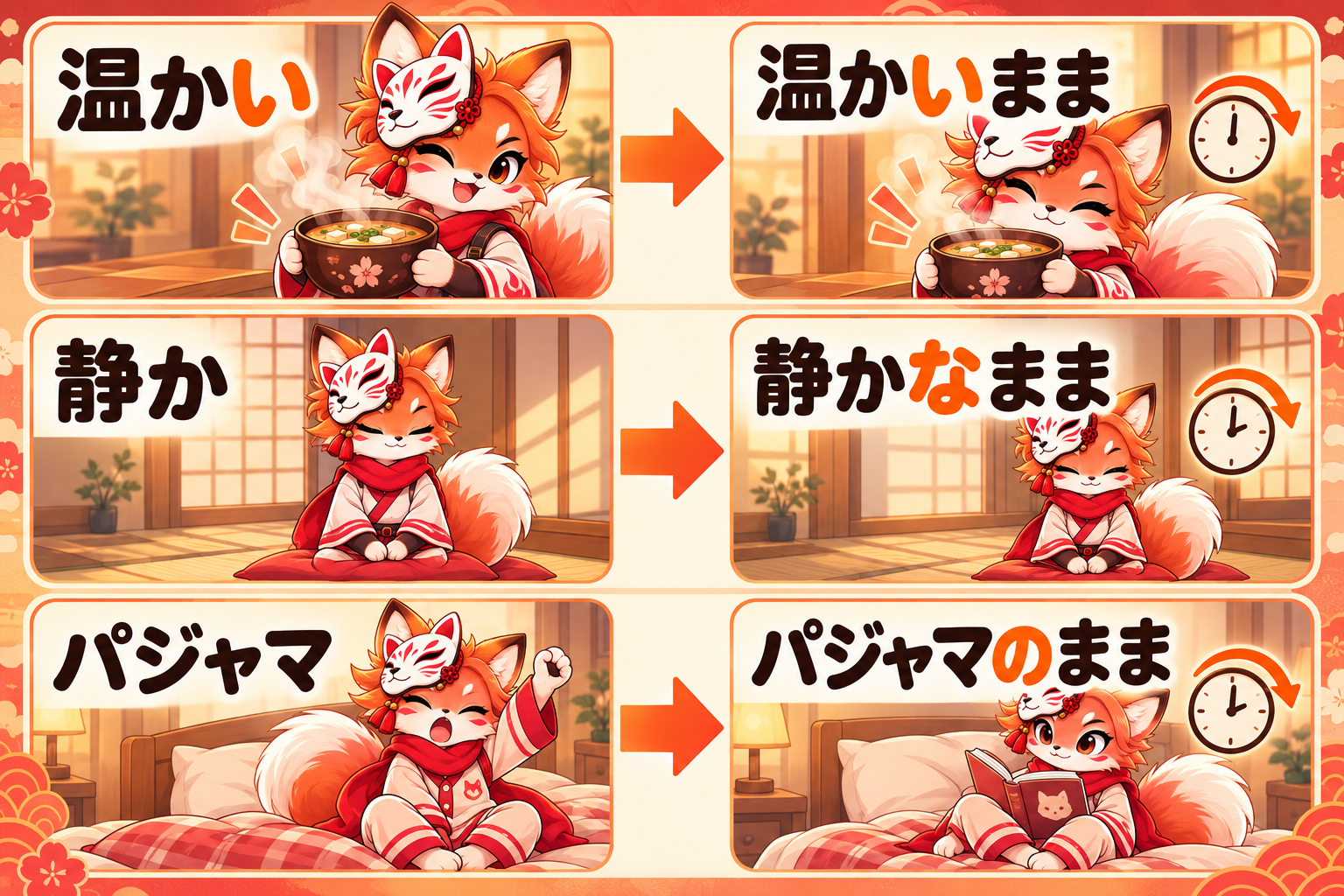
Read each row from the base word to the completed expression. The clock marks continuity: the soup stays warm, the room stays quiet, and the pajamas remain on. The orange characters show the connector to retain or add.
Decision guide: choose a base, then an ending
- Identify the unchanged state. If an action created it, take the verb route. If you are describing a quality or clothing, choose the adjective or noun route.
- Follow the matching branch below. For example, a coat already put on gives 着たまま; pajamas give パジャマのまま.
- Choose the sentence ending. For an observation now, use です. For an observation then, use でした. For another action, continue with that action, such as 座りました.
Follow this decision tree from its question to the matching branch:
What is unchanged?
├─ A result of a verb → its た-form + まま
├─ An い-adjective state → adjective + まま
├─ A な-adjective state → stem + な + まま
└─ A noun description → noun + の + まま

What comes next?
├─ Report the state now → です
├─ Report the state then → でした
└─ Describe another action → continue with that action
メガネをかけたまま、本を読みました。
I read a book with my glasses on.
You put on the glasses, and they stayed on during the reading. The point is their unchanged state. For two activities performed together, such as listening to music while reading, a pattern like 音楽を聞きながら本を読みました is a more useful model. Do not mechanically change every English “while” into まま. Ask whether you are describing a continuing result or two ongoing activities.
Before another action, ままで is also possible. コートを着たままで座りました and コートを着たまま座りました both describe sitting with the coat still on. Learn the shared relationship rather than treating the extra で as a new tense or a command.
An unchanged state can be intentional
Leaving something unchanged is often inconvenient, but まま itself does not mean “by mistake.” The rest of the sentence and the situation tell you whether the speaker wanted the state to continue.
電気をつけたまま、寝てしまいました。
I ended up falling asleep with the lights on.
Here てしまいました helps convey the speaker's regret or unintended outcome. Contrast that with an instruction during a fitting:
コートは着たままでいいですよ。
You can keep your coat on.
The coat staying on is acceptable in this situation. Do not add regret to its translation. Likewise, そのまま means “as it is” or “that way,” referring to a state already clear from context:
この書類はそのまま置いてください。
Please leave this document as it is.
Point to the document or establish it in conversation first. Without shared context, “that way” may not tell your listener what to preserve.
A short room-check dialogue
A: 会議は終わりましたか。
“Has the meeting finished?” A first checks whether anyone still needs the room.
B: はい、終わりました。
“Yes, it has.” B confirms the event is over.
A: 電気がついたままですよ。
“The lights are still on.” A describes the remaining state without naming the person responsible.
B: あ、今、消します。
“Oh, I'll turn them off now.” B responds with an action that changes that state.
The observation can serve as an indirect reminder in this exchange. It is not automatically a polite request in every context. With someone you do not know, すみません can soften the opening; if you need an explicit action, 電気を消してください directly asks them to turn off the lights. Match the wording to the relationship and the task.
Check the connector, then practice
Avoid つきますまま for this result-state pattern; use ついたまま. Avoid パジャマなまま; the noun needs の. Avoid 静かのまま; the な-adjective needs な. In 温かいまま, retain the final い. Finally, distinguish 電気がついたまま, which focuses on the light's state, from 電気をつけたまま, which presents someone turning it on and leaving it on.
Choose one ordinary object near you. Describe its unchanged state, add a second action, and then name an action that would change the state. For a window, try 窓を開けたまま本を読みました, “I read with the window open,” followed by そのあと、窓を閉めました, “After that, I closed the window.” Picture the open window throughout the reading. That picture gives まま its purpose.
Learning references
- Japan Foundation, Irodori Lesson 15: continuing light states in everyday conversation.
- Japan Foundation, Marugoto teaching notes, Lesson 15: まま and ままで before another action.
- Meshclass, 〜まま: verb, adjective, and noun attachment.
- AOTS, Japanese for caregiving, expression notes: the continuing result of an action.