
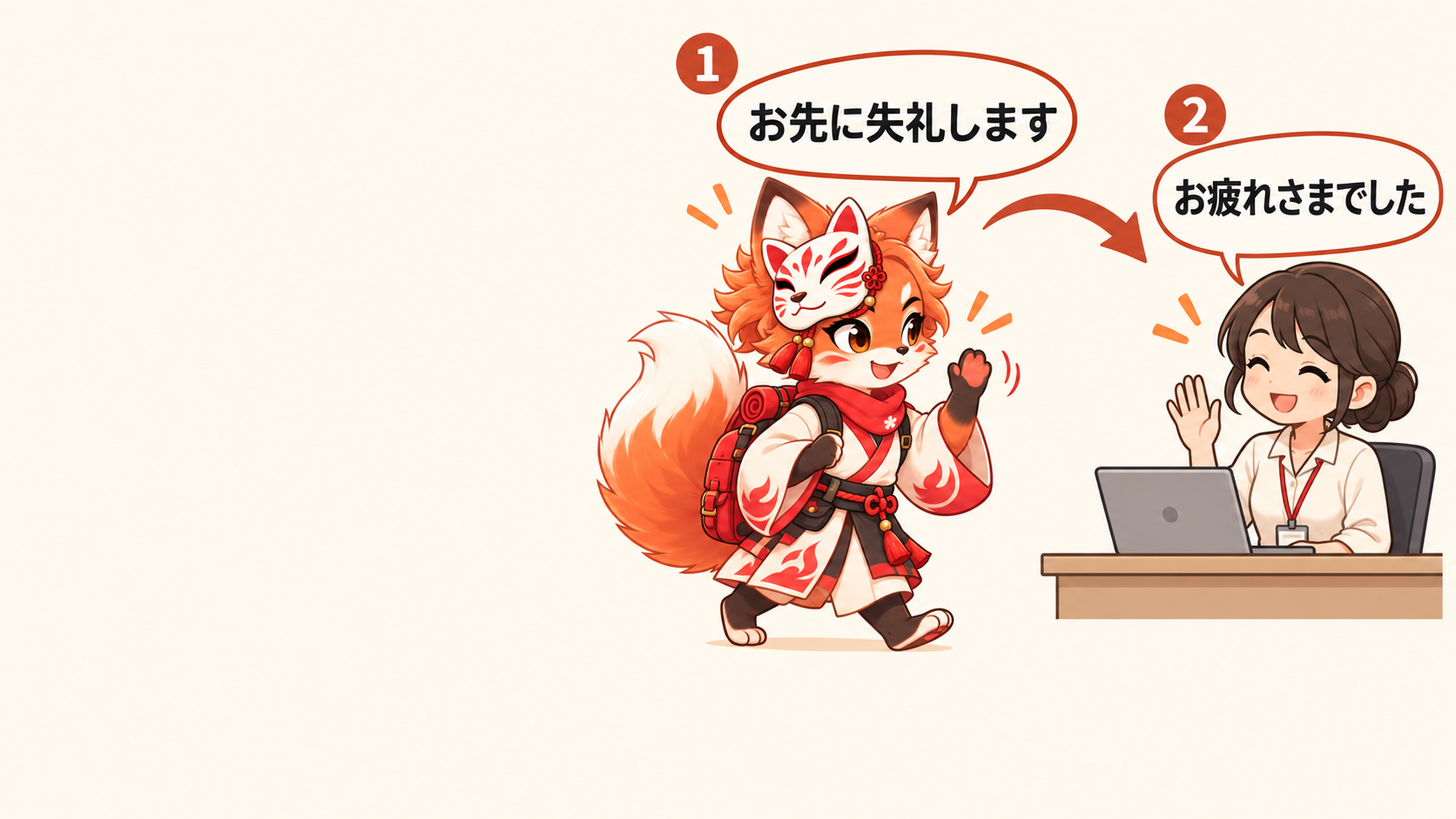
Leaving Work with お先に失礼します
Leaving Work with お先に失礼します
Your work is finished, your bag is packed, and a colleague is still at a desk. A useful farewell is お先に失礼します(おさきにしつれいします): “Excuse me for leaving before you.” The colleague can reply お疲れさまでした(おつかれさまでした): “Thanks for your work today.” Learn the exchange as two connected turns. Knowing which person says each line matters as much as recognizing the words.
This lesson follows one ordinary workplace departure. You will identify the person leaving, choose a polite farewell, and answer when someone else leaves. You will also practise a small but useful distinction: announcing that you will go first and inviting another person to go first. These expressions do different jobs even though both contain お先に.
Start with the person leaving
Imagine that Mika is going home while Sato continues working. Mika says:
佐藤さん、お先に失礼します。
Sato, excuse me for leaving before you.
お先に means “ahead” or “before the others” in this expression. The comparison is between people: Mika is leaving before Sato. It does not automatically mean that Mika is leaving earlier than her scheduled finishing time. She may be leaving exactly on time. Avoid translating the phrase as a confession that she has done something wrong.
失礼します is a polite fixed expression used when excusing yourself. Learn お先に失礼します as a complete farewell for this situation. It announces your departure considerately; it does not ask whether you have permission to leave. If a change to your working hours needs agreement, arrange that separately before the farewell. A greeting cannot replace a necessary conversation about the schedule.
The Japan Foundation's Irodori Starter, Lesson 1 teaches this workplace exchange alongside other farewells. Here, keep the full polite form as your practice model. It gives you a usable line without needing to copy a colleague's shorter, more familiar wording.
Answer from the colleague's position
Sato stays at the desk and replies:
お疲れさまでした。
Thanks for your work today.
The reply acknowledges Mika's work and closes her working day. Sato can say it while Sato's own work continues. Do not reason that でした requires everyone in the room to have finished. In this exchange, the person being acknowledged is the colleague who is leaving.
The expression is not a diagnosis of tiredness. Compare 疲れました(つかれました), “I'm tired,” which reports a feeling. お疲れさまでした addresses another person with an acknowledgement. The Japan Foundation's Nihongo de Care-navi gives the Indonesian sense as thanks for someone's effort and hard work. That social function is more useful here than a word-for-word translation built around fatigue.
You will also hear お疲れさまです(おつかれさまです). A useful starting distinction is です for acknowledging someone during work and でした when looking back on completed work or at a departure. Actual workplace habits vary, and both forms can occur around farewells. Treat the pair in this lesson as a dependable model, rather than a rule that makes every other reply incorrect.
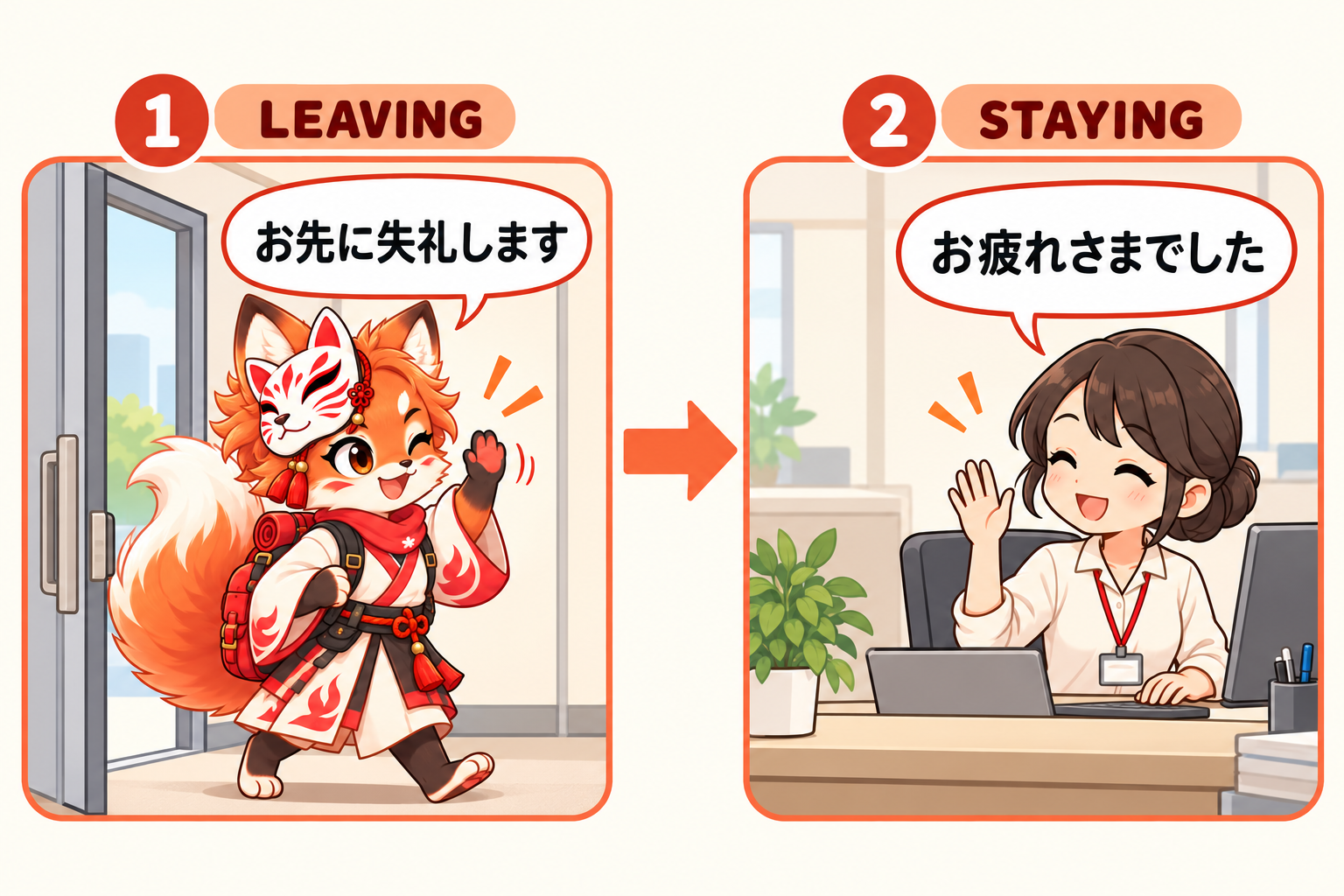
The left panel shows the person leaving; the right panel shows the colleague who stays. The arrow connects the farewell to its reply, even though the colleague's work continues.
Compare the speaker's job
| Expression | Who says it in this lesson? | What it does |
|---|---|---|
| お先に失礼します。 | The person leaving before colleagues | Announces the speaker's departure politely |
| お疲れさまでした。 | The colleague answering the person leaving | Acknowledges the departing colleague's work |
| お疲れさまです。 | A colleague acknowledging someone during work | Gives a workplace acknowledgement; use depends on context |
| お先にどうぞ。 | Someone letting another person proceed first | Invites the listener to go ahead |
The last row changes the direction of the action. When you say お先にどうぞ, the other person goes first. For example, you can stand back at a doorway and let a colleague pass. You are not announcing that you will go home. Tuttle's published practice explanations explicitly distinguish this invitation from the farewell お先に失礼します.
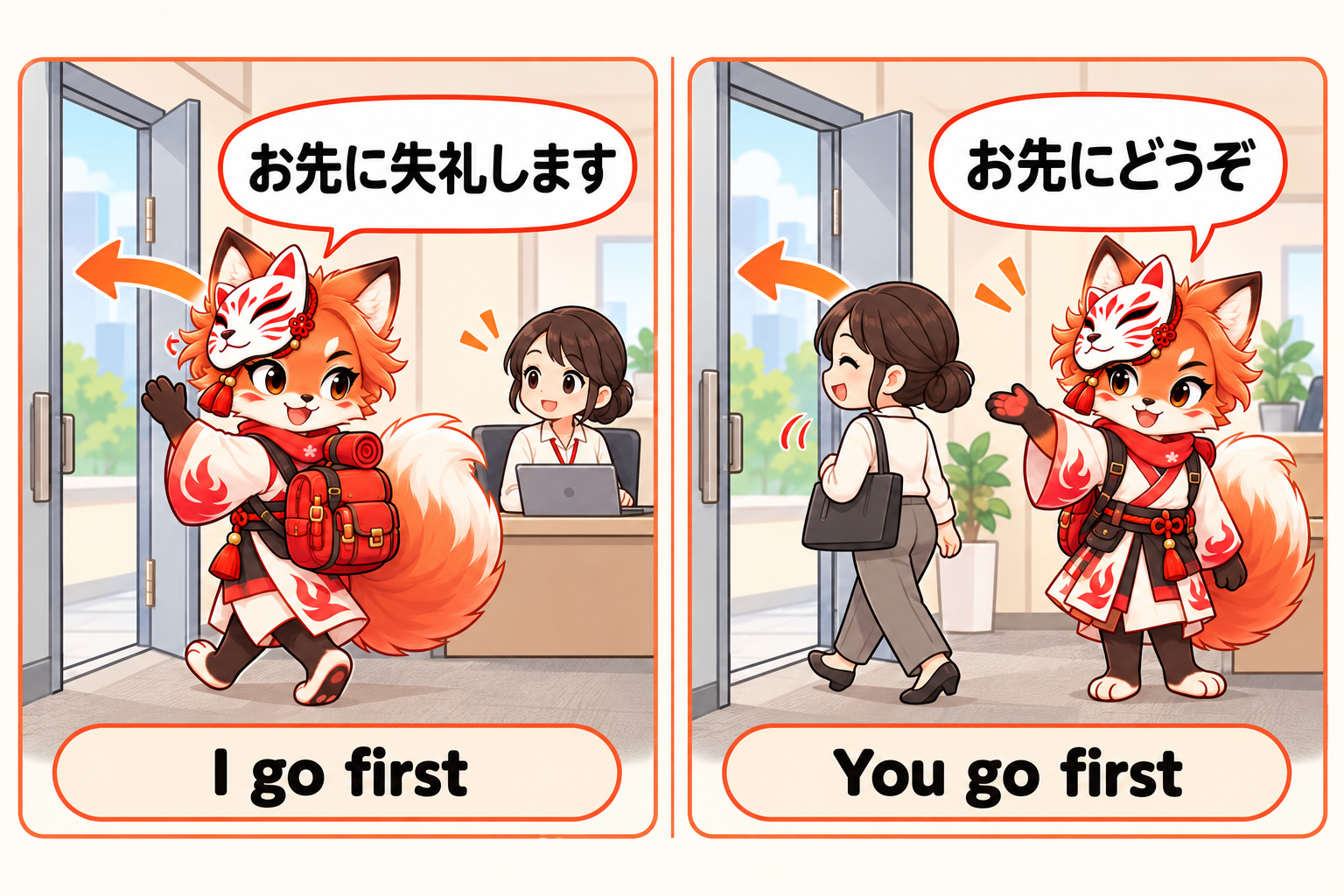
In the left panel, the speaker moves through the door. In the right panel, the speaker stands aside and the listener moves. Follow the movement arrow to identify who goes first.
A decision guide before you speak
Follow the branch that matches your role:
Who will go first?
├─ I am leaving work while colleagues remain.
│  └─ Say お先に失礼します。
├─ A colleague has just said お先に失礼します。
│  └─ Reply お疲れさまでした。
└─ I am letting someone pass or proceed ahead of me.
   └─ Say お先にどうぞ。
Read the situation before choosing a line. If you are holding a door and motioning another person through, follow the invitation branch. If you are taking your bag and leaving the workplace, follow the departure branch. The shared words お先に do not decide the answer by themselves. The rest of the expression identifies whose action you are describing.
The Care-navi entry for お先に also shows a colleague inviting someone to proceed first at lunchtime. The same direction applies: the listener does something before the speaker. Our doorway example lets you practise that direction without adding more vocabulary.
An annotated end-of-day dialogue
The following is a practice scene. Mika has finished her work and already knows she can leave. Sato is staying.
- Mika: 今日はありがとうございました。 “Thank you for your help today.” Mika thanks Sato for help received that day. This optional sentence adds a specific thanks; it is not a required password before leaving.
- Mika: お先に失礼します。 “Excuse me for leaving before you.” Mika now gives the departure greeting. The speaker is the person going home.
- Sato: お疲れさまでした。また明日。 “Thanks for your work today. See you tomorrow.” Sato acknowledges Mika's day. また明日(またあした)fits this scene because they expect to meet tomorrow.
- Mika: はい、また明日。 “Yes, see you tomorrow.” Mika answers the added farewell and leaves.
Practise once as Mika and once as Sato. On the second reading, keep Sato seated and move Mika's bag toward the door. This small physical change helps you remember the speaker roles. Then remove the optional thanks and the tomorrow lines. The central two-turn exchange still works.
Mistakes to catch in practice
Do not answer お先に失礼します automatically when someone else says it. If you are staying, that reply would also announce your own departure. Use the acknowledgement in the model exchange instead. If you really are leaving too, your situation has changed; identify that situation before choosing what to say.
Keep the polite endings intact. お先に失礼します already ends in the polite verb form します. Do not add です after it. In お疲れさまでした, keep さま and でした together as part of the expression. お疲れさま is a shorter familiar form you may hear, but practising the complete polite version avoids an unnecessary register decision at first.
Finally, match any added words to reality. また明日 means “see you tomorrow,” so leave it out when you do not expect to meet tomorrow. A practical farewell can be short and still be complete.
Rehearse one departure
Put two objects on a table to represent you and a colleague. Move your object toward an imaginary exit and say お先に失礼します. Answer from the colleague's position with お疲れさまでした. Switch roles, then try a doorway scene with お先にどうぞ. Finish by checking one thing: did the person who goes first match the expression you chose? When that relationship is clear, the words become easier to use at the actual moment of leaving.