
Missed a Word? Keep a Japanese Conversation Going
A receptionist tells you the meeting time. You recognize the word for “tomorrow,” but the number disappears into the rest of the sentence. You could nod and hope. A more useful response is a short request that gives the other person something concrete to do: repeat the time, say it more slowly, or write it down.
This lesson teaches one practical skill: recovering the information you need so that a Japanese conversation can continue. You do not need to understand every word before you speak. You need to identify the missing piece, ask for the right kind of help, and check the answer before acting on it.
Start with a request you can actually say
すみません、もう一度お願いします。
Sumimasen, mō ichido onegaishimasu.
“Sorry, once more, please.”
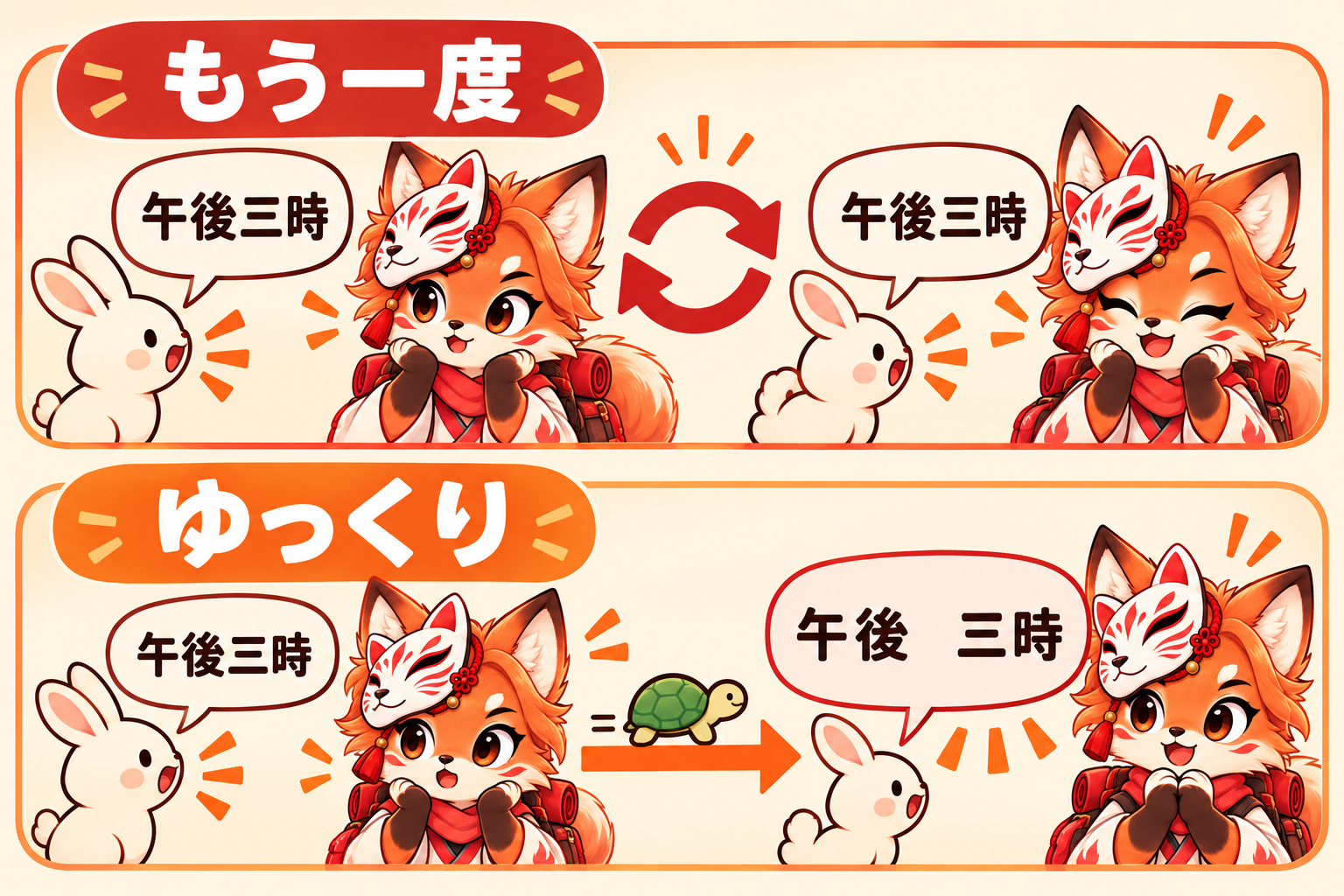
もう一度 means “once more.” In this situation, the action being requested is already clear: you want the previous words repeated. You can use this short expression without building a longer sentence under pressure. The Japan Foundation teaches this as a basic conversation strategy in Irodori Starter, Lesson 2.
For a more explicit request, say すみません、時間をもう一度言ってください。 — “Sorry, please say the time again.” 時間(じかん) identifies the part you missed. If you caught the rest of the message, this lets your partner repeat only the useful detail. In your own practice, substitute 名前(なまえ, name) or 電話番号(でんわばんごう, telephone number).
Pause after the request. Give the other person time to answer. Saying the phrase successfully is only the first half of the exchange; listening to the repair is the part that gets you the information.
Match the help to the problem
Different requests change different things. Repetition gives you another hearing. Slower speech gives you more processing time. Writing makes a name or number visible. A meaning question asks for an explanation rather than another performance of the same sounds.
| What is missing? | Useful Japanese | What you are asking for |
|---|---|---|
| You missed the utterance | もう一度お願いします。 | Another hearing of the previous words |
| You need a slower delivery | もう少しゆっくり言ってください。 | The words said a little more slowly |
| You need a visible record | ここに書いてください。 | Writing in the place you indicate |
| You heard an unfamiliar word | 「受付」はどういう意味ですか。 | An explanation of “uketsuke” |
| You want to check a detail | 午後三時ですか。 | Confirmation that it is three in the afternoon |
Treat this table as a set of tools, not a script you must recite from top to bottom. If you already heard the word clearly, asking for slower speech may not solve your problem. Choose the tool that changes what you still need to know.
Build a clear request with the te-form
The action-request pattern is verb in the te-form + ください. For the three godan verbs used here, form the te-form by changing the final kana: 言う changes its final う to って, giving 言って; 書く changes く to いて, giving 書いて; 話す changes す to して, giving 話して. These are conjugation changes, not simply additions to the dictionary form. The NihonGO NOW! conjugation table lists these exact forms.
Now add ください to the completed te-form: 言ってください (“please say”), 書いてください (“please write”), and 話してください (“please speak”). This is the request construction explained in Tae Kim’s guide. Keep the kanji 言 in 言って, read いって. 行って has the same reading but comes from 行く, “to go”; it does not mean “say.”
もう少しゆっくり話してください。
“Please speak a little more slowly.”
もう少し means “a little more,” and ゆっくり describes the pace. You can also ask for a particular item again: 最後の言葉をもう一度言ってください。 — “Please say the last word again.” 最後の言葉(さいごのことば) narrows the request to the last word.
These are polite but direct requests. A question-shaped option is もう一度言ってもらえますか。 — “Could you say that again for me?” It also follows the te-form, so 言って comes before もらえますか. Wasabi’s request lesson illustrates this pattern. You do not need to learn every possible politeness ending today. Pick one complete request and make it available when you need it.
With a close friend, もう一回言って。 means “Say it again.” Here, ください has been left out, making the request casual. Keep ください or the polite question form when that degree of familiarity does not fit. Tone matters too: make space for an answer instead of delivering the request as a complaint.
Decision guide: choose your next move
- Did the sounds go by before you caught them? Ask for repetition: もう一度お願いします。
- Did you catch fragments but lose the pace? Ask for slower speech: もう少しゆっくり言ってください。
- Is an exact name, address, or number still unclear? Offer a place to write: ここに書いてください。
- Can you repeat the word but still cannot explain it? Ask about meaning: 「受付」はどういう意味ですか。
- Do you now have a possible answer? Say the detail back as a question, then listen for confirmation or correction.
You may move between these steps. If a slower repeat still leaves the number uncertain, change to writing. The point is to make the next turn useful, not to repeat the same request indefinitely.
An annotated dialogue: recover a meeting time
Staff: 明日の説明会は午後三時からです。
“Tomorrow’s information session starts at three in the afternoon.”
Learner: すみません、時間をもう一度言ってください。
“Sorry, please say the time again.”
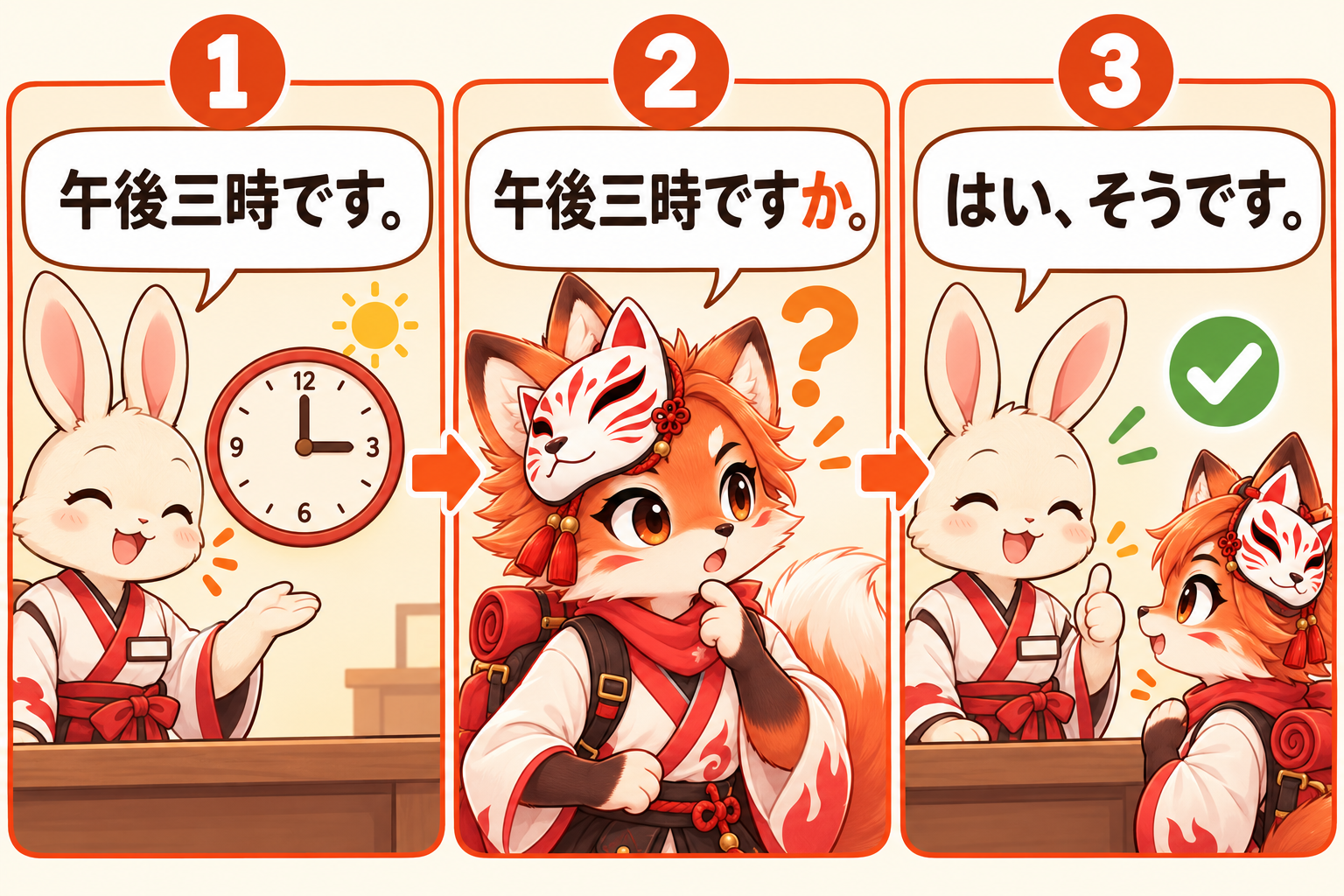
Staff: 午後三時です。
“It is three in the afternoon.”
Learner: 午後三時ですか。
“Three in the afternoon?”
Staff: はい、そうです。
“Yes, that’s right.”
Learner: わかりました。ありがとうございます。
“I understand. Thank you.”
The learner does three separate jobs: identifies the missing information, asks for it, and checks the answer. Notice that the confirmation repeats 午後, “afternoon,” as well as the number. A bare “three?” would leave more room for uncertainty. In this practice dialogue, do not skip the staff’s answer to the confirmation question.
When repeating is not enough
Imagine you hear 受付(うけつけ) clearly but do not know what it refers to. Ask 「受付」はどういう意味ですか。 — “What does ‘uketsuke’ mean?” In a building, the answer might be 受付は、案内をするところです。 — “The reception desk is the place that provides information.” Here you are asking about a word, so quote that word rather than leaving the target vague. Irodori Elementary 1, Lesson 10 models this kind of meaning question.
For an unclear number, try すみません、電話番号をここに書いてください。 — “Sorry, please write the telephone number here.” Indicate a real place to write. Then read the number back. A written answer is helpful, but checking that you have copied or read it correctly is still part of the task.
Two common practice mistakes are ending at わかりません (“I don’t understand”) without requesting help, and saying わかりました (“I understand”) before the important detail is clear. The first leaves your partner to guess what you need. The second can close an exchange too early. Add one specific request, then use わかりました when you have understood.
A short Japanese recap
わからないときは、聞き返しましょう。もう一度聞きます。速いときは、ゆっくり言ってもらいます。最後に、大切な情報を確認します。
“When you do not understand, ask again. Listen once more. If it is fast, have the other person say it slowly. Finally, check the important information.”
Practice one complete exchange today
Ask a partner to invent a meeting time. Deliberately leave the time out of your notes, request it again, repeat the full detail as a question, and wait for the answer. Next, practice with an invented telephone number and ask for writing. Finally, practice with an unfamiliar word and ask what it means. Keep each round short enough to repeat without reading.
Your goal is a complete exchange: a specific difficulty, an appropriate request, an answer, and a checked detail. Save three phrases you can say comfortably and use the accompanying practice to choose between them. You can keep a conversation moving while still learning the words inside it.