
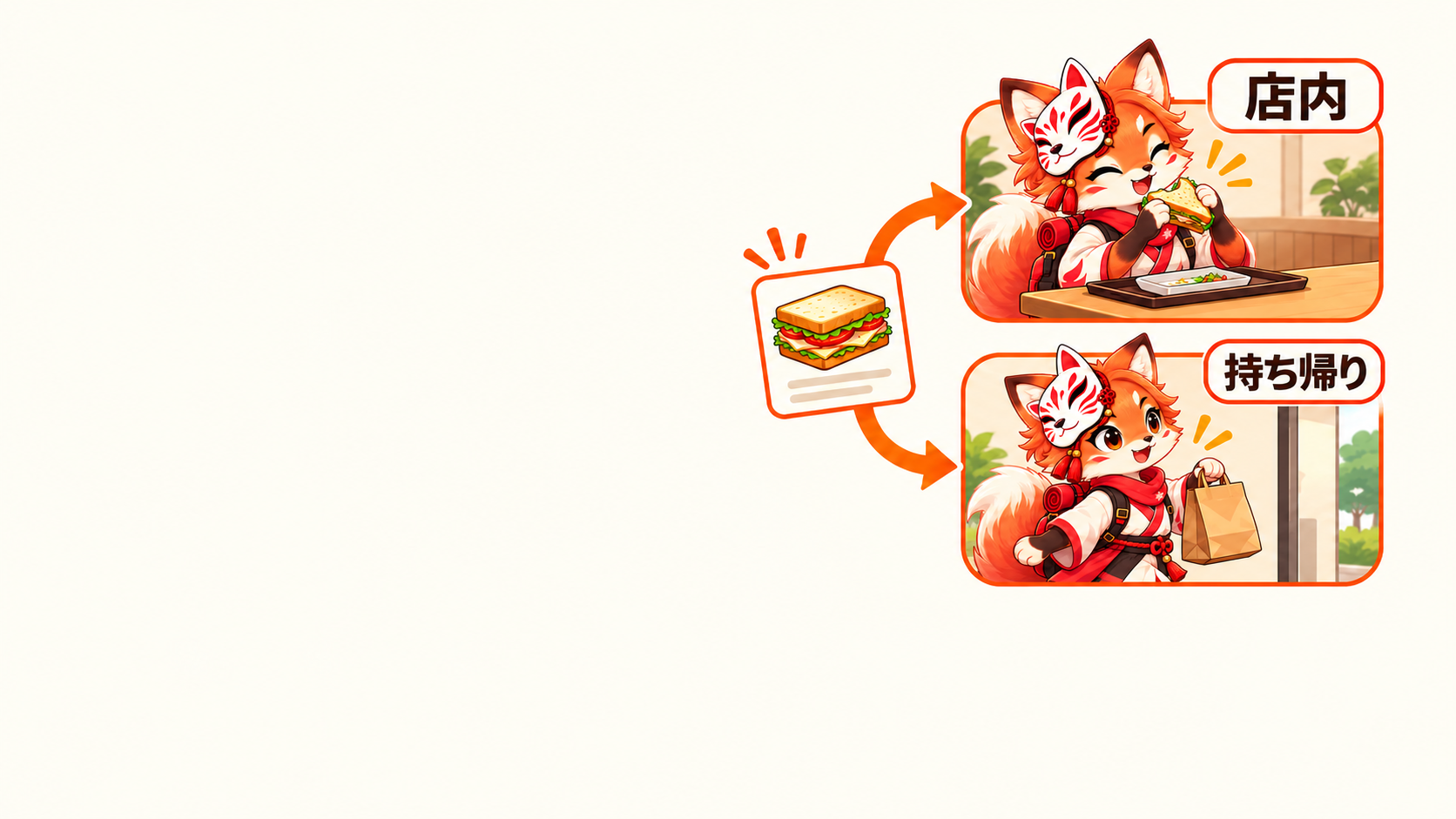
Ordering Food to Go in Japanese
You have chosen lunch, but the staff member asks another question before taking payment. The food is settled; where you will eat it is not. A useful takeaway order tells the shop both things: what you want and that you want to take it away.
Start with this short exchange:
Customer: サンドイッチを一つください。
One sandwich, please.
Staff: こちらでお召し上がりですか。
Will you be eating here?
Customer: いいえ、持ち帰りでお願いします。
No, to go, please.
The last reply is the core of this lesson. 持ち帰り(もちかえり) means taking something away with you. In a food order, 持ち帰りでお願いします tells the staff to prepare your order as takeaway. You do not need to build a long sentence about going home. You might eat the food somewhere else entirely.
Separate the item from the service choice
Think of an order as two pieces of information. サンドイッチを一つください identifies the item and quantity. 持ち帰りでお願いします identifies how you want the order provided. You can say the second piece when asked, or add it yourself:
サンドイッチを一つください。持ち帰りでお願いします。
One sandwich, please. To go, please.
This is an original practice example, not a script that every shop follows. Staff may ask about size or drinks before asking about takeaway. Keep listening for the information being requested rather than waiting for one fixed sequence.
You may also hear テイクアウト, the Japanese loanword for takeout. テイクアウトでお願いします expresses the same service choice in this situation. Learn to recognize both terms so a different label does not make a familiar question feel new.
Hear the question before saying yes
こちらでお召し上がりですか asks whether you will eat here. こちら means “here” in this exchange. お召し上がり is a respectful expression referring to the customer's eating. You need to understand it, but you can answer in ordinary polite Japanese. はい、ここでお願いします is enough if you want to stay.
お持ち帰りですか asks whether your order is takeaway. Notice that a yes answer now selects the opposite service choice. The prefix お belongs to the polite wording; the customer can simply say 持ち帰り.
| Staff asks | If you want takeaway | If you want to eat here |
|---|---|---|
| こちらでお召し上がりですか。 “Will you eat here?” | いいえ、持ち帰りでお願いします。 | はい、ここでお願いします。 |
| お持ち帰りですか。 “Is that to go?” | はい、持ち帰りでお願いします。 | いいえ、店内でお願いします。 |
| 店内ですか、持ち帰りですか。 “For here or to go?” | 持ち帰りでお願いします。 | 店内でお願いします。 |
店内(てんない) means inside the shop. For a two-option question, naming the option is clearer than replying only はい. This also gives you a dependable response when you understood the key nouns but missed some of the longer polite wording.
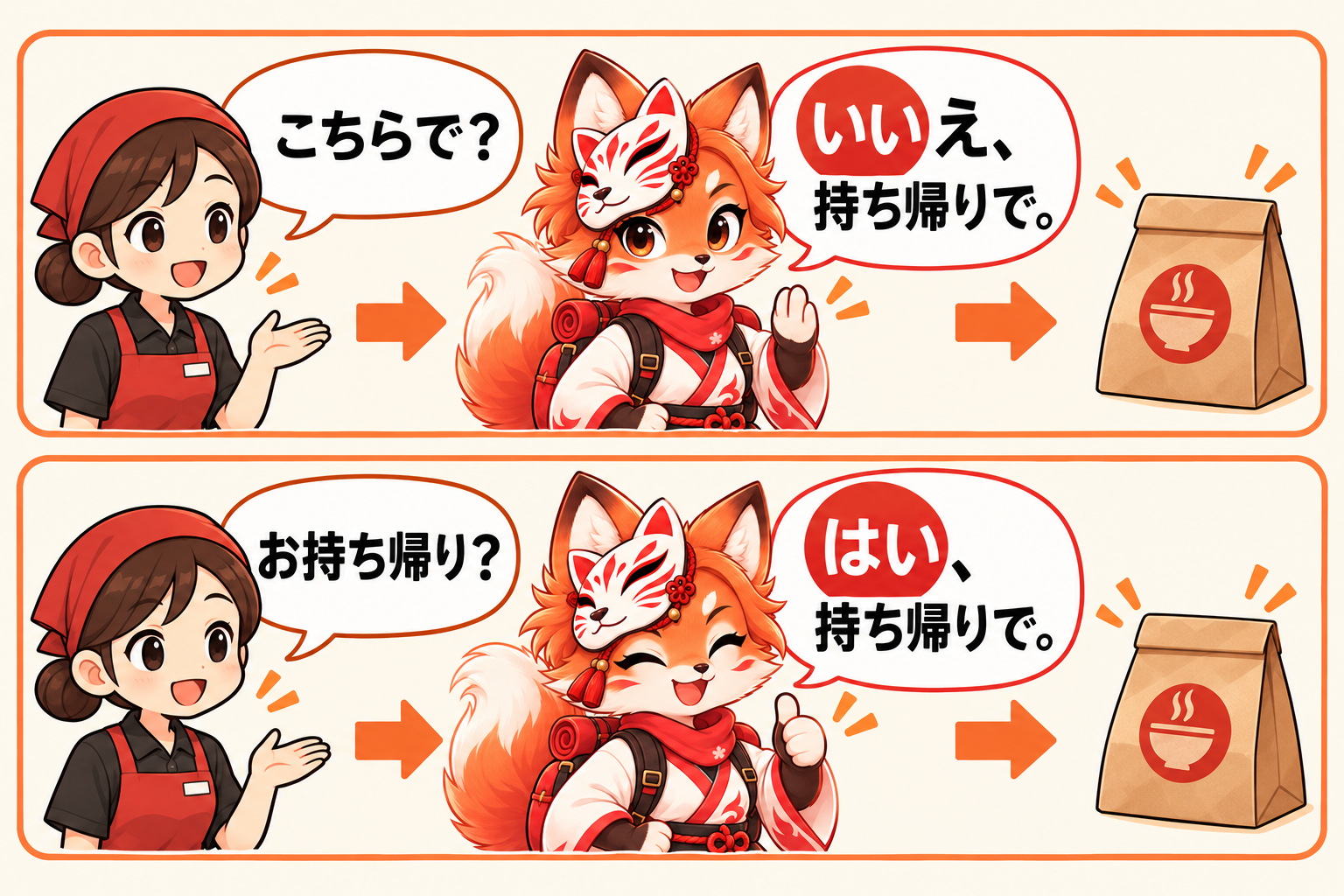
Both rows in the illustration end with a takeaway bag. Follow the arrows from each staff question through the customer's reply: the question changes, so the yes-or-no response changes, while the takeaway choice stays the same. The short bubbles abbreviate the fuller polite sentences in the table.
A decision guide for the counter
Use this branching guide to decide what information your next reply should contain:
What is the staff asking about?
├─ Food or drink → name the item, then give the quantity if needed.
├─ Size → name the size shown on the menu.
└─ Eating here or taking away?
   ├─ Taking away → 持ち帰りでお願いします。
   └─ Staying here → 店内でお願いします。
The guide separates the stages of an order. A request for size is not a request to decide where to eat. If the staff asks サイズはどうなさいますか, “What size would you like?”, answer Mサイズでお願いします, “Medium, please,” when that size is offered. Then answer the service question separately.
The same ending, でお願いします, appears in several useful requests. Learn these as complete counter phrases. In 持ち帰りでお願いします, で presents the requested service option. In 店内で食べます, “I will eat inside,” で marks the location of the action. Do not assume every で in an order has exactly the same job.
Choose the food with Nにします
Before ordering, a friend might ask 何にしますか, “What will you have?” To announce your decision, place a noun directly before にします:
カレーにします。
I'll have curry.
飲み物はアイスコーヒーにします。
For my drink, I'll have iced coffee.
The attachment is noun + に + します. Keep に after the selected item. カレーをします does not express this menu choice. します is the polite form of する, so カレーにする is the corresponding plain form when speaking casually with a friend.
Nにします announces a choice, while Nをください requests an item. Both can occur around ordering, but they help you do slightly different jobs. For your first counter interaction, an item request followed by 持ち帰りでお願いします makes your intention explicit. You can also point at a menu and say これを一つください, “One of these, please.” The pointing makes これ identifiable.
Follow an annotated order
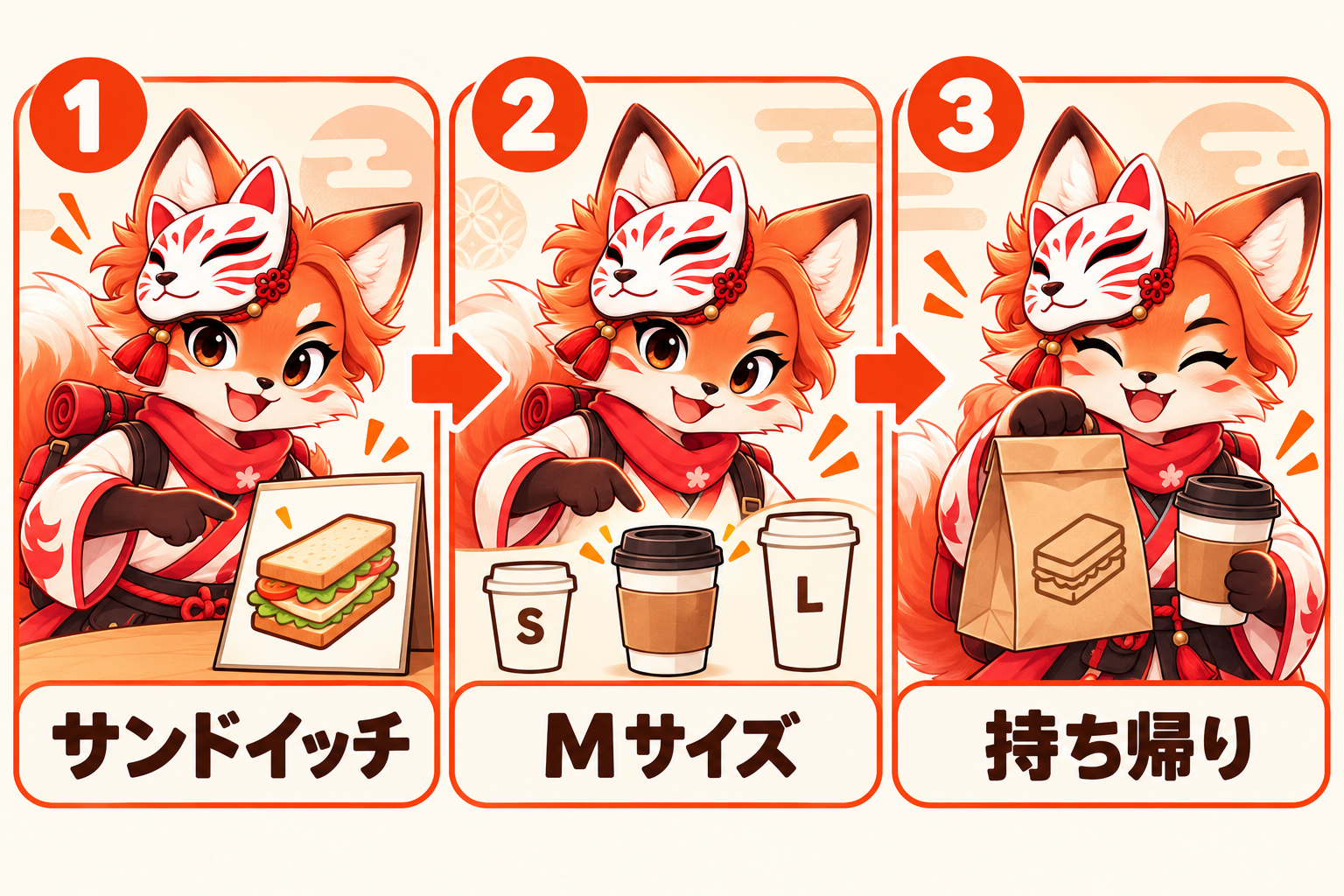
The three panels below assemble one order along the arrows: first a sandwich, then a medium drink size, then the takeaway service. Panel three retains the selected sandwich in a bag and the medium drink. This is one possible order of questions, not a required script.
Read this practice conversation aloud. The names of the food and drink can change while the structure stays useful.
- Customer: サンドイッチを一つと、アイスコーヒーを一つください。
One sandwich and one iced coffee, please. The customer provides the items and quantities. 一つ is read ひとつ. - Staff: お飲み物のサイズはどうなさいますか。
What size would you like for your drink? The staff asks about the drink, not the whole order. - Customer: Mサイズでお願いします。
Medium, please. The customer selects a listed size. - Staff: こちらでお召し上がりですか。
Will you be eating here? This question requires the service choice. - Customer: いいえ、持ち帰りでお願いします。
No, to go, please. いいえ rejects eating here; the rest states the desired option. - Staff: お持ち帰りですね。
That's to go, right? The staff repeats the choice for confirmation. - Customer: はい、お願いします。
Yes, please. Now はい confirms takeaway because that is what the staff just said.
The change from いいえ to はい does not mean the customer changed plans. The wording of the staff's question changed. Follow the proposition being confirmed, not the answer you gave on the previous turn.
Avoid three easy mix-ups
First, do not answer every long question with はい just to keep the line moving. Naming your choice is more useful. If you accidentally agreed to eat inside, correct it with すみません、持ち帰りでお願いします, “Sorry, to go, please.” The correction can be short and polite.
Second, distinguish choosing takeaway at the counter from asking to pack food left after a meal. This lesson covers an order prepared to go. It does not establish whether a restaurant will pack leftovers or whether every menu item is available for takeaway. When availability is unclear, ask 持ち帰りはできますか, “Is takeaway available?”, and listen to the answer before ordering.
Third, keep the speaker roles straight. The staff may use お召し上がり to refer respectfully to your eating. Your own simple reply can use ここで or 店内で. You do not need to repeat the staff's honorific expression about yourself to sound polite.
Practise one order in two versions
Choose one food and one drink from a menu you can read. Say your item request, a size if relevant, and 持ち帰りでお願いします. Then ask yourself こちらでお召し上がりですか and answer for takeaway. Ask お持ち帰りですか next and confirm the same choice with はい.
Finally, practise the eat-in version with 店内でお願いします. Your goal is to keep the items unchanged while changing only the service choice. If you can do that without losing track of what はい confirms, you can handle the central decision in this counter exchange.
Further listening and practice
The Japan Foundation's Irodori Starter Lesson 6 provides fast-food listening and ordering notes. Its grammar worksheets offer additional noun-choice and quantity practice. The dialogues and branching guide above are practice material written for this lesson.