
Read Japanese Shop Signs Before You Enter
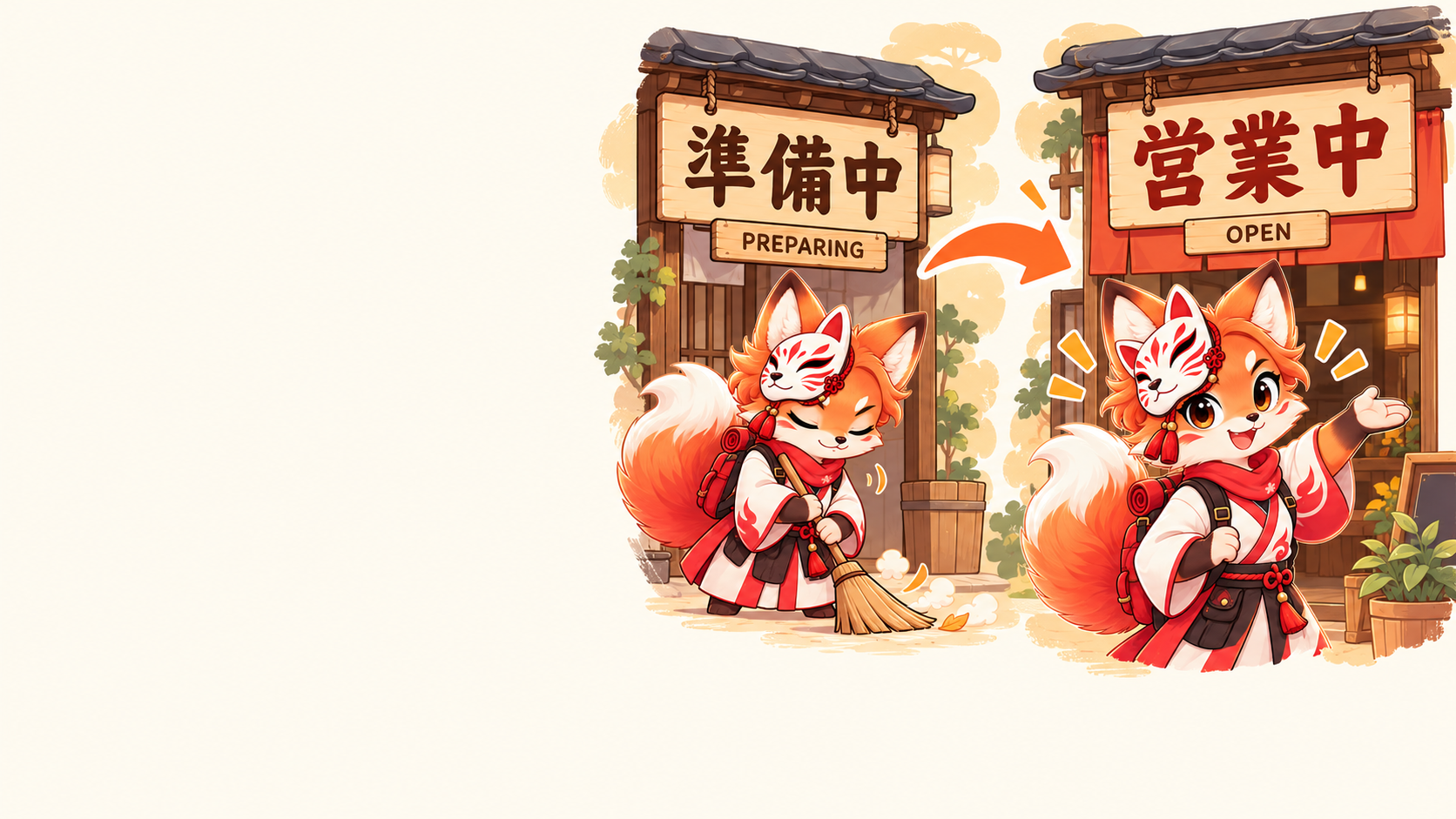
You reach a small restaurant at 10:45. The lights are on and someone is arranging bowls, but the sign on the door says 準備中. Can you go in and order? The useful clue is the sign: the restaurant is preparing and is not serving customers yet. A little later, the same doorway may display 営業中, meaning that it is open for business.
This lesson helps you read a shop's current status, check its schedule, and ask one short question when the information is unclear. You will practise five sign expressions as complete words. You do not need to know every individual kanji before you can use them.
Start with the word before 中
営業中 is read えいぎょうちゅう. 営業 refers to business operations, and the whole expression means open for business. 準備中 is read じゅんびちゅう. 準備 means preparation, so the whole expression describes preparation in progress. At a shop entrance, that means customers should wait for opening rather than enter to order. These sign meanings are explained by the Nagoya International Center.
In these two words, 中 is pronounced ちゅう and marks an activity or state in progress. Read the whole expression before deciding what to do. Seeing 中 alone does not tell you whether a business is accepting customers.
The formation here is 営業+中 and 準備+中. These are activity nouns followed directly by 中. Do not insert の or attach 中 to 営業します. In conversation, add です to make a polite statement: 営業中です or 準備中です. On a sign, the short noun expression is complete for its purpose; the absence of です is normal sign wording.
Compare two original examples:
- この店は今、営業中です。 “This shop is open for business now.”
- まだ準備中です。 “We are still getting ready.”
まだ means still in the second sentence. It does not supply an opening time. To find that, look for the hours or ask a staff member. Learn ちゅう with these complete words; 中 has other readings in other expressions, so this is not a universal pronunciation rule.
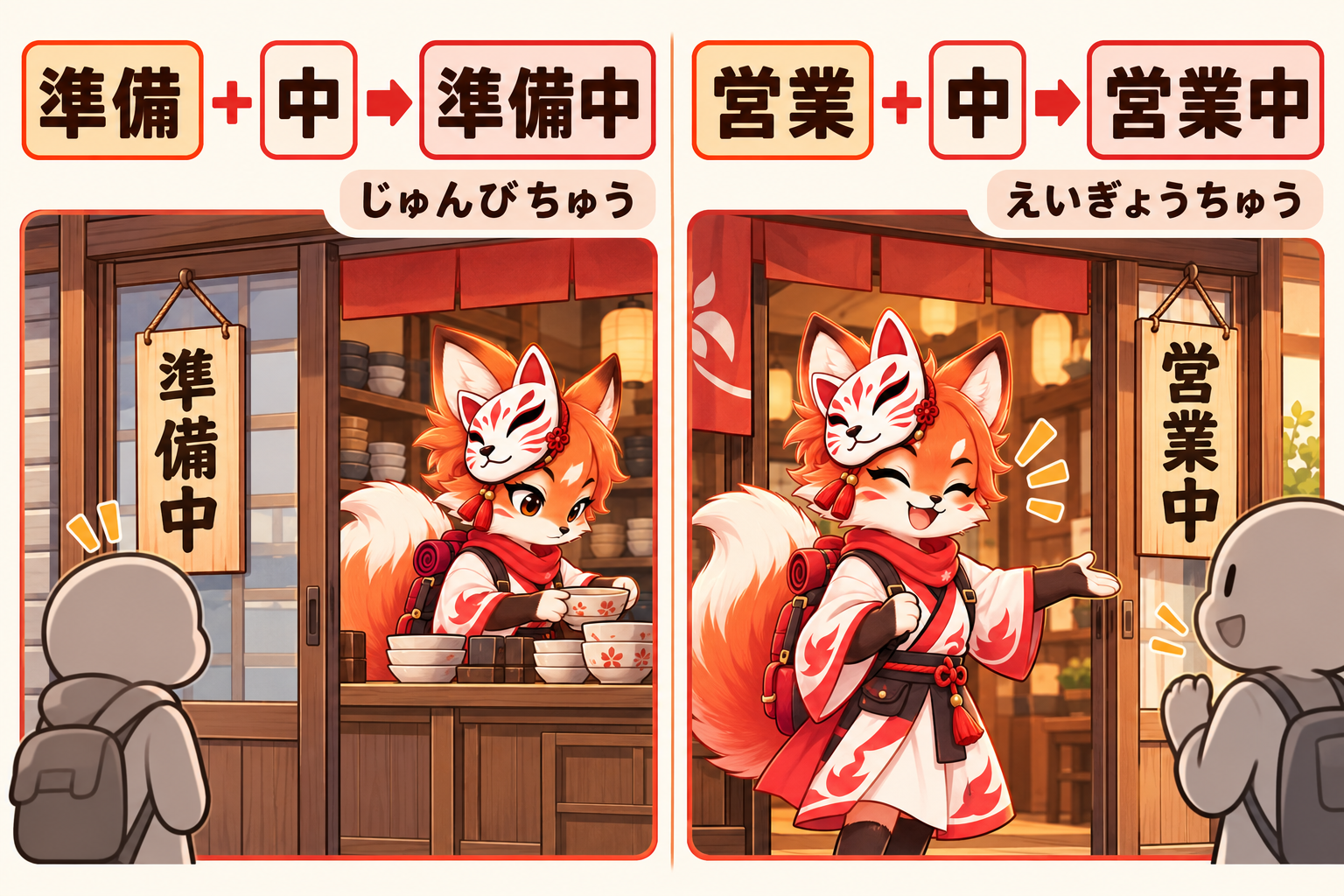
The two panels show the same 中 attached to different activities. Preparation keeps the customer outside; business in progress allows the customer to approach for service. Read the word before 中, not just the shared final character.
Compare status signs and closure notices
| Sign | Reading | What it tells you | Useful next step |
|---|---|---|---|
| 営業中 | えいぎょうちゅう | Open for business now | Approach the entrance and follow staff guidance |
| 準備中 | じゅんびちゅう | Preparing; not serving yet | Check the opening time |
| 定休日 | ていきゅうび | A regular closing day | Check which weekday or date it applies to |
| 本日休業 | ほんじつきゅうぎょう | Closed today | Plan another visit |
| 臨時休業 | りんじきゅうぎょう | A temporary closure outside the regular closing schedule | Read any dates or reopening notice |
本日 means today, and 休業 means a suspension of business. 本日休業 tells you about today; it does not by itself explain the reason or promise that tomorrow will be open. 臨時休業 identifies an exceptional closure, but the expression alone does not tell you how long it lasts. The Tokyo Intercultural Portal Site explains the distinction between a regular closing day and a closure outside that schedule.
Read the schedule separately
Imagine this practice notice at a café:
営業時間 11:00〜18:00
定休日 火曜日
営業時間, read えいぎょうじかん, means business hours. 火曜日, read かようび, is Tuesday. The notice gives the usual hours and regular closing day. At 10:45 on Wednesday, a 準備中 sign fits the posted schedule. At 12:00 on Tuesday, the regular closing day matters even though the clock falls between 11:00 and 18:00.
Try saying what you know:
- 営業時間は午前十一時から午後六時までです。 “The business hours are from eleven in the morning to six in the evening.”
- このカフェの定休日は火曜日です。 “This café's regular closing day is Tuesday.”
- 今日は臨時休業です。 “The café is temporarily closed today.”
The third sentence could explain a closure on a day when the café would normally operate. It does not change the meaning of 定休日. A dated exceptional notice gives information about that occasion, so read it alongside the usual schedule. Also keep status separate from seating: 営業中 does not guarantee that a restaurant has a free table or is still taking every kind of order.
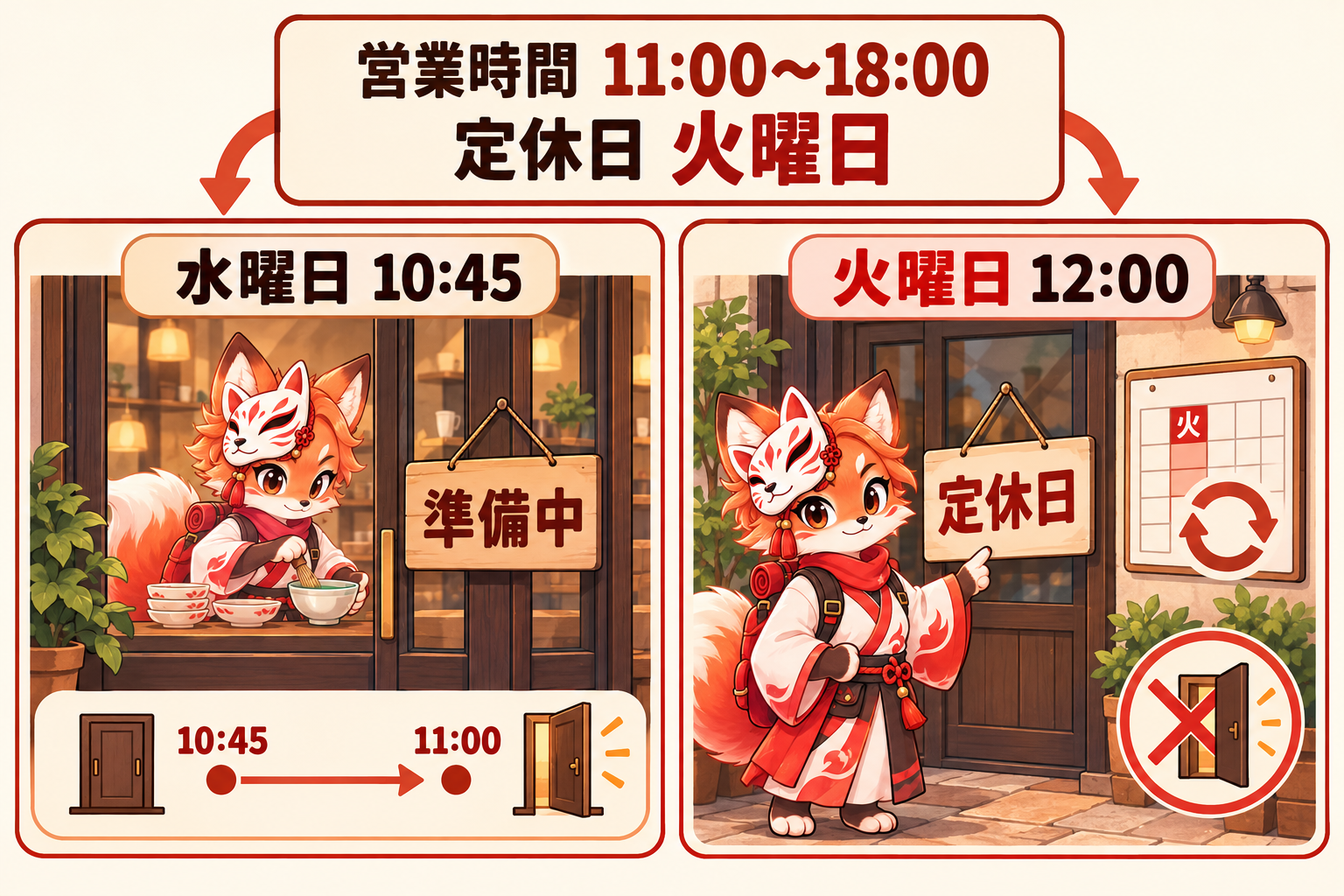
Follow the two arrows from the shared schedule. On Wednesday at 10:45, the timeline leads forward to opening at 11:00. On Tuesday at 12:00, the recurring closing day applies even though noon is inside the usual hours. The calendar changes the decision that the clock alone would suggest.
Use this entrance decision guide
- Look for a notice about today. If it says 本日休業 or gives a temporary closure covering today's date, plan another visit.
- Check the regular closing day. If today matches it, do not treat the printed opening hours alone as permission to enter.
- Read the current status. 営業中 points to business in progress; 準備中 points to preparation.
- If the signs conflict or the time is unclear, ask a short question and follow the answer.
The branches can be remembered like this:
Closure applies today? → Return another time.
No closure notice, but 準備中? → Check when service starts.
営業中? → Approach and check any remaining conditions.
Unclear? → Ask a staff member.
An annotated doorway dialogue
This original practice conversation takes place before the posted opening time. The customer stays at the entrance and a staff member comes over.
Customer: すみません。今、営業中ですか。
“Excuse me. Are you open for business now?”
The customer asks about the current status. 今 means now, and ですか makes this a polite question suitable for an unfamiliar staff member.
Staff: すみません。まだ準備中です。十一時からです。
“Sorry. We are still getting ready. We open at eleven.”
The second sentence leaves out the already understood business activity. 十一時から gives the starting time. Here it means eleven in the morning because the scene and posted hours establish that context.
Customer: わかりました。また来ます。
“Understood. I'll come back.”
また来ます makes the customer's next action clear without requesting early service. If you only need the opening time, ask 何時からですか, “What time do you open?” Use the answer rather than guessing from lights, movement, or an unlocked door.
Avoid these reading mistakes
Do not translate every occurrence of 中 as inside. In 営業中 and 準備中, the relevant meaning is an ongoing activity. Read the two expressions with ちゅう, not なか. Conversely, do not assume that every word ending in 中 uses that reading.
Do not read 準備中 as a promise that service will begin immediately. The sign gives a status, while 十一時から gives a time. Keep those two pieces of information separate. A person working inside may be preparing the shop rather than receiving customers.
Do not turn a regular closing day into a statement that the business has permanently shut. 定休日 describes a recurring day off. 本日休業 describes today, and 臨時休業 describes an exceptional interruption. For each notice, check the actual day or date before making a plan.
Practise one visit from start to finish
Write three cards for an imaginary shop: 準備中, 営業中, and 本日休業. Give the shop an opening time and a regular closing day. Turn over one card, choose a day and time, and say your next action aloud. For 準備中, ask 何時からですか. For 営業中, practise asking whether you can enter. For 本日休業, choose another day.
On your next real visit, read the status first, then check the schedule and any notice for that date. The goal is a small, useful decision: understand whether service is available now and know what to ask when the sign does not answer everything.