
Reading 時: Meaning Clues, Sound Clues, and Whole Words
これは私の時計です。
Kore wa watashi no tokei desu.
“This is my watch.”
You recognize 時 and remember the reading じ. Yet 時計 is とけい, not じけい. That small surprise teaches a useful habit: study a kanji's parts to organize what you see, then learn the pronunciation of the complete word. A component can help you remember a character without deciding every word that contains it.
This lesson uses one familiar character, 時, to practice that habit. By the end, you will be able to separate its radical from its other component and read a small set of everyday time expressions. You do not need to memorize a list of radical families or reconstruct ancient pronunciation.
Start with the shape
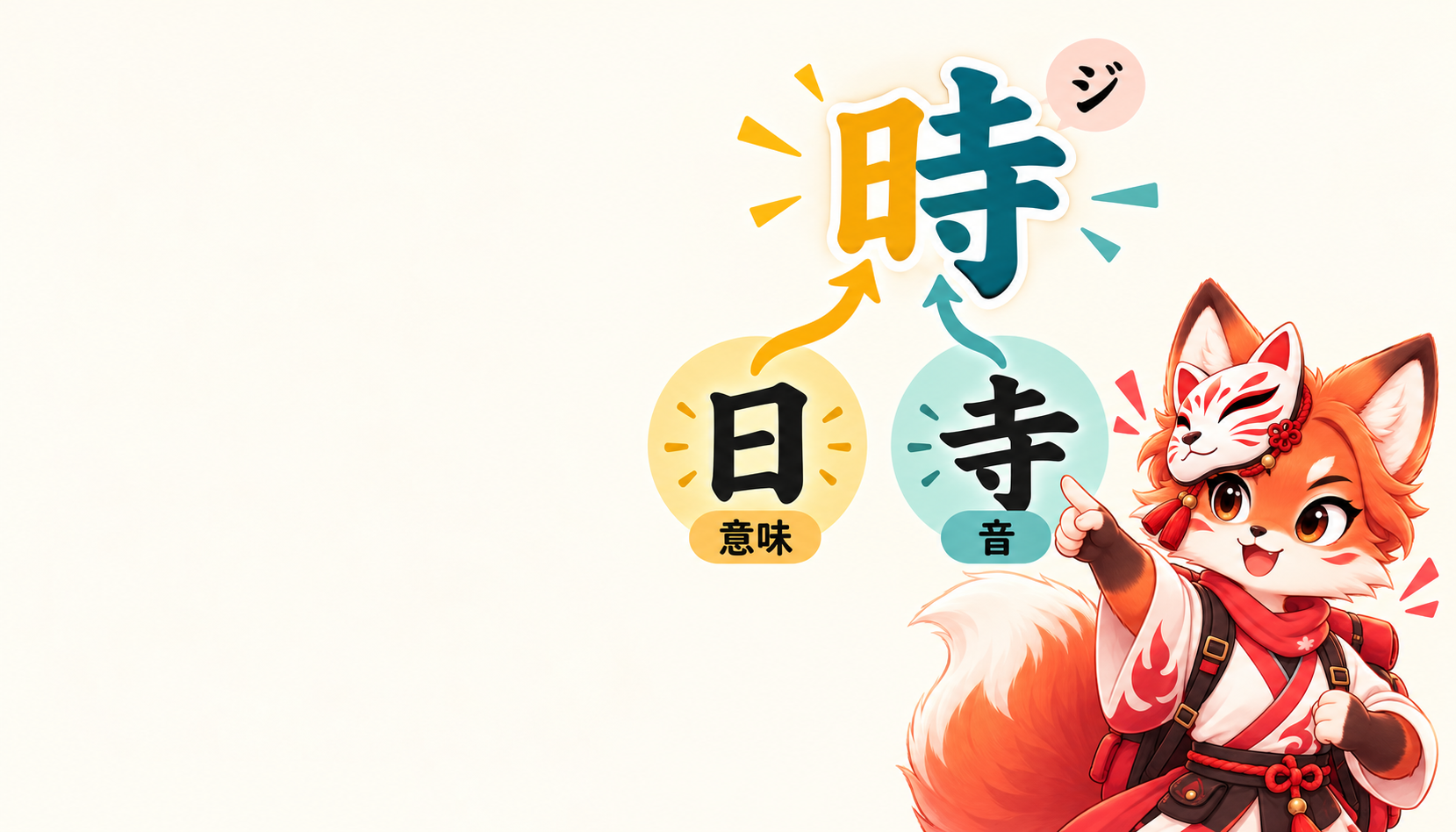
Look at 時 as two main visible pieces: 日 on the left and 寺 on the right. In Kanjipedia's classification, the radical is 日. Its left-side names include ひへん and にちへん. 寺 is another component in 時; it is not this character's dictionary radical. You can verify the classification in Kanjipedia's 日 radical index.
“Radical” names the part used to organize the dictionary entry. “Component” is a broader word for a piece of the written character. Those terms answer different questions. When identifying the radical of 時, give 日. When describing its main visible components, give 日 and 寺.
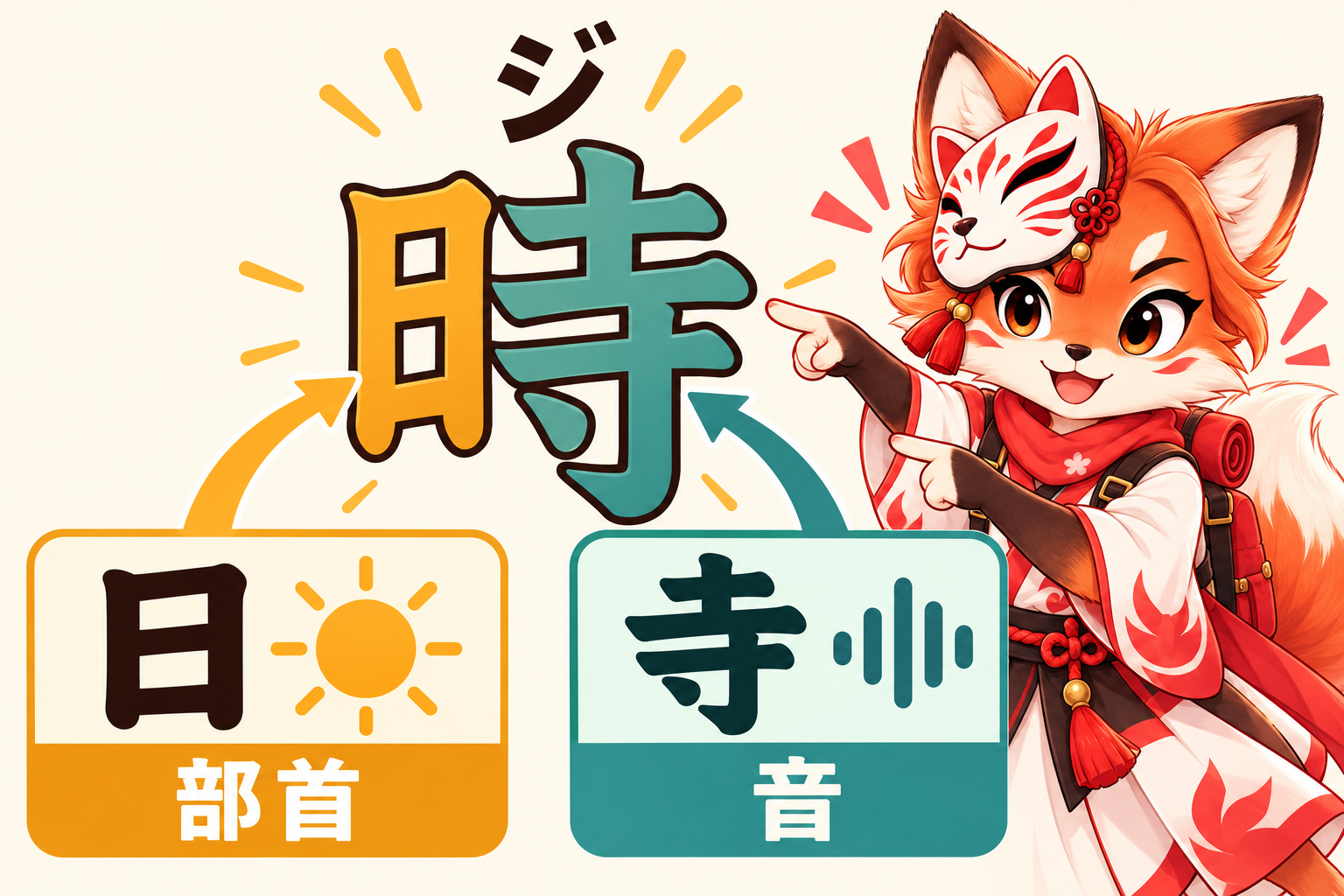
Follow the colored arrows in the illustration: they join two parts with different jobs into one character. The colors help you track the roles; they are learning aids rather than features of ordinary Japanese writing.
Separate the historical account from a memory aid
Kanjipedia describes 時 as a semantic-phonetic character: 日 contributes the meaning side, and 寺 is the phonetic component. That account connects the character with time and the passage of days.
For a present-day memory cue, link 寺 and 時 through their shared Japanese on-reading ジ. This cue helps recall; it does not reconstruct the original sound. 寺 also has the kun-reading てら and means a Buddhist temple, as its dictionary entry shows.
If you invent a picture of a temple bell reminding you of the time, label it in your notes as your mnemonic. It is not the historical explanation given here. Keep a separate space for verified character history and personal stories, so a memorable picture does not become a claim about the character's origin.
Compare complete expressions
The everyday readings you need here are ジ and とき. In learner materials, katakana commonly displays on-readings and hiragana displays kun-readings. In sentences, both can appear as ordinary kana when a reading is supplied. The Agency for Cultural Affairs' kanji index lists the readings and the special word 時計.
| Expression | Reading | Meaning here | What to learn |
|---|---|---|---|
| 時 | とき | time; a moment | Learn the word in context |
| 三時 | さんじ | three o'clock | A point on the clock |
| 一時間 | いちじかん | one hour | A length of time |
| 時間 | じかん | time | Learn the complete noun |
| 時計 | とけい | clock; watch | Remember this word's reading |
The table compares what each expression does. 三時 tells you a clock time; 一時間 tells you a duration. 時計 names the object you use to check the time. All three contain 時, but you cannot replace one with another merely because the written character is shared.
Avoid turning “many compounds use on-readings” into “every compound must use ジ.” Record 時計 together with とけい. Do not force it into a reading assembled from the first sound you remember for each kanji.
A reading decision guide
Use this branching guide when you meet one of the expressions from the table. It is a recognition aid for these examples, not a rule that generates every Japanese reading.
Find the whole expression containing 時.
│
├─ Is it 時計?
│  └─ Yes → とけい → a clock or watch
│
├─ Is it 三時?
│  └─ Yes → さんじ → three o'clock
│
├─ Is it 一時間?
│  └─ Yes → いちじかん → a duration of one hour
│
├─ Is it the noun 時間?
│  └─ Yes → じかん → time
│
└─ Is it another word or use of 時?
   └─ Check its reading and sentence meaning in a dictionary.
Start with the entire expression, then use the surrounding sentence to confirm what it means. If you see 時 alone in a new construction, look it up instead of automatically choosing a reading from this guide.
Put a clock time on a timeline
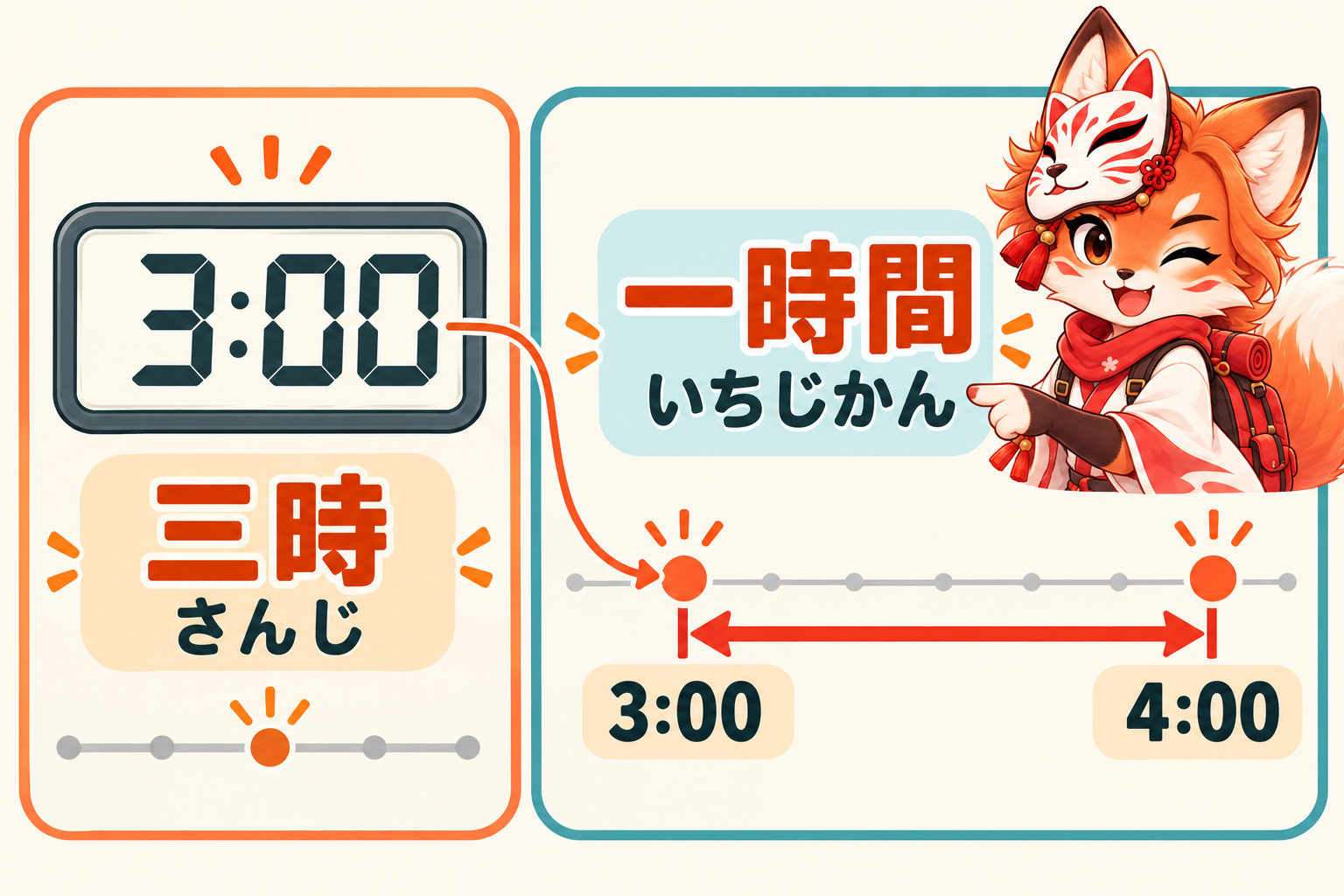
Imagine a conversation that starts at three and ends at four. The starting point is 三時. The elapsed length is 一時間.
三時 (3:00)                 四時 (4:00)
     ●━━━━━━━━━━━━━━━━━━━━━━●
           一時間 (one hour)
三時に会います。
Sanji ni aimasu.
“We will meet at three.”
一時間話します。
Ichijikan hanashimasu.
“We will talk for one hour.”
In these examples, に marks the meeting time. The duration 一時間 goes directly before 話します without に. These are ordinary polite sentences suitable for a basic conversation. The second illustration sets the clock point beside the measured span, so you can see why the two expressions answer different questions.
Read a short conversation
A: 何時に会いますか。
Nanji ni aimasu ka?
“What time shall we meet?”
B: 三時に会いましょう。
Sanji ni aimashō.
“Let's meet at three.”
A: 一時間ぐらい話しませんか。
Ichijikan gurai hanashimasen ka?
“Would you like to talk for about an hour?”
B: いいですね。
Ii desu ne.
“That sounds good.”
The first question asks for a clock time, and B supplies 三時. A's next line proposes a duration, softened by ぐらい, “about.” The invitation ending ませんか is polite; Tokyo University of Foreign Studies also describes this form's invitation function. Read the exchange once for meaning, then cover the readings and say 三時 and 一時間 again.
Check the word before trusting the clue
Try these short tasks without looking at the table.
- Read 時計 aloud in これは私の時計です。
- You want to say “three o'clock.” Choose 三時 or 一時間.
- You want to say “one hour.” Choose 三時 or 一時間.
- Identify the dictionary radical of 時.
- Explain the role of 寺 in the historical analysis used in this lesson.
Answers: 1. とけい. 2. 三時, さんじ. 3. 一時間, いちじかん. 4. 日. 5. It is the phonetic component.
For review, make a card with a complete Japanese expression on the front and its reading, meaning, and one short sentence on the back. Keep 三時 and 一時間 on separate cards, and give 時計 its own card. Say the answer before turning the card over. If you miss it, correct the complete word rather than adding an invented reading rule.
日本語で確認: 時の部首は日です。三時は「さんじ」、一時間は「いちじかん」、時計は「とけい」と読みます。
For further practice with everyday clock times, see the Japan Foundation's Irodori Starter, Lesson 9. The character history above follows Kanjipedia; the practice sentences and learning diagrams here are teaching examples.