
Reading 木・林・森: How Repeated Parts Build Meaning
Reading 木・林・森: How Repeated Parts Build Meaning
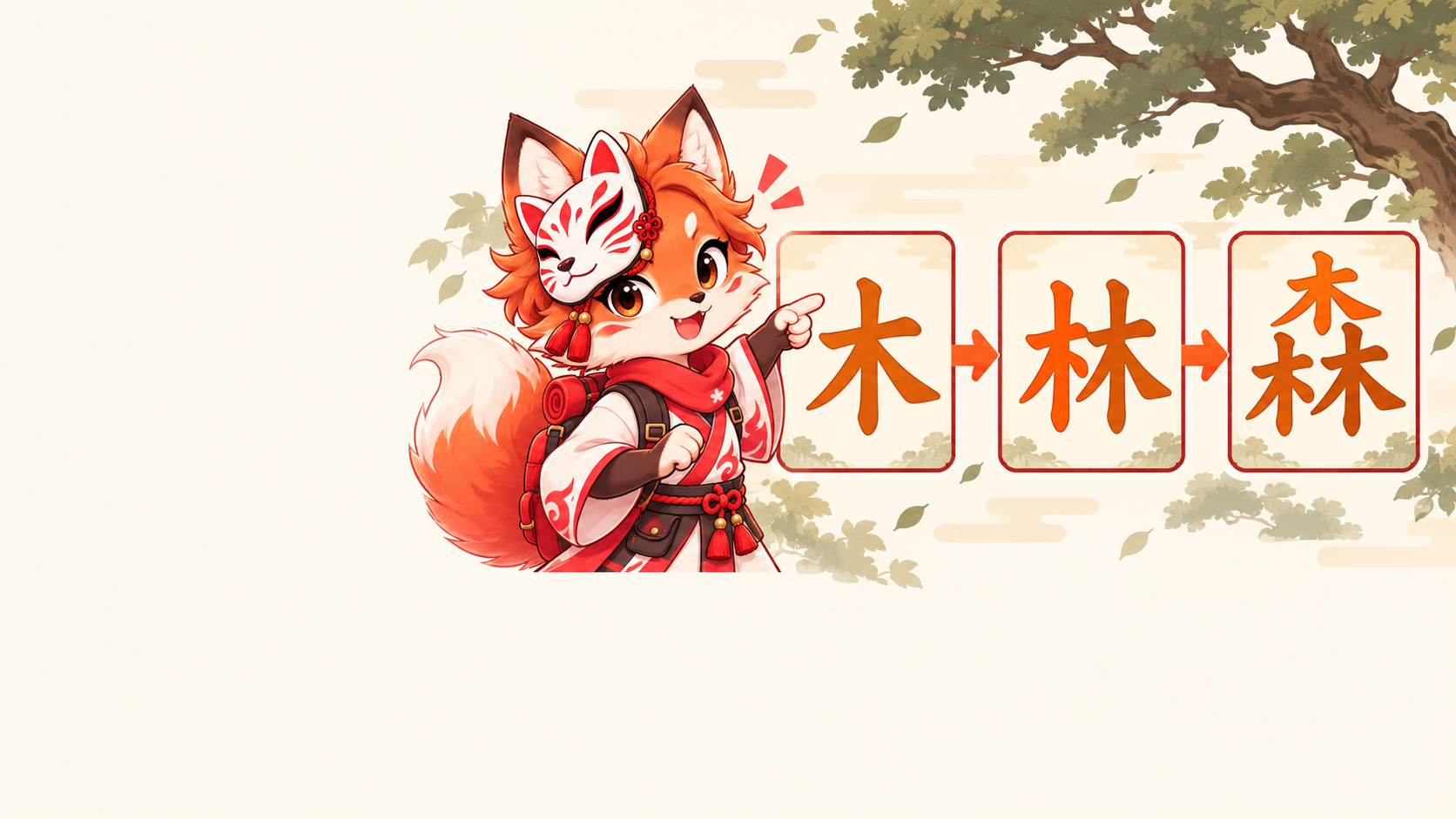
Look at 木, 林, and 森 before trying to pronounce them. The same tree-shaped part appears once, twice, and three times. That visible relationship gives you a useful way to remember the characters. It does not tell you every word's pronunciation, and it does not mean that a real forest contains exactly three trees.
This lesson connects shape, meaning, and a small set of usable words. By the end, you can recognize the arrangement of each character, read 木(き), 林(はやし), 森(もり), and 森林(しんりん), and describe a simple outdoor scene. Keep the whole word beside its reading as you practise. Recognizing a component and reading a word are separate skills that work together.
Start with a tree, then notice the arrangement
Kanjipedia's entry for 木 classifies it as a pictograph based on a standing tree. You can use the vertical line as a reminder of the trunk and the spreading strokes as a reminder of the tree's shape. That is a memory aid for the modern character, not an exact drawing of every historical stage.
林 combines two 木 side by side to express trees growing together. 森 combines three 木 to express many trees. These two characters illustrate 会意(かいい), combining meaningful elements to express a meaning. You do not need to memorize that classification to use the words, but it explains why the repeated shapes are helpful.
Notice placement as well as repetition. In 林, the two parts sit beside each other. In 森, one sits above the lower pair. Each arrangement fits inside one character space. A row of three separate characters, 木木木, is not the standard spelling of 森. When copying, look at the entire square before focusing on individual strokes.
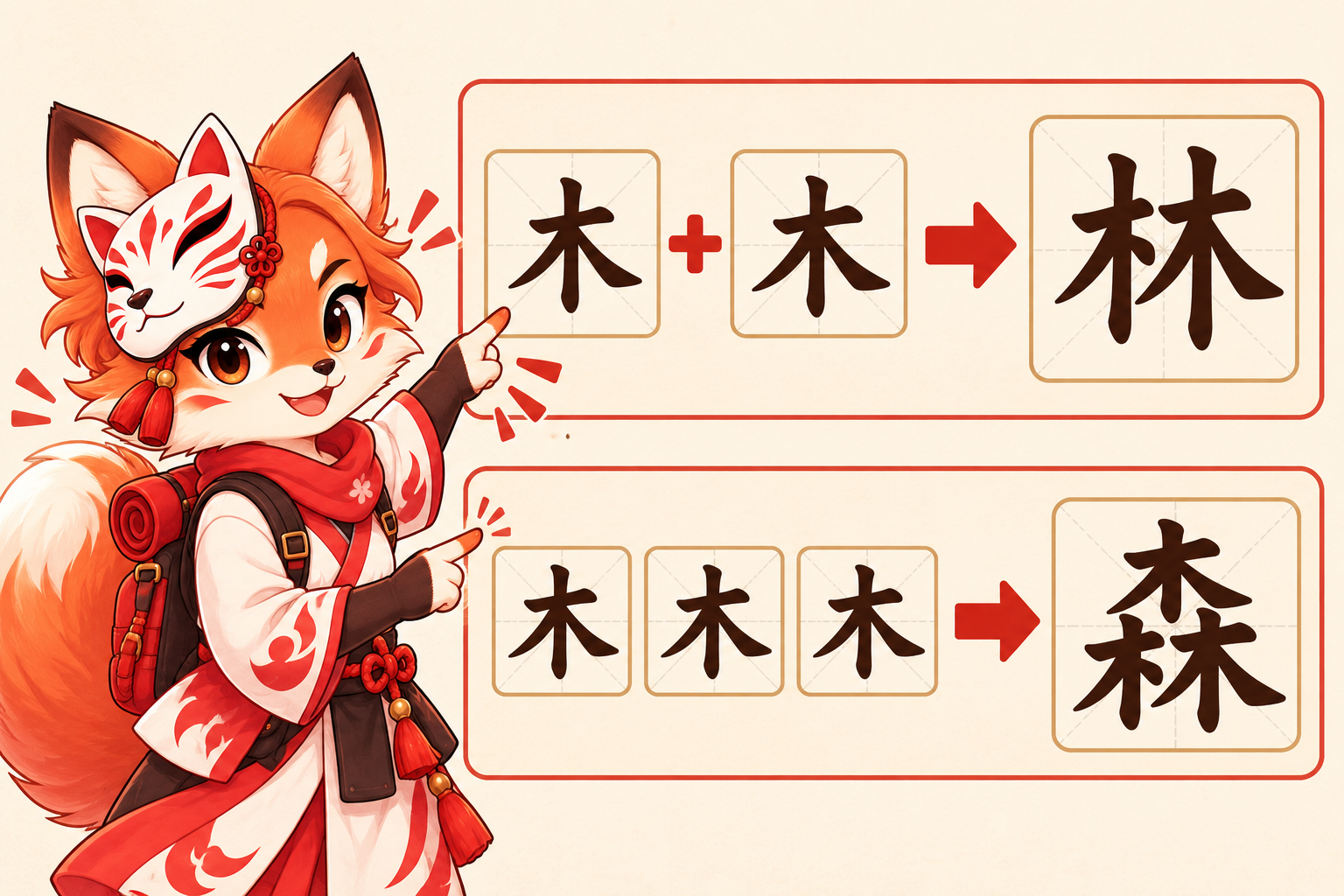
The upper row combines two components into 林; the lower row arranges three into 森. The arrows connect separate parts to a single written character, not stages in the growth of a forest.
Compare the characters and the words
| Written form | Arrangement | Reading in this word | Useful meaning |
|---|---|---|---|
| 木 | One tree-shaped character | き | Tree; wood, depending on context |
| 林 | Two 木 side by side in one character | はやし | A wood or grove |
| 森 | Three 木 in one character | もり | A forest |
| 森林 | Two complete characters, 森 then 林 | しんりん | Forest; forested area |
The translations help you begin, but they are not a measurement chart. Do not count two real trees and automatically call them 林. The repeated components explain the written design; ordinary words describe places in context. For this lesson, learn each word with a phrase rather than trying to decide every possible boundary between woods and forest.
A reading path you can follow
Follow this reading decision guide before saying a word aloud:
- Find the boundaries of the complete word. A component inside one kanji is not a separate spoken word.
- If you recognize one of the four words below, retrieve its complete reading from the matching branch.
- If the combination is unfamiliar, check that whole word in a dictionary and record its reading beside it.
- Read the complete example sentence aloud, keeping the word reading you checked.
Use the branches below for the four words in this lesson:
Look at the complete written word
  ├─ 木 by itself in this lesson → き
  ├─ 林 by itself in this lesson → はやし
  ├─ 森 by itself in this lesson → もり
  └─ 森林 as one word → しんりん
New combination? → Check the whole word → Record its reading and meaning
The branches are examples for these words, not a rule that every single character has only one reading. In 森林, 森 contributes シン and 林 contributes リン. Kanjipedia records the complete word as シンリン. The usual readings もり and はやし do not simply join together here. Reading 森林 as もりはやし would miss the established word.
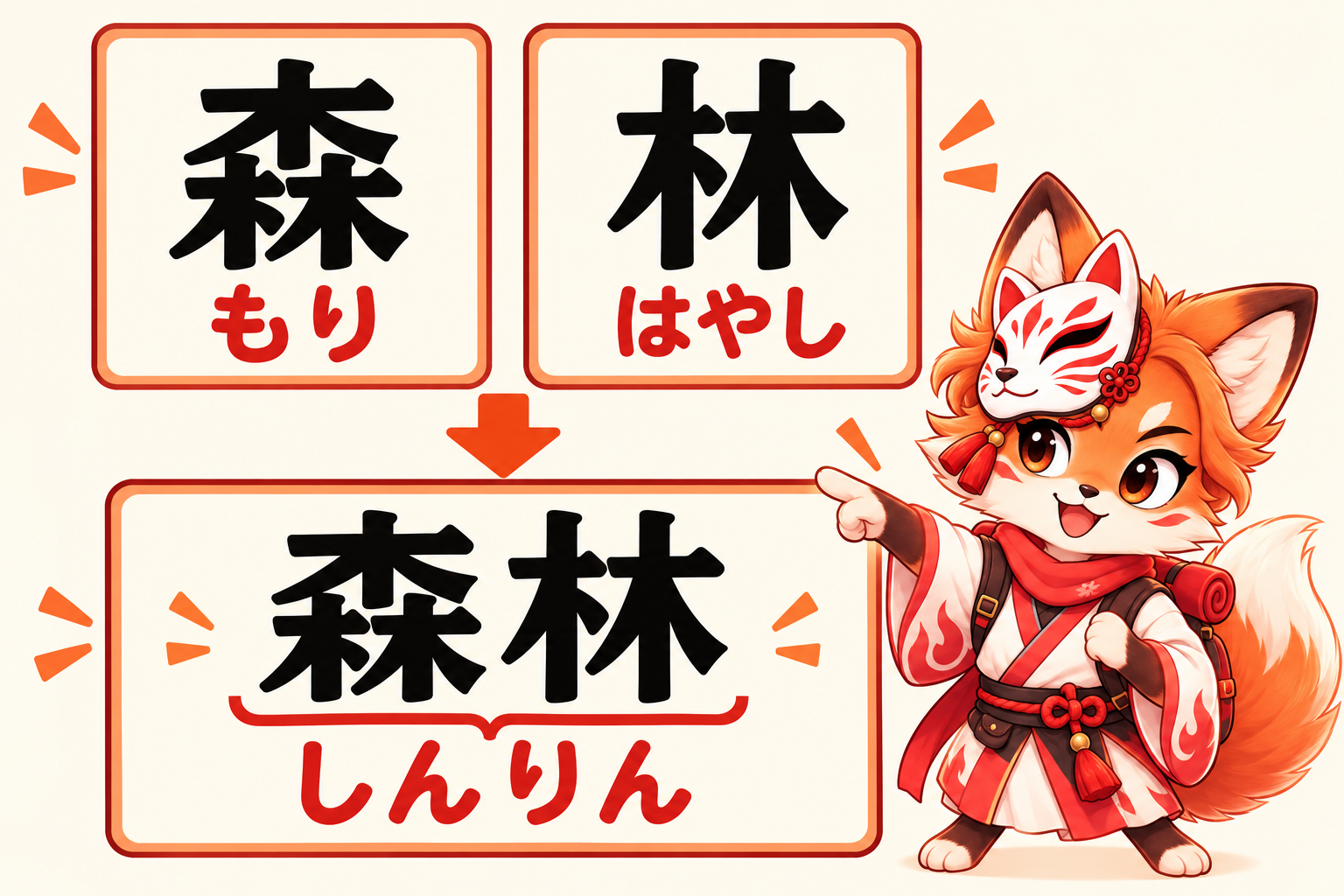
The upper cards read もり and はやし separately. The downward arrow leads to 森林 with the grouped reading しんりん. Read the lower card as one word rather than joining the two upper readings.
These are ordinary nouns. Their politeness comes from the sentence around them. 森です is a polite identification, while 森だ is a plain identification. The character itself does not become more formal because you add another 木-shaped component.
Put the words into natural sentences
庭に大きな木があります。
にわに おおきな きが あります。
There is a large tree in the garden.
Here 木 names the tree. 庭に tells you where it is, and あります states that it exists. The sentence gives you a concrete picture to connect with the written word.
家の近くに林があります。
いえの ちかくに はやしが あります。
There is a wood near my house.
日曜日に森を歩きました。
にちようびに もりを あるきました。
I walked through the forest on Sunday.
In the last sentence, を marks the area traversed. It does not make the forest an object that someone picks up or changes. You can also describe an activity's location with 森で: 森で写真を撮りました。 means “I took photographs in the forest.” Read it もりで しゃしんを とりました. The particles serve different jobs, so learn the complete sentence with its intended meaning.
この地域には森林が多いです。
この ちいきには しんりんが おおいです。
There are many forests in this region.
This sentence uses 森林 as a whole vocabulary item. It describes a region rather than pointing to an individual tree. You can recognize both characters while still retrieving one complete reading.
Read an annotated conversation
Two friends are looking at a map before a walk. The dialogue below is a practice example, not a quotation from a real exchange.
1. Notice the trees. A: この公園には大きな木がありますね。
この こうえんには おおきな きが ありますね。
There are large trees in this park, aren't there?
Annotation: 木(き)names the trees; この公園には places them in the park.
2. Add another place. B: はい。公園の向こうには森もあります。
はい。こうえんの むこうには もりも あります。
Yes. There is also a forest beyond the park.
Annotation: 森(もり)introduces the forest, and も adds the meaning “also.”
3. Suggest an activity. A: じゃあ、森で写真を撮りましょう。
じゃあ、もりで しゃしんを とりましょう。
Then let's take photographs in the forest.
Annotation: 森で marks the activity's location, and 撮りましょう makes the suggestion “let's take.”
First, A mentions individual trees. B introduces another place with も, “also.” Finally, A proposes an activity there. Notice that 木 can refer to more than one tree in context; Japanese nouns do not require an English-style plural ending. The diagram's single 木-shaped component therefore does not force a singular translation in every sentence.
Avoid these shortcuts
Do not pronounce every visible 木 as き inside a larger character. 林 is はやし in the standalone word here, not きき. 森 is もり, not ききき. A component helps you recognize the writing without becoming a separate spoken syllable.
Do not treat the sequence 木・林・森 as a formula for inventing new kanji. It is a useful family to study, not permission to assemble any number of components and assume the result is a standard character. Likewise, shared appearance alone does not establish another character's historical origin.
Do not turn the illustrations into ecological definitions. A picture may show a few representative trees to explain the characters. It cannot establish a fixed tree count or prove whether a place is natural or planted. Keep those real-world questions separate from this writing lesson.
Practise with a scene of your own
Fold a page into a writing side and a reading side. On the writing side, copy 木, 林, 森, and 森林, keeping the components inside their character spaces. On the reading side, write き, はやし, もり, and しんりん. Cover one side and retrieve the other, then reverse the exercise.
Finish by choosing one scene you can describe accurately. Say 庭に木があります if there is a tree in the garden, or 森で写真を撮りました if you took photographs in a forest. Change the place or time to fit your own experience. The goal is to connect a recognizable written shape with a complete word and a sentence you can actually use.