
Talk About Experiences With 〜たことがある
Talk About Experiences With 〜たことがある
温泉に入ったことがありますか。
おんせんに はいったことが ありますか。
Have you ever been in a hot spring?
This question asks whether the experience belongs to your past. It does not ask which hot spring you visited yesterday or whether you have finished bathing today. A simple answer can open a conversation about travel, food, hobbies, or work. You can say that you have done something, say that you have never done it, and then add a detail your listener can respond to.
The pattern is verb in the た-form + ことがある. Its polite version ends in ことがあります. This lesson follows one small conversation task: ask about an experience, answer accurately, and move from the general experience to one specific memory.
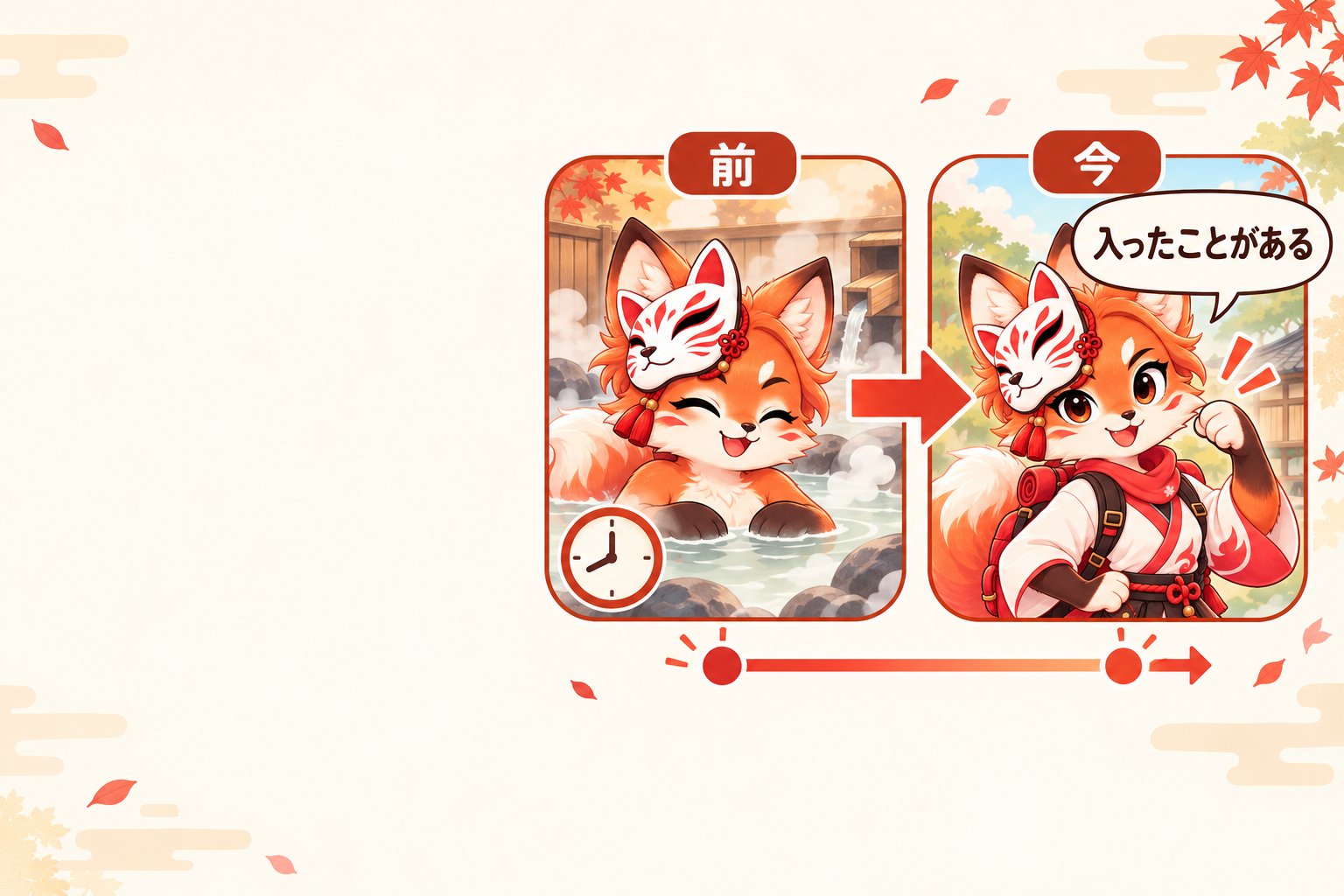
The cover shows a past hot-spring visit on the left of an arrow and the mascot speaking now on the right. The timeline links that earlier visit to 入ったことがある, an experience the speaker has now. The two panels do not show a daily habit or a plan for tomorrow.
Build the experience expression
Start with the verb's plain た-form, not its polite ました form. Then attach ことがあります. The name “た-form” includes forms ending in だ, such as 読んだ. If you know a verb's て-form, change its final て to た or its final で to だ. Irodori Lesson 8 presents this attachment and a useful conjugation chart.
Follow these complete chains:
- 見る → 見て → 見た → 見たことがあります: have seen.
- 読む → 読んで → 読んだ → 読んだことがあります: have read.
- 行く → 行って → 行った → 行ったことがあります: have been.
- する → して → した → したことがあります: have done.
Say each final expression aloud rather than stopping at the middle form. Pay attention to 行った: 行く does not become 行いた. For 食べる, the chain is 食べて → 食べた → 食べたことがあります. Changing the politeness of the whole expression does not require 食べました before こと.
日本の小説を読んだことがあります。
にほんの しょうせつを よんだことが あります。
I have read a Japanese novel.
Here 読んだ names the experience, while あります gives the sentence its polite ending. The experience is in the past even though the final verb is not ありました. For the ordinary task of saying what you have experienced up to now, keep あります.
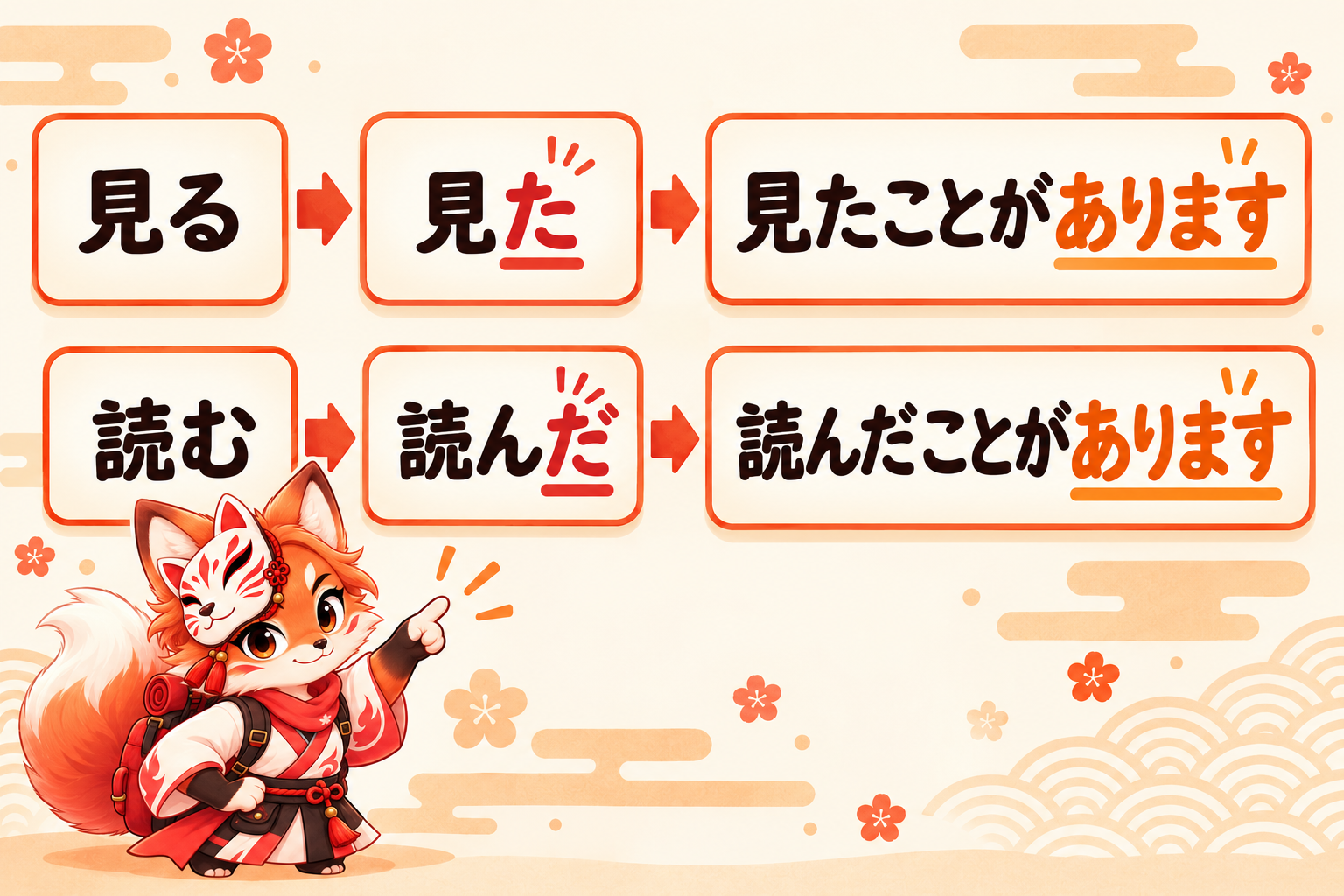
The upper arrow sequence changes 見る to 見た before adding ことがあります. The lower sequence does the same with 読む and 読んだ. Both final expressions keep the plain inner verb and use あります for the polite ending.
Put a memory on the timeline
Imagine a line running from earlier in your life to now. If at least one relevant event belongs on that line, you can answer with 〜たことがあります. The expression does not specify the event's date or establish how skilled you are. Mango Languages explains the experience construction and its negative forms.
着物を着たことがあります。
きものを きたことが あります。
I have worn a kimono.
This tells your listener that wearing a kimono is among your experiences. It does not mean that you wear one every day or can put one on without help. Choose a separate sentence if you want to describe a habit or ability.
| What you want to communicate | Japanese example | Meaning |
|---|---|---|
| A past experience | 温泉に入ったことがあります。 | I have been in a hot spring. |
| No such experience | 温泉に入ったことがありません。 | I have never been in a hot spring. |
| A specific past event | 昨日、温泉に入りました。 | I went in a hot spring yesterday. |
| A regular habit | 毎週、温泉に入ります。 | I go in a hot spring every week. |
For a straightforward report of yesterday's activity, use the ordinary past form. Do not add ことがあります to every sentence just because an event happened before now. Tofugu's usage discussion distinguishes an experience statement from a simple report of a recent event. The table compares communicative purposes; it is not a ban on mentioning time anywhere in a longer conversation.
Choose an answer, then continue
Use this branching guide when someone asks about an experience:
Have you ever done this? → Vたことがありますか
  ├─ Yes → はい、あります
  │        └─ Add one detail → place, time, or impression
  └─ No → いいえ、ありません
           └─ If useful → say whether you want to try
A: 歌舞伎を見たことがありますか。
かぶきを みたことが ありますか。
Have you ever seen kabuki?
B: はい、あります。東京で見ました。
はい、あります。とうきょうで みました。
Yes, I have. I saw it in Tokyo.
The first answer confirms the experience. The second sentence supplies a place with the ordinary past form. You do not need to repeat the entire question in every answer. This short-answer pattern also appears in Tokyo University of Foreign Studies' experience dialogue.
If the answer is no, the full expression is 見たことがありません. Another polite conversational option is 見たことがないです. In both, the negative ending denies having the experience; 見た stays in the た-form.
まだ歌舞伎を見たことがありません。
まだ かぶきを みたことが ありません。
I have not seen kabuki yet.
まだ adds “not yet.” It leaves room for a future experience but does not promise that you will arrange it. If you want to express interest, add 見たいです, “I want to see it.” Interest and experience are different pieces of information.
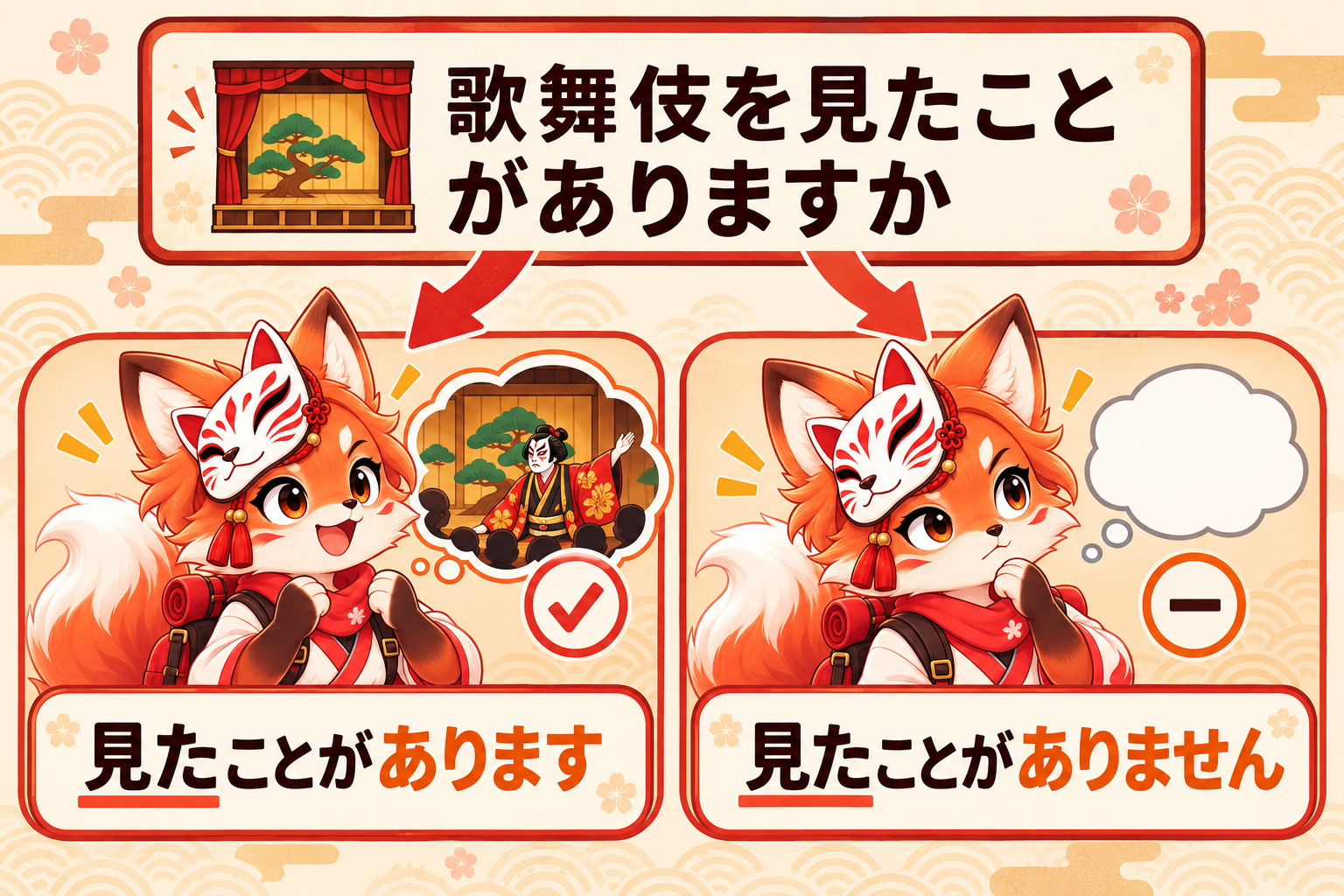
The question at the top branches to two valid answers. The left memory bubble contains a theatre visit; the right bubble is empty because that experience has not happened. Both answer cards keep 見た, while あります and ありません distinguish the replies.
Read the conversation in two stages
The following is an original practice dialogue between acquaintances discussing an outing.
A: この美術館に行ったことがありますか。
この びじゅつかんに いったことが ありますか。
Have you ever been to this art museum?
B: はい、一度行ったことがあります。去年、友だちと行きました。
はい、いちど いったことが あります。きょねん、ともだちと いきました。
Yes, I have been once. I went with a friend last year.
A: どうでしたか。
どうでしたか。
How was it?
B: おもしろかったです。写真の展示がよかったです。
おもしろかったです。しゃしんの てんじが よかったです。
It was interesting. The photography exhibition was good.
Read A's first question as the experience stage. Read the remaining lines as the detail stage. 一度(いちど) means “once”; it adds a count without turning the sentence into a regular habit. 去年 and 友だちと then locate one memory. B finally offers an opinion that gives A something more specific to discuss.
Recognize casual forms in their setting
In a conversation between close friends, you may hear 行ったことある?, “Have you been?” This is a casual question: the ending is plain ある and が is omitted. Recognize it when listening to friends, but keep 行ったことがありますか for this lesson's speaking practice. With a new acquaintance, teacher, or colleague in a formal exchange, start with the full polite pattern rather than copying a friend's shortened question.
The question's ending and particle omission are separate features. 行ったことありますか can also occur in polite conversation with が omitted, as shown in Irodori Lesson 8. Omission alone therefore does not establish the whole sentence's politeness. Choose a complete sentence that suits the relationship; for a clear polite reply in practice, use はい、あります or いいえ、ありません.
Check the meaning before speaking
For “I have never eaten it,” say 食べたことがありません. Do not change it to 食べませんでした, which reports that you did not eat on a particular past occasion. Also avoid 食べましたことがあります when practising the experience pattern: the attachment needs 食べた.
Keep the verb's original particles: 小説を読む becomes 小説を読んだことがあります, while 美術館に行く becomes 美術館に行ったことがあります. Adding こと does not replace を or に.
Finally, do not substitute a dictionary form and assume the meaning stays the same. 食べることがある can describe eating something occasionally. For the past-experience meaning in this lesson, retrieve 食べたことがある as a complete pattern.
Try a short experience interview
Choose three topics you can discuss honestly: a place, a food, and an activity. Prepare one question for each, such as 温泉に入ったことがありますか or 着物を着たことがありますか. Answer with あります or ありません, then add one useful sentence. A positive answer can lead to a place or impression. A negative answer can lead to a wish, if you actually have that wish.
Practise both roles aloud. Keep the experience question broad, and use an ordinary past sentence when you move to a particular memory. By the end of the exchange, your partner should know both whether you have had the experience and one concrete thing you want to say about it.