

Talk About Your Weekend With 〜たり〜たりする
「日曜日は何をしましたか。」 Someone asks what you did on Sunday. You read a manga, cooked lunch, listened to music, and took a walk. You probably do not need to report every activity in order. A useful answer is 漫画を読んだり、音楽を聞いたりしました。 “I did things like reading manga and listening to music.”
The two activities are examples from your day. You are giving the listener a picture of how you spent your time, with room for other activities. This lesson helps you build that kind of answer, change its time reference, and avoid accidentally presenting it as an itinerary.
Pick examples that answer the question
The pattern is verb in the た-form + り、verb in the た-form + り + する. In a polite sentence, the final verb can be します or しました. The activities you mention should fit the question or topic. If someone asks about your weekend, reading and walking fit naturally. If someone asks what you do at a language club, choose activities from the club.
日本語のクラブでは、歌を歌ったり、ゲームをしたりします。
“At the Japanese club, we do things like singing songs and playing games.”
You have named representative activities without claiming that these are the club's entire programme. You also have not said which one happens first. The Japan Foundation and Tokyo University of Foreign Studies describe this pattern as listing examples of actions, with other relevant actions left unmentioned. TUFS grammar explanation
For your first practice, choose two familiar actions. Two is a manageable learning frame, rather than a claim that Japanese always requires exactly two items.
Build each activity from its た-form
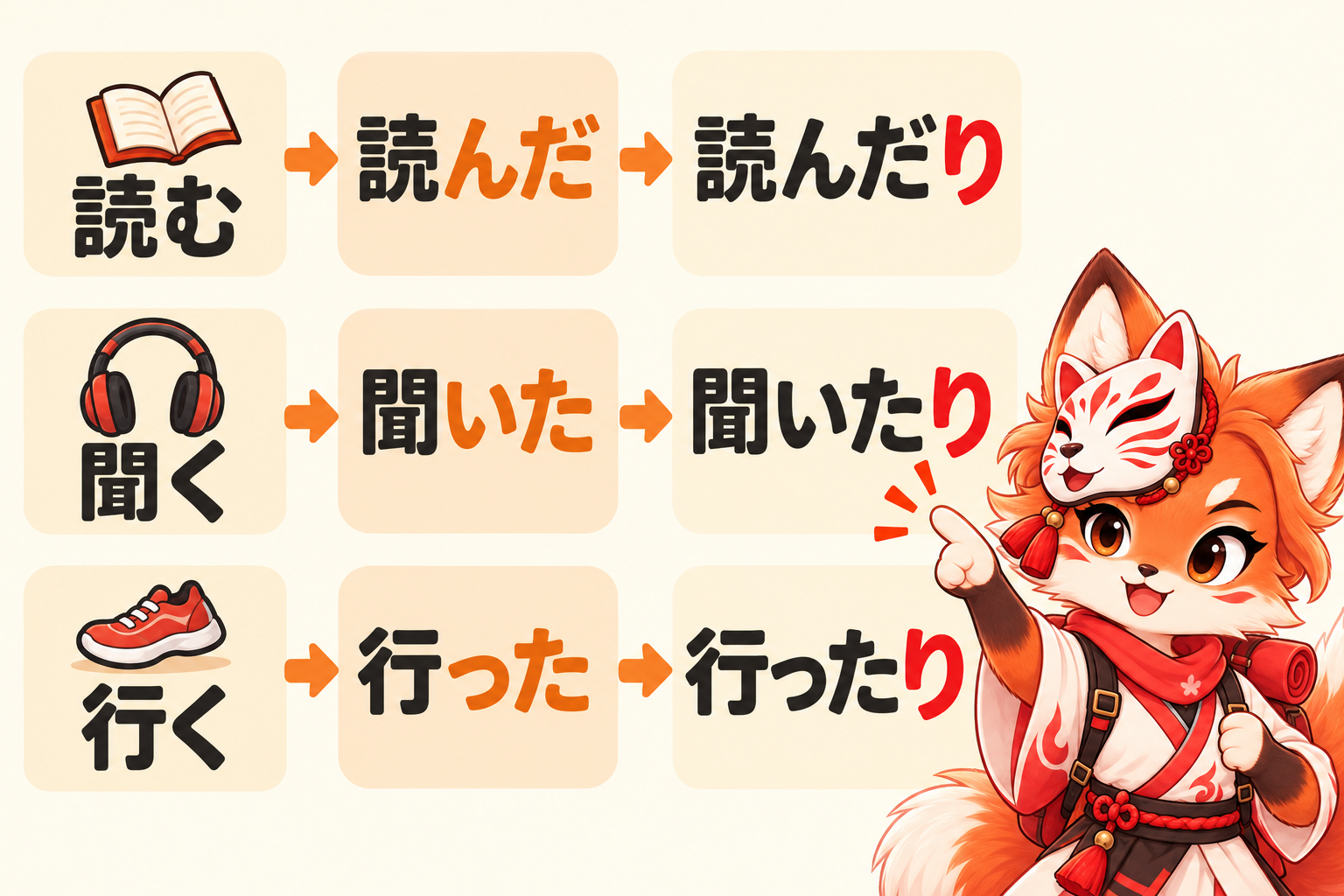
Keep the object and particle, then change the verb. 本を読む becomes 本を読んだり. 音楽を聞く becomes 音楽を聞いたり. Do this to both activities before adding the ending.
| Dictionary form and meaning | Plain past form | Form used in the list |
|---|---|---|
| 読む(よむ), read | 読んだ | 読んだり |
| 聞く(きく), listen | 聞いた | 聞いたり |
| 食べる(たべる), eat | 食べた | 食べたり |
| 行く(いく), go | 行った | 行ったり |
| する, do | した | したり |
| 来る(くる), come | 来た(きた) | 来たり(きたり) |
Notice the difference between 読んだり and 聞いたり. You are attaching り to the correct past form, rather than attaching たり directly to the dictionary form. 行く has the exceptional past form 行った, so its listed form is 行ったり. 来たり is read きたり here. These forms follow the standard た-form patterns in Marugoto's conjugation reference and the University of Texas ta-form chart.
Try saying the transformation aloud: 読む → 読んだ → 読んだり. Then build a whole answer: 家で本を読んだり、料理をしたりしました。 “At home, I did things like reading and cooking.” The particles を and で still do their ordinary jobs; the new pattern connects the activities.
Let the ending carry the time reference
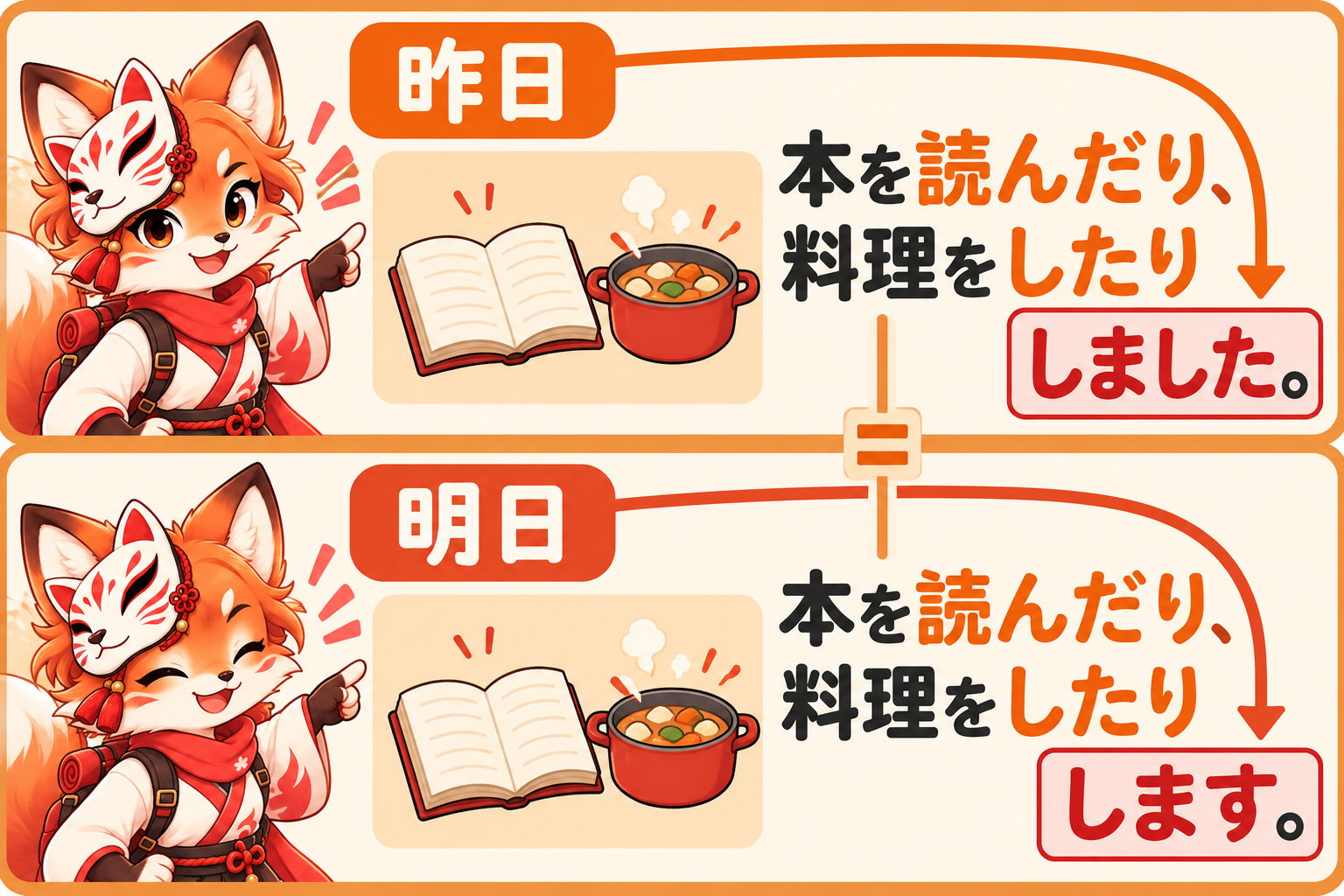
The た inside 読んだり does not, by itself, make the whole sentence past. Compare these three answers:
| Situation | Complete answer | Meaning |
|---|---|---|
| Your usual days off | 休みの日は、本を読んだり、料理をしたりします。 | On days off, I do things like reading and cooking. |
| Last Sunday | 先週の日曜日は、本を読んだり、料理をしたりしました。 | Last Sunday, I did things like reading and cooking. |
| Tomorrow's plans | 明日は、本を読んだり、料理をしたりします。 | Tomorrow, I will do things like reading and cooking. |
The listed forms stay the same. The ending and time expression tell the listener how to place the activities. Japanese nonpast します can describe a habit or a future action in context. You can also use a plain ending with friends: 週末は、映画を見たり、料理をしたりする。 “On weekends, I do things like watching films and cooking.” The pattern itself is useful in ordinary conversation; choose the final polite or plain form to suit the relationship.
When describing an ongoing routine, you may hear 〜たり〜たりしています. For example, 最近は、歩いたり、家で運動したりしています。 “Lately, I have been doing things like walking and exercising at home.” Marugoto's lesson on regular activities uses this ending for examples of things someone does regularly.
Use this speaking guide
Follow this decision tree before building your answer:
What information does the listener need?
├─ Examples of your activities
│  └─ Choose two relevant actions → Vた + り、Vた + り
│     ├─ Completed day → しました
│     └─ Habit or future plan → します
└─ A clearly ordered sequence
   └─ First action in て-form + から → next action
For the examples branch, keep each complete activity: 漫画を読む and 音楽を聞く become 漫画を読んだり、音楽を聞いたり. Then choose the ending that fits the question. For the sequence branch, identify which action must happen first before connecting it to the next.
If the order matters, make it explicit instead. 図書館に行ってから、昼ご飯を食べました。 means “After going to the library, I ate lunch.” Here, 〜てから makes the sequence clear. By contrast, 図書館に行ったり、昼ご飯を食べたりしました presents activities as examples. It does not establish that the library visit came first.
This is a choice about what information your answer needs. A friend asking how you relaxed may welcome examples. Someone arranging when to meet you may need an ordered schedule. Choose the sentence that gives them the information they need.
Listen for the job of each line
A:日曜日は何をしましたか。
“What did you do on Sunday?”
The question asks about a completed day, so prepare a past ending.
B:家で漫画を読んだり、音楽を聞いたりしました。
“At home, I did things like reading manga and listening to music.”
B gives two examples of leisure activities. 家で tells us where they happened.
A:何の漫画を読みましたか。
“What manga did you read?”
A chooses one activity for a follow-up question. A list of examples gives the conversation several useful directions.
B:スポーツの漫画を読みました。
“I read a sports manga.”
B now gives a specific detail with an ordinary past sentence. There is no need to keep using たり after the conversation narrows to one fact.
Repair these common slips
読むたり misses the necessary transformation. Build 読んだ first, then add り: 読んだり. Likewise, use 聞いたり, rather than 聞くたり.
本を読んだり、映画を見ました loses the balanced listing pattern this lesson is practising. For a complete model answer with two examples, use 本を読んだり、映画を見たりしました。 Both examples receive り, followed by the final verb.
昨日、本を読んだり、料理をしたりします has a time mismatch when you mean completed activities yesterday. Use しました for that intended meaning. Conversely, you do not need しました just because the individual listed verbs contain た.
You may encounter shorter or more elaborate uses in real conversation. This lesson focuses on complete two-activity answers so that the formation and ending remain easy to check. The Japan Foundation's teacher notes also note that an example list can contain a single verb.
Make it your own
Choose two activities from your actual weekend. First write their dictionary forms with objects: for example, コーヒーを飲む and 映画を見る. Convert them to コーヒーを飲んだり、映画を見たりしました。 “I did things like drinking coffee and watching a film.”
Now move the same pair into tomorrow: 明日は、コーヒーを飲んだり、映画を見たりします。 Finally, add one follow-up detail, such as 映画は家で見ます。 “I will watch the film at home.” This gives you a flexible speaking routine: a brief overview, then one concrete detail the listener can respond to.