
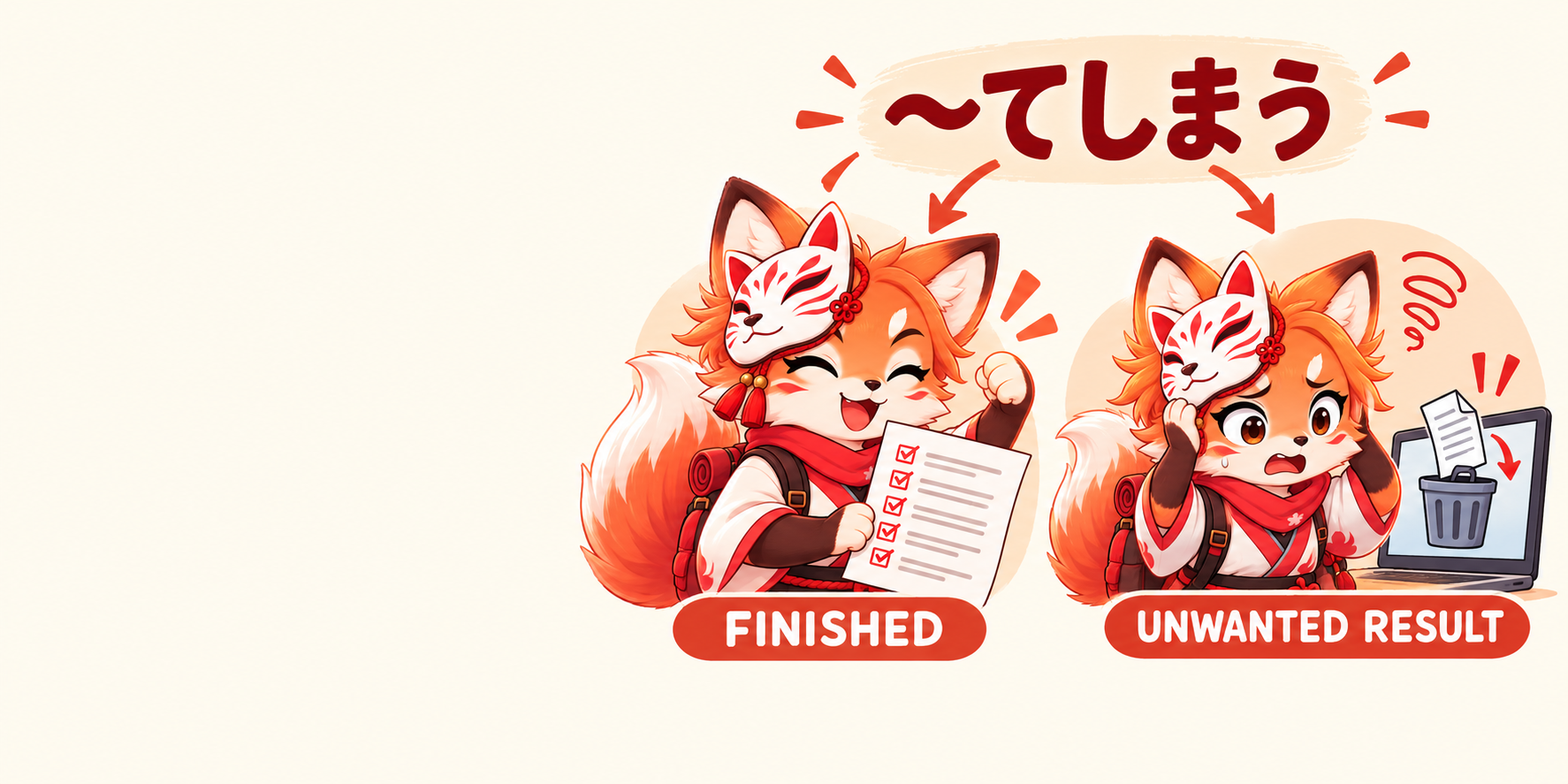
Understanding 〜てしまう in Everyday Japanese
Understanding 〜てしまう in Everyday Japanese
レポートを全部書いてしまいました。 “I have finished writing the whole report.” Someone has cleared a task from their list. Now compare 大事なファイルを消してしまいました。 “I accidentally deleted an important file.” The second speaker has a problem. Both sentences use 〜てしまう, but translating both with “unfortunately” would distort the first situation.
Your goal is to describe a completed action or an unwanted result, then use the surrounding situation to interpret the speaker's attitude. You will also learn to recognize 〜ちゃう and 〜じゃう, the shorter forms heard in everyday conversation. Learn the full forms first so you can expand a short expression when you hear it.
Build the expression from the て-form
Attach しまう to a verb's て-form. Keep the verb's normal て or で ending: 書く becomes 書いて, while 読む becomes 読んで. The resulting expressions are 書いてしまう and 読んでしまう. Do not attach しまう directly to the dictionary form or the ます-stem.
The final しまう carries the tense and level of politeness. 書いてしまいます is polite nonpast; 書いてしまいました is polite past; 書いてしまった is plain past. “Nonpast” matters here because the expression can describe something you intend to finish later. It does not automatically mean that an accident has already happened.
| Dictionary form | て-form | Full plain nonpast | Conversational plain nonpast |
|---|---|---|---|
| 食べる, eat | 食べて | 食べてしまう | 食べちゃう |
| 読む, read | 読んで | 読んでしまう | 読んじゃう |
| 書く, write | 書いて | 書いてしまう | 書いちゃう |
| 買う, buy | 買って | 買ってしまう | 買っちゃう |
| する, do | して | してしまう | しちゃう |
Read the whole path 買う → 買って → 買ってしまう → 買っちゃう. The portion 買っ remains through the last two steps, including its small っ. Likewise, 読む → 読んで → 読んでしまう → 読んじゃう follows the voiced path, rather than adding ちゃう to 読み. The table compares complete expressions; the choice between them does not by itself reveal the speaker's attitude.
Finish a bounded task
Imagine that you need to leave at six and still have a short report to write. You decide to clear it first:
出かける前に、このレポートを書いてしまいます。
“I will finish writing this report before I go out.”
The report gives the action a recognizable endpoint. In this context, 〜てしまいます presents the work as something to get finished. You are making a plan, not confessing a mistake. After completing it, you can say レポートを全部書いてしまいました。 “I have finished writing the whole report.”
残りのページを読んでしまいましょう。
“Let's finish reading the remaining pages.”
Here 〜てしまいましょう invites someone to bring the remaining work to an end. The suggestion makes intentional completion clear. Ordinary 読みました, “I read it,” can also report a past action. Use 〜てしまう when the sense of reaching the end or getting something out of the way contributes to the message; it need not appear in every progress report.
Report an unwanted result
Now imagine checking a folder and discovering that a necessary file is gone:
大事なファイルを消してしまいました。
“I accidentally deleted an important file.”
The adjective 大事な, “important,” and the situation make regret a natural interpretation. The speaker presents the deletion as an unwelcome result. The expression can also describe something outside the speaker's control:
使っていたパソコンが壊れてしまいました。
“Unfortunately, the computer I was using broke down.”
Notice パソコンが壊れる, “the computer breaks.” The sentence does not say that you deliberately broke it. With 壊す, “break something,” the structure would instead be パソコンを壊してしまいました, “I unfortunately broke the computer.” Choose the underlying verb and particle to match what happened before adding 〜てしまう.
Regret does not prove that an action was accidental. A person can knowingly do something and regret it afterwards. Conversely, finishing a task with 〜てしまう does not require regret. Keep the event and the speaker's evaluation separate.
Read the situation before choosing a translation
Consider the same sentence in two short situations:
ケーキを全部食べてしまいました。
The cake was yours to finish and you were clearing the plate. A suitable translation is “I finished eating all the cake.” It was supposed to be shared later, but you ate it before everyone arrived. Now “I ended up eating all the cake” can convey the unwelcome result. Completion and regret can overlap; the sentence does not force you to choose only one.
Use this decision guide when reading or listening:
- Identify the event. What was written, eaten, deleted, or broken? Find the main verb before interpreting the ending.
- Look for an endpoint. Is someone clearing the remaining pages or finishing a whole task? Completion may be the main point.
- Check the consequence. Is there a lost file, a broken device, an apology, or a disappointed response? An unwanted result may be the main point.
- Leave room for both. If the context is incomplete, avoid adding a strong claim such as “by accident” merely because しまう appears.
The guide helps you choose a translation from evidence. Words such as 全部, “all,” show extent, but they do not cancel regret. A person's reaction often supplies the missing information.
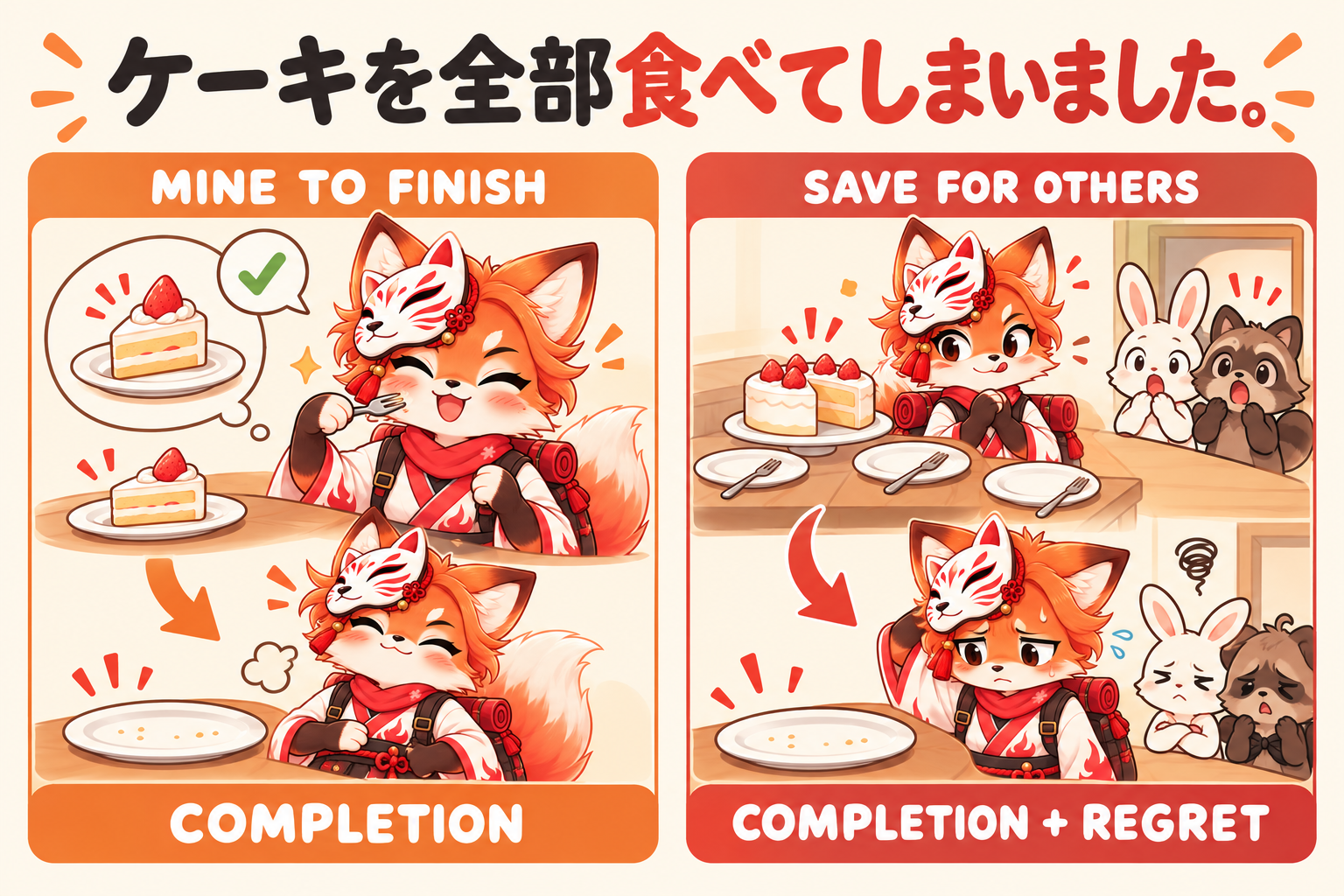
The two panels keep the empty plate the same. MINE TO FINISH shows permission and satisfaction; SAVE FOR OTHERS shows an unmet expectation. The second result combines completion with regret.
Recognize ちゃう and じゃう
The name て-form refers to a conjugation family that includes both 食べて and 読んで. It does not mean that every member ends in the written kana て. ちゃう is not a suffix to add to every verb in this family, and it must not replace an ending with voiced で. Work through the verb's group and full expression first:
- Voiced path: godan verbs ending in む・ぶ・ぬ make forms ending in んで, while those ending in ぐ make forms ending in いで. Their full expressions lead to じゃう: 読む → 読んで → 読んでしまう → 読んじゃう; 泳ぐ → 泳いで → 泳いでしまう → 泳いじゃう. The ん or い stays. 読みちゃう and 読んちゃう are incorrect for this use of 読む.
- Unvoiced path: ichidan verbs such as 食べる and 見る give 食べてしまう → 食べちゃう and 見てしまう → 見ちゃう. For godan verbs, the usual く → いて, す → して, and う・つ・る → って forms lead to 書いてしまう → 書いちゃう, 話してしまう → 話しちゃう, and 買ってしまう → 買っちゃう. The familiar exception 行く has 行ってしまう → 行っちゃう. The irregular verbs give してしまう → しちゃう and 来てしまう → 来ちゃう (きちゃう).
These paths concern the whole auxiliary expression. They are not a rule for replacing an isolated て elsewhere in a sentence. In 買っちゃう, the small っ is retained from 買って; 食べちゃう and 見ちゃう have no additional っ. You can check the University of Texas て-form reference alongside Tae Kim's explanation of the spoken pairs.
For past events, the endings become ちゃった and じゃった: 消しちゃった, “I deleted it, unfortunately,” and 読んじゃった, “I finished reading it,” in a completion context. They retain the same need for context as the full expression. A shorter form does not automatically make the event more accidental.
Use the plain short forms with friends or in similarly relaxed exchanges. For a careful explanation to a teacher, customer, or someone you do not know well, 〜てしまいました is a useful default. You may hear polite contracted forms such as 買っちゃいました too. Their polite ending does not remove the conversational feel of the contraction.
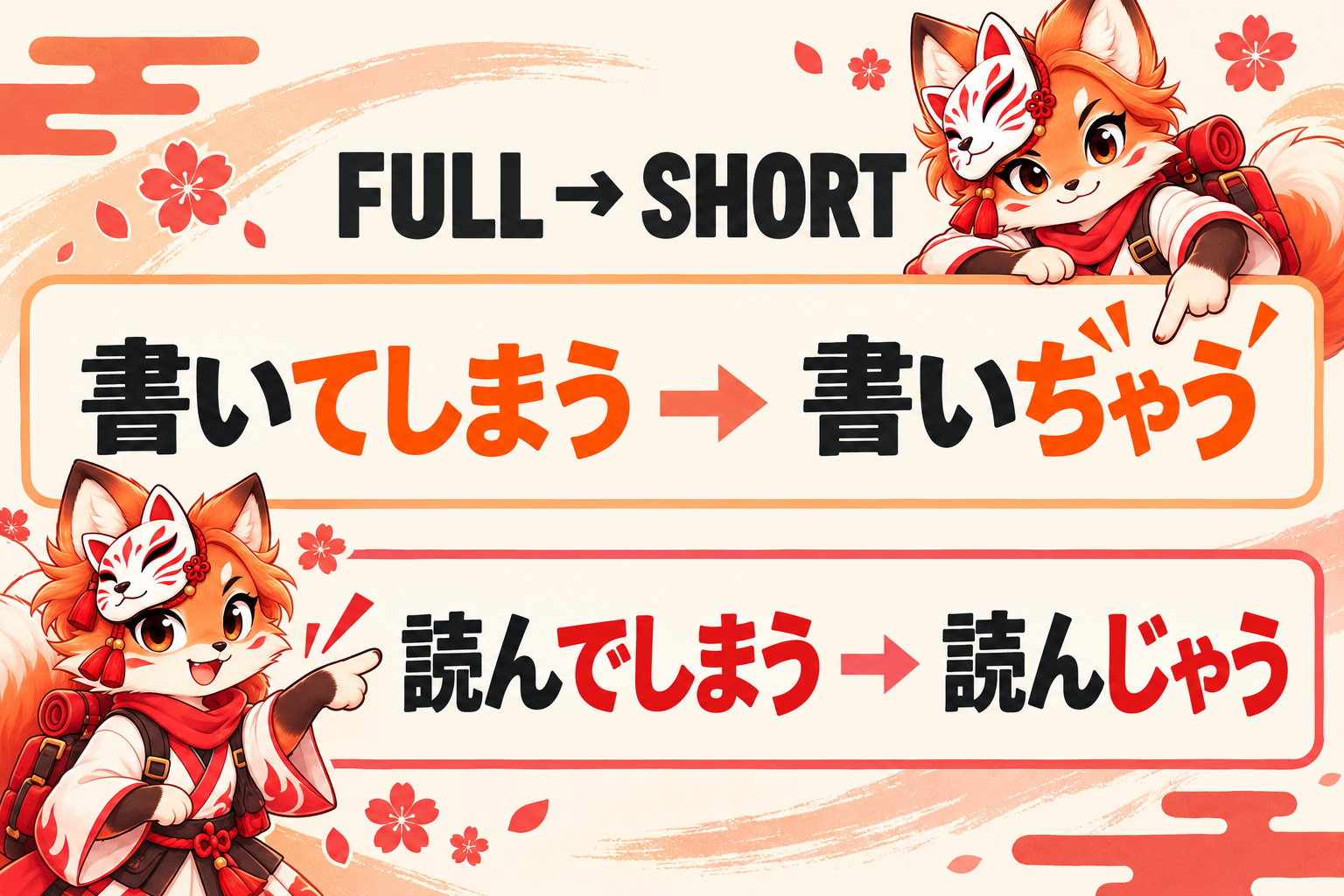
Follow the orange upper path for てしまう → ちゃう and the red lower path for でしまう → じゃう. FULL → SHORT means that only the ending contracts; 書い and 読ん stay in place.
Follow the change in a short dialogue
This practice dialogue takes place between colleagues discussing a report and its files.
A:レポートは、もう書きましたか。
“Have you written the report yet?”
B:はい、全部書いてしまいました。
“Yes, I have finished writing all of it.”
The question asks about progress, so B emphasizes completion.
A:じゃあ、この古いファイルは消してもいいですか。
“Then, may I delete this old file?”
B:待ってください。それは必要なファイルです。
“Please wait. That is a file we need.”
A:すみません。消してしまいました。
“I'm sorry. I deleted it.”
Now the apology and 必要な, “necessary,” make regret clear. The ending itself has not changed; the consequence has. In a casual retelling to a friend, A might say 必要なファイルを消しちゃった。 “I accidentally deleted a file we needed.”
Check form, meaning, and register
Before speaking, check three things. First, build a real て-form: してしまいました is correct for する; するしまいました is not. Second, conjugate the final verb: use 食べてしまいました, not 食べてしまうでした. Third, choose the degree of familiarity you want. 消しちゃった and 消してしまいました describe the same underlying event but suit different conversational relationships.
For practice, draw two cards. On one, write a task you want to finish before leaving, such as reading the remaining pages. On the other, write an unwelcome result, such as deleting a needed file. Make one sentence for each with the full polite form, then add one sentence of context. Finally, turn the two expressions into casual speech. If your listener can explain both what happened and why you chose the ending, your message is doing its job.
Sources
- Japan Foundation, Irodori Elementary 2, Lesson 11, grammar note 6: て-form attachment, disappointing results, and spoken forms.
- Rose-Hulman Institute of Technology, instructor handout on 〜てしまう: completion, regret, and overlapping interpretations.
- Tae Kim, Unintended Actions: conversational ちゃう/じゃう and conjugation.
Examples and the practice dialogue were written for this lesson. Sources checked on 28 October 2026.