
Using 〜すぎる to Describe Excess
このスープは熱すぎます。少し待ちます。
“This soup is too hot. I’ll wait a little.”
The soup has crossed a useful limit: it is hotter than the speaker wants for drinking now. Japanese expresses that judgment with 〜すぎる. You can use the same pattern when a bag costs more than your budget, a room feels uncomfortably quiet, or you realize you bought more bread than you can eat. This lesson shows how to build those sentences and make the limit clear through context.
Start with the limit
Compare two observations about a speaker’s suitcase:
- このかばんは重いです。 “This bag is heavy.”
- このかばんは重すぎます。一人では持てません。 “This bag is too heavy. I can’t carry it alone.”
The second speaker judges the weight against a practical need. You do not need a number: the following sentence explains what the excessive weight prevents. Different travelers may judge the same bag differently. Imagine a small shoulder bag and a packed suitcase; the relevant limit depends on who must carry it.
For the basic complaint use, think “beyond a suitable amount or degree.” The Japan Foundation’s grammar notes teach this excess meaning with actions and descriptions. In your own examples, name a concrete consequence rather than treating every strong feeling as a problem.
Compare the attachment rules
Choose the word class first. The comparison table shows three routes to the same ending. The University of Texas grammar exercise confirms these verb and adjective attachments.
| Word class | Starting word | Steps to the complete expression | Meaning |
|---|---|---|---|
| Verb | 買う | 買います → 買い → 買いすぎる | buy too much / too many |
| Verb | 飲む | 飲みます → 飲み → 飲みすぎる | drink too much |
| Verb | 練習する | 練習します → 練習し → 練習しすぎる | practice too much |
| い-adjective | 熱い | 熱い → 熱 → 熱すぎる | be too hot |
| い-adjective | 重い | 重い → 重 → 重すぎる | be too heavy |
| な-adjective | 静か | 静か → 静かすぎる | be too quiet |
| な-adjective | 複雑 | 複雑 → 複雑すぎる | be too complicated |
For verbs, attach すぎる to the ます-stem. The full sequence is 買う → 買います → 買い → 買いすぎる: 買う is the dictionary form, 買います is its polite form, and removing ます gives the attachment base 買い. Do not add すぎる directly to 買う or to the て-form. With 食べる, the route is 食べます → 食べ → 食べすぎる. Learning from the polite form helps you handle both verb groups without guessing which final sound to remove.
For an い-adjective, remove its ending い. For a な-adjective, attach directly to the base. Check the dictionary class when uncertain: きれい is a な-adjective, despite its last sound. Thus きれいすぎる keeps that い. TUFS explicitly identifies this class in its adjective guide. One useful irregular form to recognize is いい → よすぎる, shown in Tokyo Metropolitan University’s grammar material.
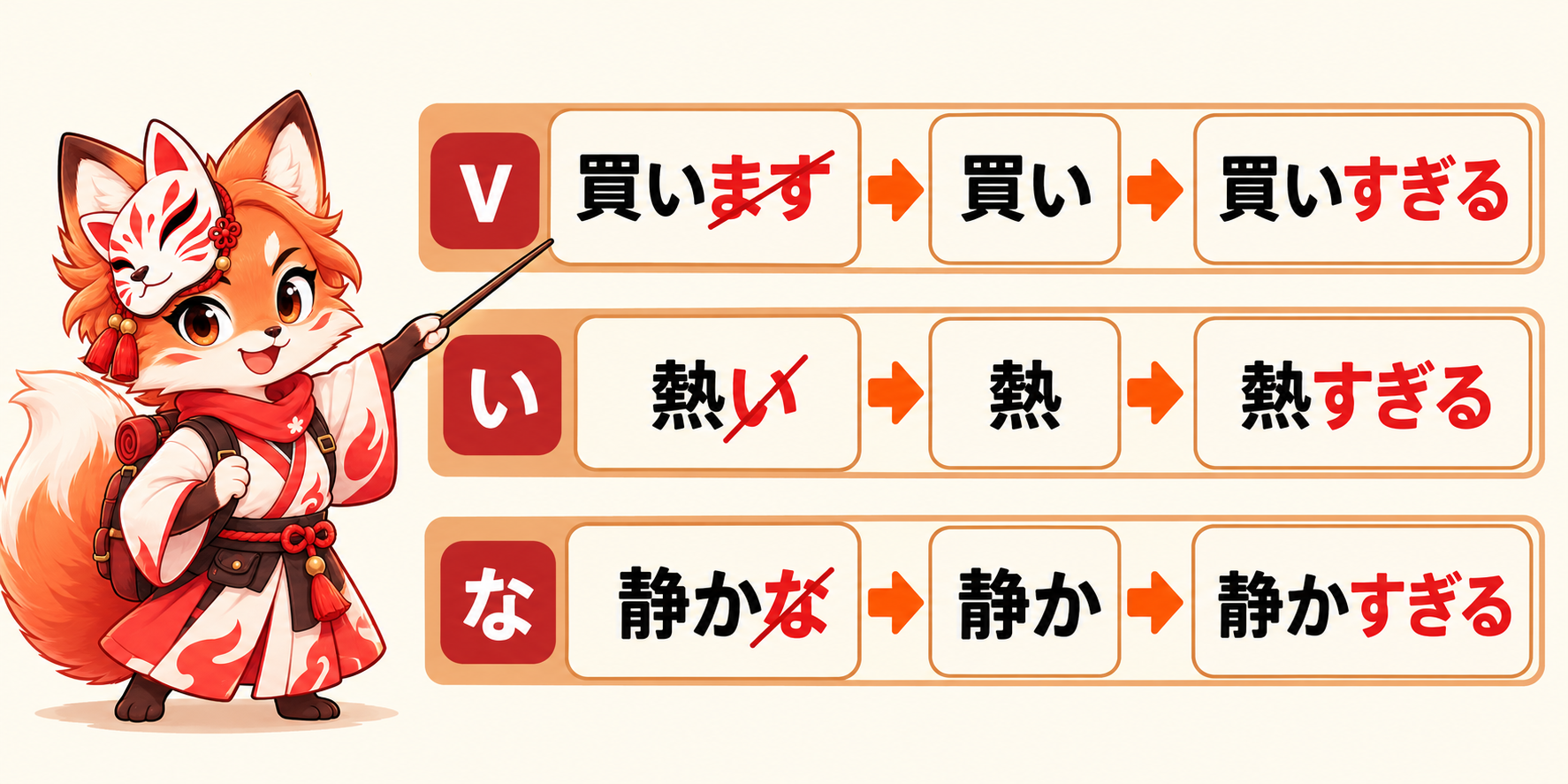
The three rows show the starting form, the base after removing its ending, and the completed expression. Follow the arrows across each row; the な-adjective keeps its full base.
A branching guide for building a sentence
Follow the branch that matches your starting word:
What describes the excess?
├─ An action → take the ます-form → remove ます → add すぎる
│  買う → 買います → 買い → 買いすぎる
├─ An い-adjective → remove the final い → add すぎる
│  熱い → 熱 → 熱すぎる
└─ A な-adjective → keep the base without な / だ → add すぎる
   静か(な) → 静か → 静かすぎる
Then choose the ending for time and speaking style.
Read each branch aloud once before looking at the completed word. This checks whether you can produce the connecting form yourself. If you hesitate over 静か, return to its class instead of borrowing the adjective rule from 熱い.
Change the final すぎる for time and style
Once attached, すぎる conjugates as an ichidan, or regular ru-verb. This also applies after adjectives, as explained in St. Olaf College’s grammar guide.
- 買いすぎる: plain nonpast, “buy too much.”
- 買いすぎます: polite nonpast, “buy too much.”
- 買いすぎた: plain past, “bought too much.”
- 買いすぎました: polite past, “bought too much.”
- 買いすぎない: “do not buy too much.”
- 買いすぎて: the connecting form, useful before a consequence.
昨日、パンを買いすぎました。まだたくさんあります。
“Yesterday I bought too much bread. There’s still a lot left.”
The time word and すぎました place the excessive purchase in the past. Avoid putting the past tense on 買う first. The standard target is 買いすぎました, not 買ったすぎます.
この説明は複雑すぎて、よくわかりません。
“This explanation is too complicated, so I don’t understand it well.”
Here すぎて connects the judgment to its result. Although 複雑 is an adjective base, the final pattern still uses the verb ending すぎて. Similarly, “was too hot” is 熱すぎました in polite speech, not 熱かったすぎます.
Follow one conversation
Two housemates are preparing dinner. Read the exchange as a sequence: notice excess, identify the cause, then adjust the plan.
A: このスープ、しょっぱすぎるね。
“This soup is too salty.”
B: ごめん。塩を入れすぎた。
“Sorry. I put in too much salt.”
A: じゃあ、水を少し足そう。
“Then let’s add a little water.”
A describes the current taste with しょっぱい → しょっぱすぎる. B names a completed action: 入れます → 入れすぎた. The two forms describe different parts of one event. A’s final suggestion responds to the problem rather than repeating it. These are plain forms between familiar housemates; a polite report would use しょっぱすぎます and 入れすぎました.

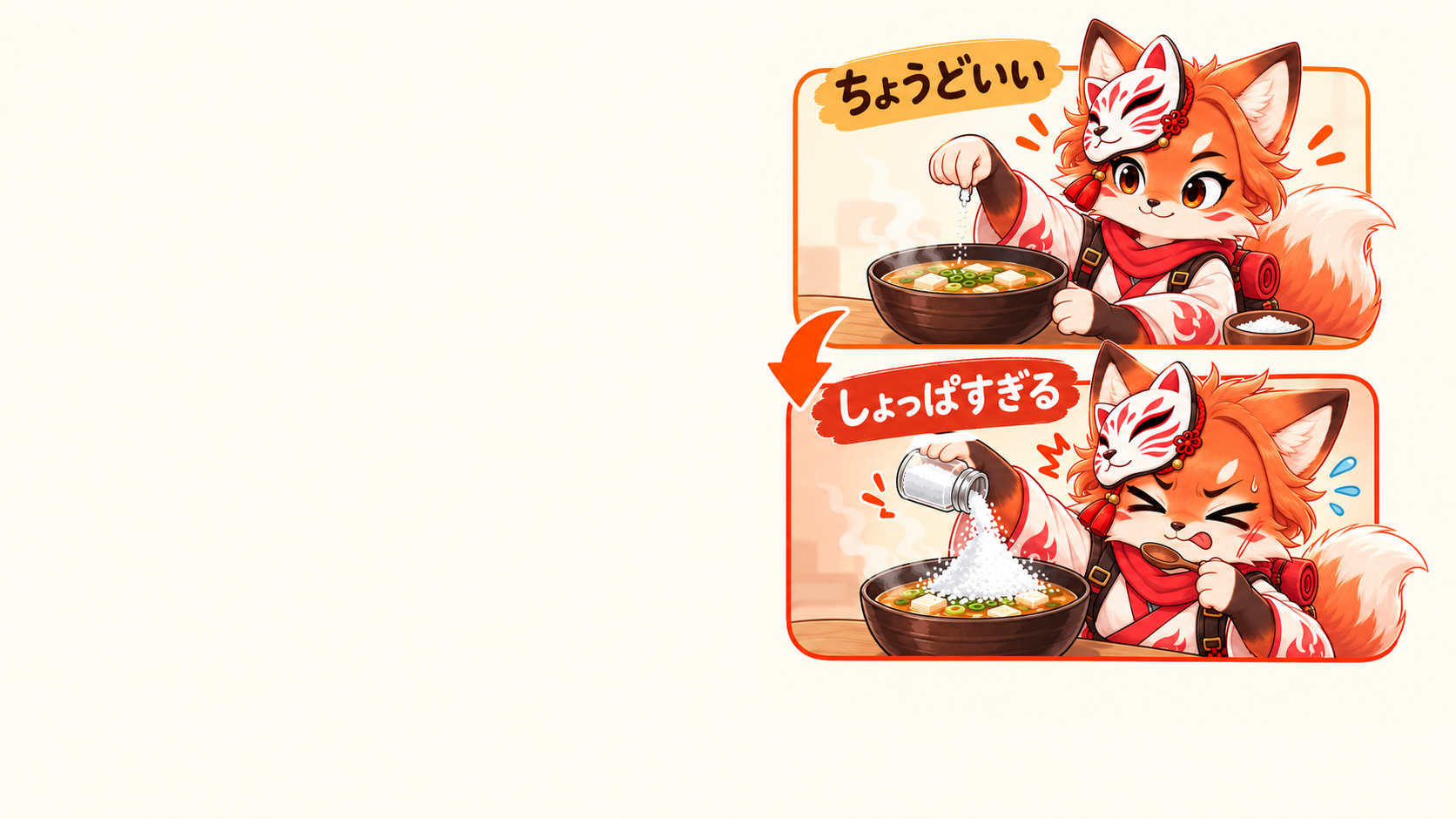
Read the two panels from left to right: the completed action 入れすぎた leads to the current taste しょっぱすぎる. The arrow shows cause and result, while the endings distinguish the past action from the present description.
Avoid these meaning and register mistakes
Do not attach to a complete polite predicate. 食べますすぎる and 静かですすぎる do not follow the pattern. Build 食べすぎる or 静かすぎる first, then select a polite ending if appropriate.
Keep “very” and “excessive” separate in ordinary descriptions. とても熱い says something is very hot. 熱すぎる normally judges it too hot for the situation. At a café, 熱すぎます can sound like a complaint even with a polite ending. Describe the issue and your preferred adjustment clearly when speaking to staff.
Do not turn the complaint use into an absolute rule. In casual praise, かわいすぎる can express delighted “so cute!” rather than a real objection. ARC Tokyo’s teacher column explains this enthusiastic use. Listen to the situation and tone. For practice here, use concrete excess and consequences so your intended meaning stays clear.
Read the position of negation. 食べすぎない means “not eat too much.” It does not mean “eat too little.” The negative belongs to the completed expression 食べすぎる. Practice that interpretation before moving on to other negative constructions.
Put it into a short daily report
Choose one real situation and write two sentences. First identify the excess; then add the result or your next step. For a purchase, try 昨日、お菓子を買いすぎました。友達と分けます。 “Yesterday I bought too many snacks. I’ll share them with a friend.” For a description, try この文字は小さすぎます。大きくしてください。 “These letters are too small. Please make them bigger.”
Finally, check three things: the starting word’s class, the form immediately before すぎる, and the ending that matches your intended time. Say your report once politely and once to a friend. The event stays the same while 買いすぎました becomes 買いすぎた. That small switch gives you a usable sentence for both a daily conversation and a more polite explanation.