
Visiting a Japanese Home: What to Say From Arrival to Goodbye
You have reached a Japanese friend's front door. You know how to say hello, but the host is still inside, your shoes are on, and you are unsure when to step forward. A home visit gives ordinary words a clear sequence: announce yourself, wait for the invitation, acknowledge entering someone else's space, and thank the host when you leave.
This lesson helps you complete that sequence as a guest. The goal is to connect each expression to a moment and a speaker. You do not need a ceremonial speech. A few short phrases, spoken at the right time, can carry a friendly visit from the entrance to the goodbye.
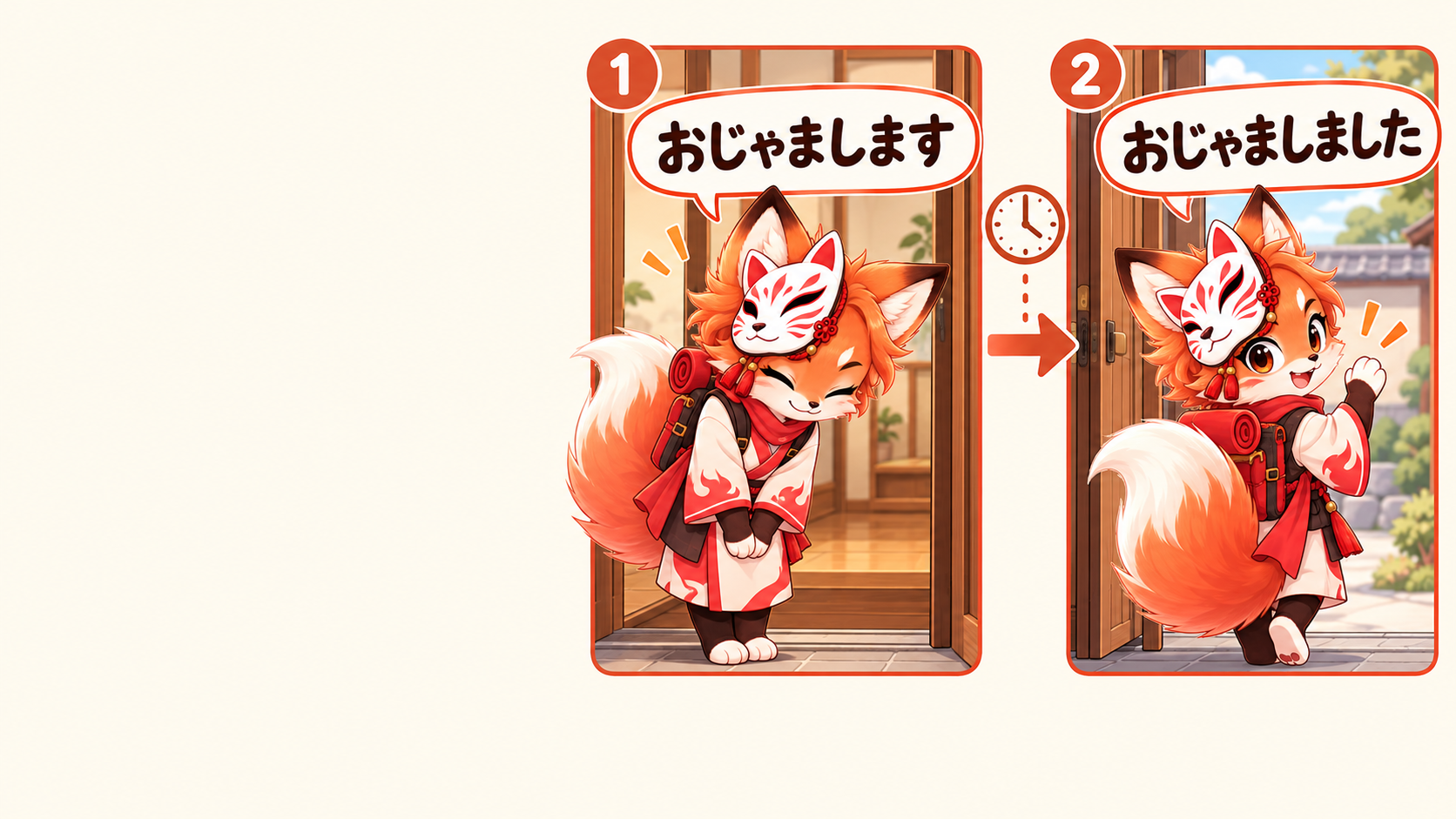
Read the cover's visit timeline
The cover's two numbered panels are linked by a time-forward arrow and a clock: panel 1 pairs entry with おじゃまします; panel 2 pairs departure with おじゃましました. Follow the arrow as the visit passes. The change in wording follows the stage of the visit, while the guest remains the speaker in both panels.
1. At the door: announce your arrival
ごめんください。
Gomen kudasai.
“Hello? Anyone home?” / “Excuse me.”
This is a visitor's way of calling to someone at a home's entrance. Picture yourself outside, waiting to be received. The expression does not grant permission to enter. Ring or knock as appropriate, and wait for the host's response. If your friend is already greeting you at the open door, a normal こんにちは can fit that immediate exchange; you do not have to restart an arrival script.
Learn ごめんください as a complete expression. Here it calls for the resident's attention. It does not perform the same job as ごめんなさい, which apologizes for something. An English translation such as “excuse me” can hide that difference, so attach the phrase to the doorway scene when you practise.
Guest: ごめんください。
“Hello? Anyone home?”
Host: はい、どうぞ。
“Yes, come in.”
Your next action depends on the invitation and the actual entrance. Let the host guide you rather than treating a memorized phrase as permission to walk through the house.
2. Entering: acknowledge the host's space
おじゃまします。
Ojama shimasu.
“Thank you for having me in.” / “Excuse me for coming in.”
The guest says this when entering another person's home. 邪魔(じゃま)relates to disturbance or being in the way, but the whole expression functions as a conventional, considerate greeting. You are acknowledging the host's space; you are not reporting that you have actually caused a problem.
Listen for an invitation such as どうぞ、上がってください。 (Dōzo, agatte kudasai.), “Please come in.” In this home-entry context, 上がる(あがる)means to enter the main part of the home. It does not necessarily mean going upstairs. The form is 上がる → 上がって → 上がってください: the verb's te-form followed by ください. Do not attach ください directly to the dictionary form as 上がるください.
The 玄関(げんかん, entrance area)often marks the boundary between outdoor footwear and the interior. Remove outdoor shoes before stepping onto the indoor floor, and follow the host's guidance about slippers. Homes differ in layout and household habits. Watch the space and the person receiving you, rather than assuming every entrance works identically.
A small pause here has a practical purpose: it gives you time to hear the invitation, handle your shoes, and say おじゃまします without rushing all three actions together.
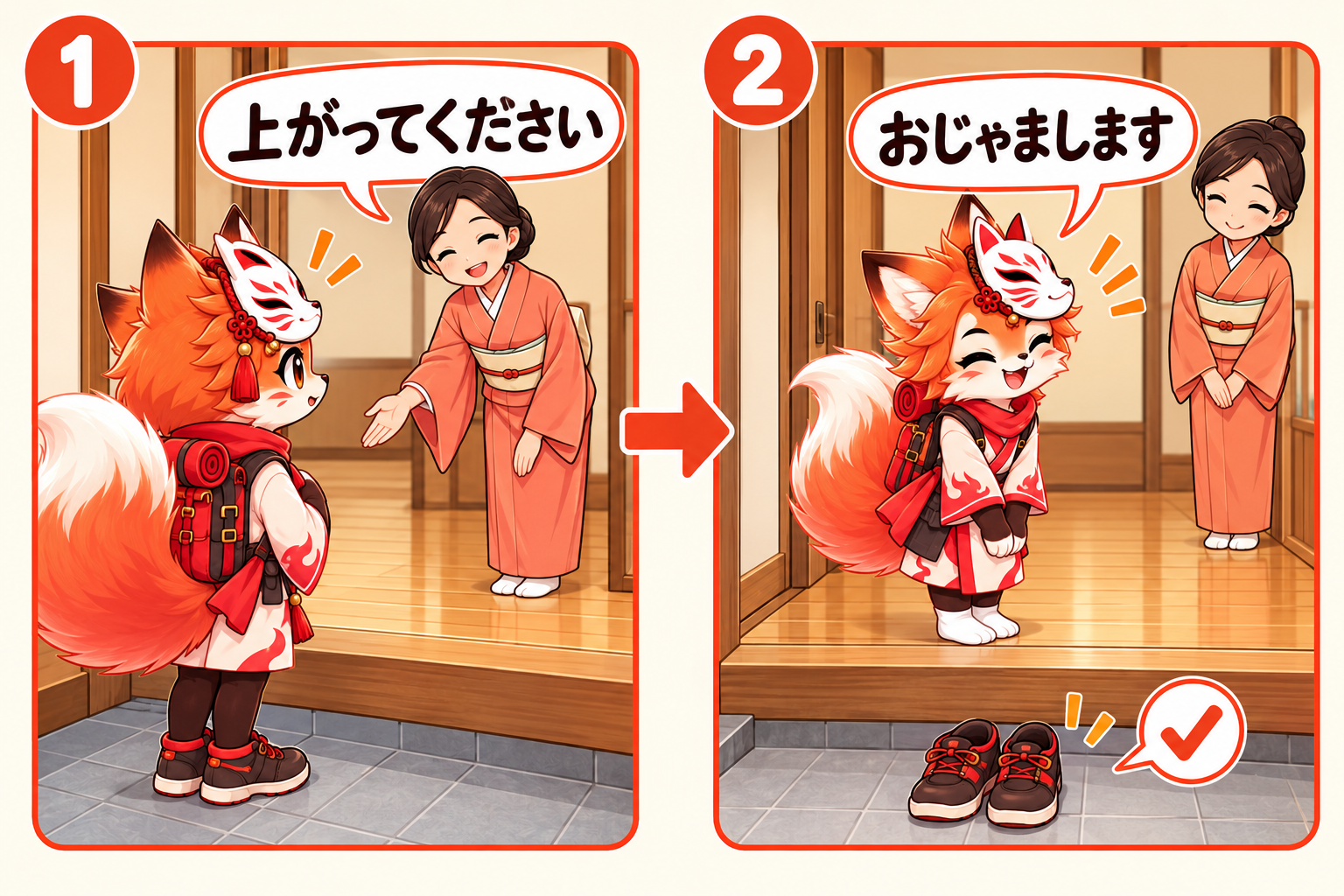
Invitation sequence: two panels joined by an arrow. Panel 1 shows the host saying 上がってください while the guest waits below the indoor floor. Follow the arrow to panel 2: the guest says おじゃまします, outdoor shoes stay below, and socked feet are now indoors. The panels connect the host's invitation to the guest's response and entry.
3. Compare expressions by role and moment
Several phrases can be translated loosely as “hello,” “welcome,” or “excuse me.” Their roles are more useful than those translations.
| Expression | Usual speaker here | Moment | Communicative job |
|---|---|---|---|
| ごめんください | Guest | At the door, calling to the resident | Announce arrival and seek attention |
| いらっしゃい | Host | Receiving the guest | Welcome the visitor |
| どうぞ、上がってください | Host | Inviting the guest inside | Invite entry into the home |
| おじゃまします | Guest | Entering the home | Acknowledge entering the host's space |
| おじゃましました | Guest | Leaving after the visit | Acknowledge the completed visit politely |
Use this table as a role check. If you are the visitor, you do not need to answer いらっしゃい by repeating it back. The host welcomes; the guest responds as the person being welcomed.
4. Decision tree: choose your next line
GUEST: choose the next line
          |
          v
Has the visit ended?
  +-- YES → Thank the host.
  |           おじゃましました。
  |
  +-- NO → Has the host invited you in?
               +-- NO → At the door:
               |          ごめんください。
               |          Then wait.
               |
               +-- YES → Remove outdoor shoes.
                           おじゃまします。
                           Enter the indoor area.
Work through these questions in order. This guide follows the visit, so you can rehearse it while imagining the doorway.
- Are you still waiting to be received? At the entrance, ごめんください can announce your presence. Pause for an answer.
- Has the host invited you into the home? Recognize どうぞ or 上がってください. Attend to the shoe boundary and say おじゃまします as you enter.
- Are you ending the visit? Thank the host, then use おじゃましました when saying goodbye.
- Were you treated to food or a meal? You can also thank the host with ごちそうさまでした. Match this extra thanks to what actually happened during the visit.
The useful connection is “situation → speaker → phrase.” Practise choosing a line from the situation before looking at the Japanese. This prevents a list of polite expressions from becoming a list you recite regardless of context.
5. Leaving: close the visit warmly
今日はありがとうございました。おじゃましました。
Kyō wa arigatō gozaimashita. Ojama shimashita.
“Thank you for today. Thank you for having me over.”
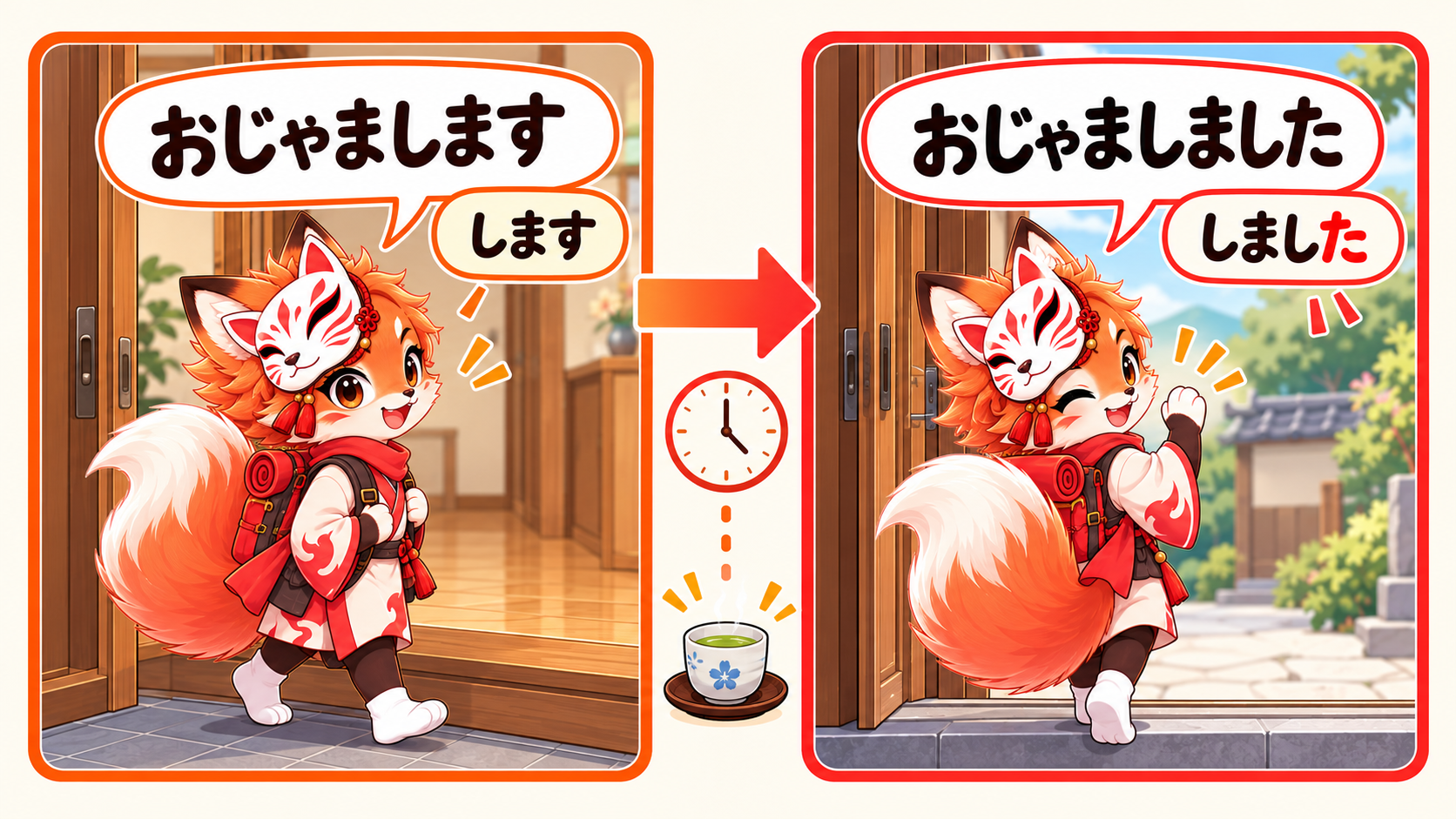
The change from します to しました places the acknowledgment after the visit. Both forms are polite: おじゃまします accompanies entry, while おじゃましました looks back as you leave. For this lesson, keep these complete expressions together with their situations rather than turning them into a rule for every word beginning with お.
You can add a simple, true comment:
楽しかったです。
Tanoshikatta desu.
“I had a lovely time.”
If the host treated you to a meal, ごちそうさまでした。 (Gochisōsama deshita.), “Thank you for the meal,” adds specific gratitude. This can also be said later to the person who treated you. You do not need to invent a meal in your goodbye if the visit involved only a brief chat.
The host might answer また来てくださいね。 (Mata kite kudasai ne.), “Please come again.” Here 来る(くる)becomes 来て(きて)before ください. Hear this as a friendly closing invitation, then respond naturally with thanks.
Entry-to-departure timeline. The arrow and clock between these two panels mean that the visit has taken place. On the left, the entering guest says おじゃまします. On the right, the departing guest says おじゃましました. The highlighted た makes the completed visit visible in the wording.
6. Annotated dialogue: speaker, line, and purpose
At the entrance — guest: ごめんください。
“Hello? Anyone home?”
The guest announces their presence and waits.
Host: こんにちは。どうぞ、上がってください。
“Hello. Please come in.”
The host receives the visitor and invites them inside.
Guest: おじゃまします。
“Thank you for having me in.”
The guest acknowledges entering and removes outdoor shoes before stepping onto the indoor floor.
After the visit — guest: 今日はありがとうございました。楽しかったです。おじゃましました。
“Thank you for today. I had a lovely time. Thank you for having me over.”
The guest gives thanks and closes the visit.
Host: また来てくださいね。
“Please come again.”
The host ends the exchange warmly.
Read only the guest's lines once, then only the host's. Separating the roles helps you hear which person owns each phrase. Next, practise with a partner and swap roles after one complete visit.
7. Mistakes worth catching
Using the leaving phrase at the beginning. おじゃましました points back to a completed visit. If you are just coming in, choose おじゃまします.
Treating 上がってください as a staircase instruction. At a home's entrance it invites you inside. Use the scene to interpret the verb.
Replacing ごめんください with an apology automatically. ごめんなさい is an apology; ごめんください is the doorway call taught here. Similar sounds do not make them interchangeable.
Making the greeting more elaborate than the moment needs. These polite guest expressions work well for an ordinary friendly visit. You can pair them with warm, simple thanks. Observe how your host speaks; household customs and relationships vary.
Try a one-minute visit
Stand on one side of an imaginary doorway. Announce yourself, wait for your partner's invitation, and enter with おじゃまします. Then jump forward to the end of the visit and say 今日はありがとうございました。おじゃましました. Repeat once with a meal included, adding ごちそうさまでした.
Finally, hide the Japanese and explain the sequence in your own words. If you can identify who speaks, what has just happened, and what the next line accomplishes, you are ready to use the expressions in a real visit.
日本語でおさらい
人の家に入るときは「おじゃまします」、帰るときは「おじゃましました」と言います。玄関で「上がってください」と言われたら、家の中へどうぞ、という意味です。訪問の終わりに、お礼も伝えましょう。
Sources and further practice
The entry and departure expressions follow the Japan Foundation's Irodori home-visit activity and Elementary 1, Lesson 17, pages 1–4. The footwear context is supported by the Five College Center for World Languages' Visiting a Home. The practice dialogue and decision guide above are original learning activities.